


Fans defy FIFA ban on Iran’s pre-revolution flag. What’s the controversy all about?
When Iran’s national football team took to the field against New Zealand, many fans in the stadium held up the country’s pre-revolution flag, featuring the lion-and-sun symbol. This came despite FIFA banning this version of the flag, with a Los Angeles court upholding the decision. But what’s the history behind this flag?

It’s Day 5 of the FIFA World Cup 2026, and it’s been a day of shocks on the football field. Spain was held in a stalemate by tiny tournament debutants Cape Verde. But it was the Iran match against New Zealand that caught the attention of the entire world. After all, the Iranian team is participating in the tournament at a time when it is engaged in a war with one of the host nations, the United States of America.
The Iran vs New Zealand match ended in a draw, with both sides scoring twice and earning a point each. While many were caught up with the action on the ground, it was the Iranian flags being waved at Los Angeles’ SoFi Stadium that caught the attention of the world’s media.
 More from Explainers
That’s because these flags defy FIFA’s rules — they are the banned pre-revolutionary flag.
So, what’s the difference between the two, and why has the footballing body banned one of them?
Iran’s pre-revolutionary flags fly high at Los Angeles stadium
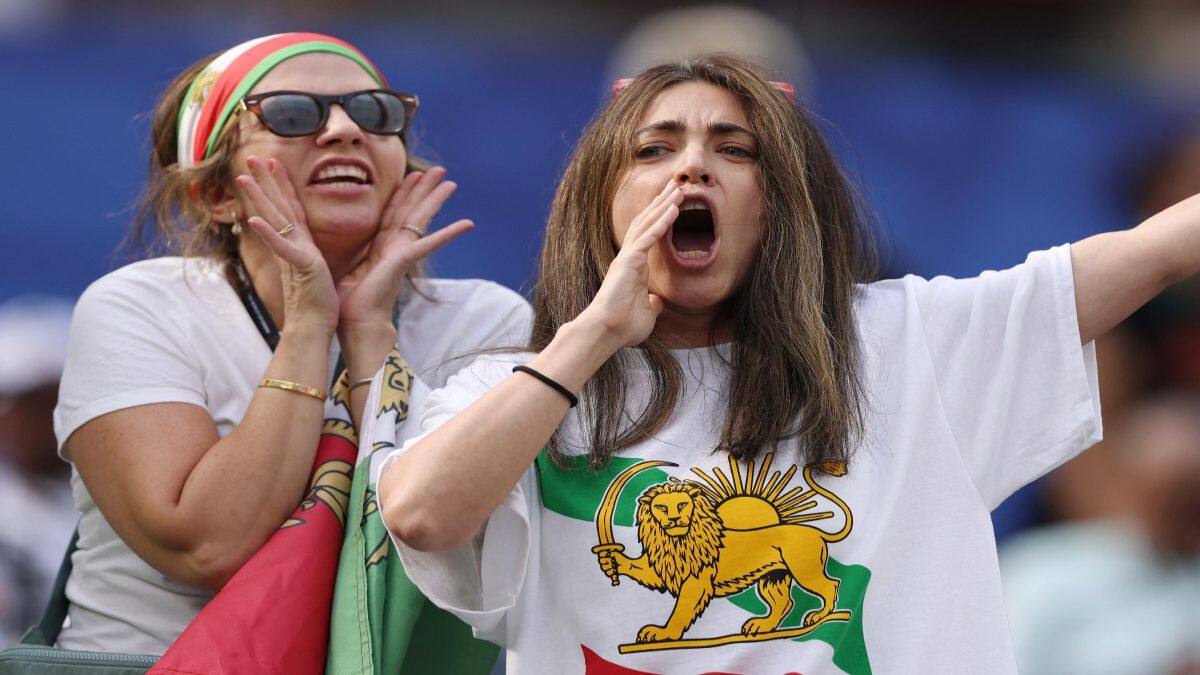
As the Iranian team took to the field, many fans could be seen waving the previous version of the Iranian flag — the lion-and-sun flag, chanting slogans denouncing the national side, which they insist is a propaganda tool for the hardline Islamic Republic.
“This team is not the Iranian people’s team, it’s the regime’s team,” Ava Amin, a philosophy student, was quoted as telling AFP.
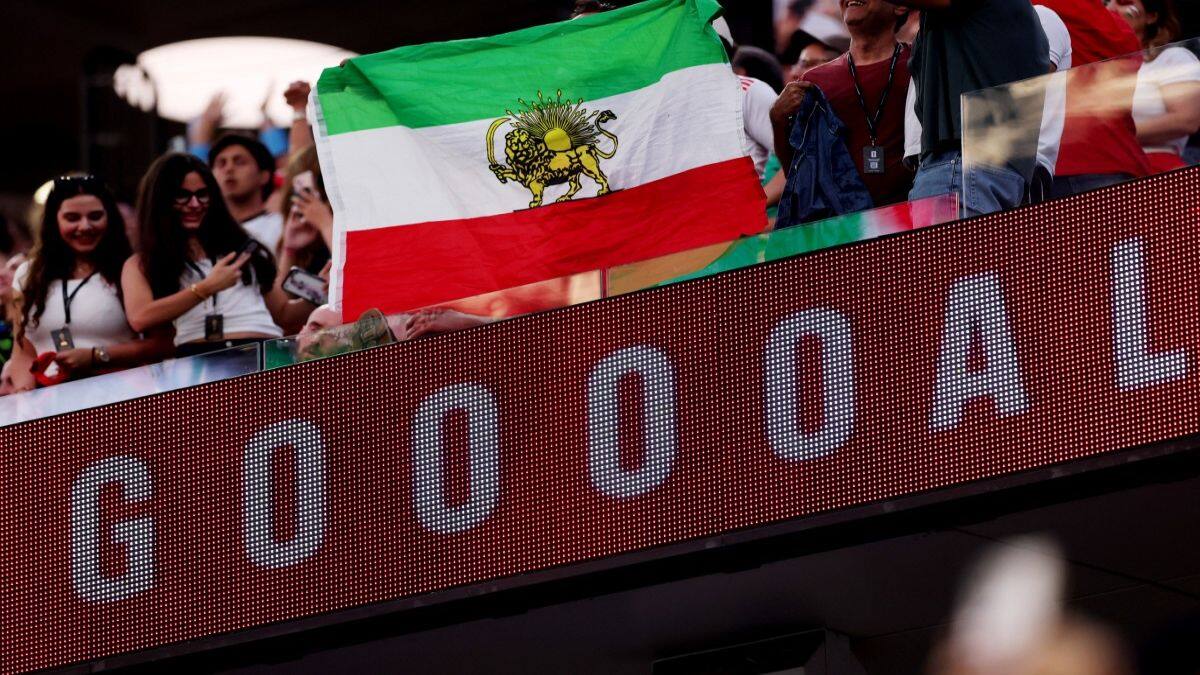
Aida Monfared was also quoted as telling the New York Post, “This team does not represent the people of Iran. They represent the government of Iran, the government that killed 40,000 people in two days.”
Parsa Ezati, 21, and his mother brought the official Iranian flag to the protest outside the stadium so people could stomp on it. “It represents the ayatollahs that killed so many Iranians and have massacred people in my generation,” Ezati said. “FIFA only accepts this flag on the floor.”
According to the New York Post, security even asked one group of fans to remove T-shirts featuring the pre-revolutionary Iranian flag. After the fans said they had no other clothing, security instructed them to turn the shirts inside out. But once inside the stadium, little appeared to be enforced, with the flags and T-shirts visible throughout the stands.
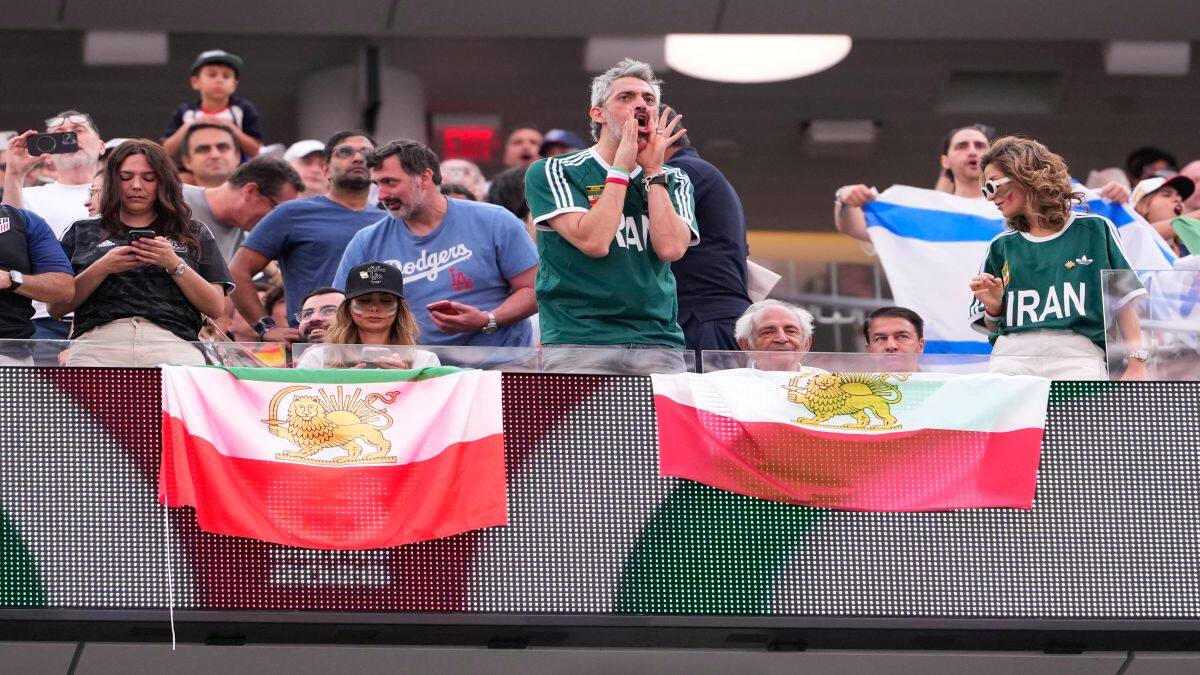
FIFA’s ban on Iran’s pre-revolutionary flag
Notably, the decision of fans to carry the pre-revolutionary flag of Iran came just hours after a Los Angeles judge upheld FIFA’s decision to ban this particular flag from being displayed at matches. The decision by the court came after a lawsuit had been filed in Los Angeles County Superior Court last Thursday by the Institute for Voice of Liberty and Sam Kermanian, an Iranian fan intending to go to the game.
In upholding FIFA’s ban on the flag, Judge Curtis A Kin said: “Free speech is incredibly important, it is sacred, a bedrock of our society, but it is not without limitation, such as by a private actor, on private property, and as shown by previous cases, regulating in a reasonable way. I deny the application.”
He further explained his reasoning. “There may be harm to some 2,500 staff members who have to deal with safety protocols,” he said. “It is a tremendous burden to change a long-standing stadium protocol for a massive event in a period of hours. It is hard to see how FIFA could make a change at one stadium and not the rest.”
FIFA has banned the pre-revolutionary flag, calling it “political” in nature. In fact, FIFA’s list of prohibited items includes “banners, flags, flyers, apparel, and other paraphernalia that are of a political, offensive, and/or discriminatory nature”.
Iran and the history of its two flags
Until 1979, Iran’s flag was a horizontal tricolour of green, white, and red with a lion and sun emblem. This flag was installed in 1907, towards the end of the Qajar dynasty. It came to represent monarchical rule in Iran, following the nation even after the Qajar dynasty gave way to the Pahlavi family.
However, that flag was formally phased out following the overthrow of the Pahlavi dynasty in the Iranian Revolution. In 1980, the flag was outlawed entirely after the Islamist took control of the government. Ayatollah Ruhollah Khomeini called the emblem an “artifact of the tyrannical” Pahlavi regime.
A new flag was introduced, which is used even today. It retains the green-white-red stripes. However, along the bottom of the green stripe and top of the red stripe, a stylised Arabic inscription—“Allāhu akbar” (“God is great”) — is repeated 22 times. Additionally, the lion and sun were replaced by the new coat of arms of Iran. This stylised design has a complex set of symbolisms; it can be read as a rendition in Arabic of the word “Allah,” as a representation of the globe, or as two crescents.
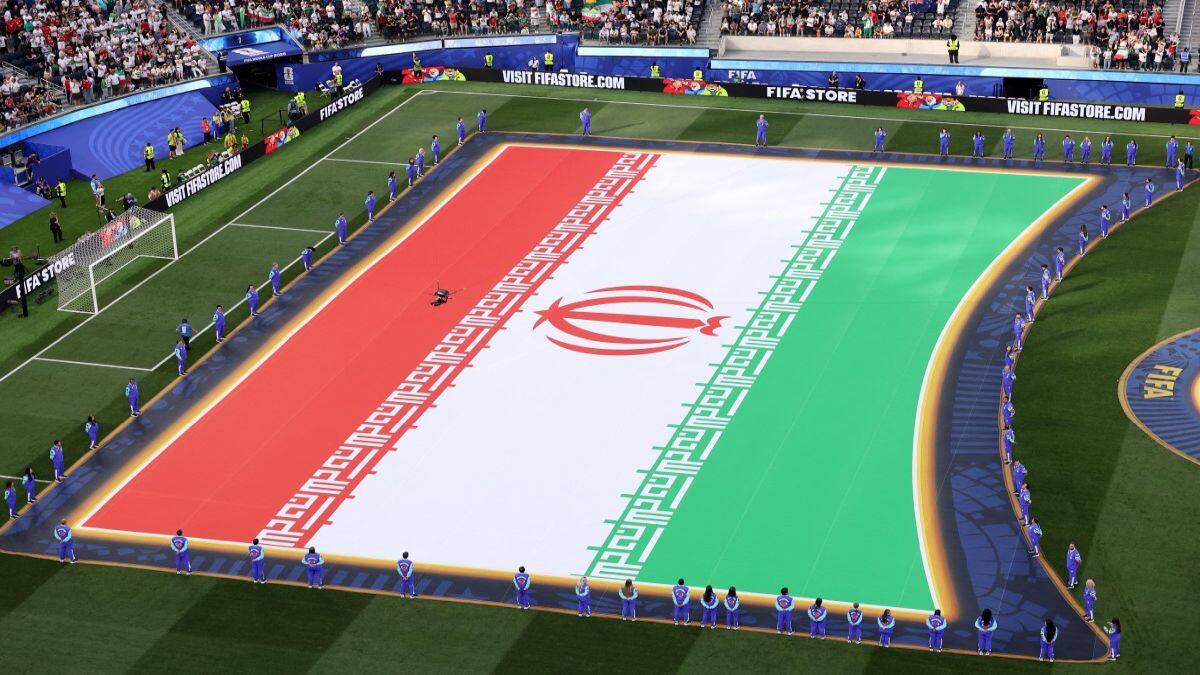
The two flags have become highly political in nature. As Dara Conduit, a political science lecturer at the University of Melbourne, told ABC News, “The flag of Iran is really, really political, and so… if you were to raise the current flag of Iran, you would possibly be associated with the regime, or it may be interpreted that you’re a supporter of the Iranian regime.”
Even Dr Shirin Khayambashi, an assistant professor in the sociology department at Toronto Metropolitan University, notes that Iran’s official flag is viewed as a symbol of the regime. “The Allah emblem definitely represents the Islamic Republic of Iran,” Khayambashi told Halifax News. “It has been something that caused anger and frustration for the Iranian community, and it’s a rarity to see during the protests.”
Experts note that many of the Iranian diaspora oppose the official flag because they say it lends legitimacy to an authoritarian state. Others reject it because of its Islamic religious references, which they see as discriminatory against Iranians of other faiths — Jewish, Christian, Bahai, Zoroastrian, etc. — as well as against non-religious Iranians.
Meanwhile, the lion and sun flag represents resistance. “Displaying the lion and sun flag inside Iran is often an act of resistance and defiance of the regime,” said Conduit.
And in 2022, the lion and sun flag emerged prominently during the Woman, Life, Freedom movement, which emerged following the death of 22-year-old Mahsa Amini in the custody of the country’s morality police and the subsequent brutal crackdown by the Iranian government.
Since then, it has become a symbol of resistance to the hardline Islamic regime in Iran.
With inputs from agencies

Why India may not witness a medal rush at 2026 Commonwealth Games
Delhi Police asks personnel to wear uniform: What the law says on cops in plainclothes during protests
Military drones & police check-ups: How Sri Lanka is fighting against worst dengue outbreak in a decade
How Facebook job ad lured 2 Karnataka men into Myanmar cyber scam camp
Why is India seeing 95% cloud cover despite a Super El Niño?