


Explained: Will throwing soup and mashed potatoes save Earth?
Desperate to end complacency about the climate crisis and to pressure governments to stop the extraction and burning of fossil fuels, activists say that they have resorted to high-profile tactics such as throwing food on art at museums because little else has worked

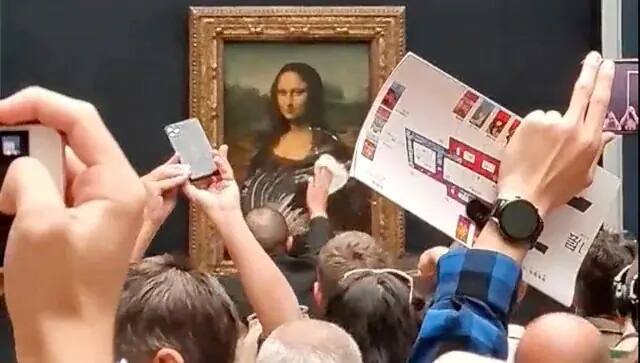
The protester earlier creamed the glass covering of the Mona Lisa with cake, and urged onlookers to think about the Earth. AP[/caption]“We want to have this conversation, and to bring it around to our demand about what we need to do to avoid climate breakdown and collapse,” Carrington said.In Germany, climate activists took notice. Carla Hinrichs, a spokeswoman for the group Last Generation, said her first reaction was disbelief until she saw how Just Stop Oil was using the moment to highlight the planned expansion of oil and gas exploration off England’s coast.“I realised it was genius,” Hinrichs said. “People get shocked, and then this window opens where they start listening.”On 23 October, two activists with Last Generation headed into the Museum Barberini in Potsdam and, in a nod to Germany’s penchant for spuds, tossed runny yellow mashed potatoes onto the glass front of Monet’s “Grainstacks,” which sold for nearly $111 million in 2019. “Our win is when politicians react to the climate crisis,” Hinrichs said. “This is a step on the way, one that people talk about, that’s not ignorable.”Hinrichs and Carrington said their groups had made certain the artworks were protected by glass, and in all three instances the museums said the paintings were unharmed, except for minor damage to at least one of the frames.Some museums are now looking to step up security (one Spanish museum director said staff would be keeping an eye out for food when X-raying backpacks) and the Barberini announced it would temporarily close until 30 October. There are also concerns about a potential “art protection crisis” that could see works being hidden away or permanently ruined.Art has been targeted by protesters before. Suffragists attacked a series of artworks a Century ago, with one slashing “The Toilet of Venus” by Diego Velázquez with a meat cleaver and getting lashed for it in the press.The soup and potato museum protests similarly elicited shock and confusion. “Embarrassing confession: Did not know that climate change was caused by French impressionists,” Scott Shapiro, a professor at Yale, said on Twitter.Conspiracy theories blossomed about the activists’ motives, as both groups received backing from the Climate Emergency Fund, a nonprofit organisation to which the oil heiress Aileen Getty and the director Adam McKay have been significant donors.Stephen Duncombe, a professor at New York University and co-founder of the Center for Artistic Activism, a nonprofit group that trains activists, said the focus of much commentary had made him question the efficacy of the protests.“Are they talking about food being thrown at art or are they talking about how carbon-based fuels are going to extinguish life on the planet?” Dr Duncombe said. “If the message getting across is activists doing crazy stuff, does it help the cause or not?”Yet Heather Alberro, a lecturer in global sustainable development at Nottingham Trent University, said such attention-grabbing actions were all but inevitable given that conventional means of protest have largely failed.To her, targeting high-value art made sense because of the link between wealth and economies built on fossil fuels. “We’re at a moment where we need every tool in the shed,” Dr Alberro said. “If you’re more outraged by throwing soup on a painting than governments investing in fossil fuels, that says a lot.”Brian Zabcik, a former organiser with the New York chapter of the AIDS activist group ACT UP, said the most potent protests tended to have obvious connections with the targets.Civil rights protesters raised awareness about racist segregation laws by breaking them. Greenpeace activists went after whaling ships and nuclear sites. PETA supporters threw paint on fur.ACT UP fought the stigma around AIDS and won approval for groundbreaking medicines through a series of high-profile disruptive actions, including staging mass “die-ins” and “kiss-ins,” interrupting scientific conferences and political events with foghorns and fake blood, marching on government offices and parading an effigy of Anthony S Fauci, the head of the National Institute of Allergy and Infectious Diseases.Zabcik, who is now the advocacy manager with the nonprofit group Save Barton Creek Association in Austin, Texas, said linking climate change to a van Gogh felt like “a stretch.”Still, he said, criticism invariably spikes with more confrontational protests, and it isn’t the best measure of success. Though ACT UP is lauded now, its tactics were often excoriated 30 years ago.Benjamin Sovacool, a professor of earth and the environment at Boston University, said the most effective social movements employed sustained and intense pressure for long periods of time, and that one measure of an action’s success was how much it builds a coalition or alienates people. While the museum protests were polarising, he said, “At least we’re talking about it.”Writing in an email to The Times, Anna Holland, 20, one of the Just Stop Oil soup throwers, said she hoped people would extend the sense of protectiveness and defensiveness they felt toward the van Gogh painting to life on Earth. She noted a quote from van Gogh, taken from a letter to his brother, Theo van Gogh.“It isn’t the language of painters one ought to listen to but the language of nature,” Vincent van Gogh wrote, and then later added. “Feeling things themselves, reality, is more important than feeling paintings, at least more productive and life-giving.”Cara Buckley, c.2022 The New York Times Company Read all the Latest News, Trending News, Cricket News, Bollywood News,India News and Entertainment News here. Follow us on Facebook, Twitter and Instagram.

Military drones & police check-ups: How Sri Lanka is fighting against worst dengue outbreak in a decade
How Facebook job ad lured 2 Karnataka men into Myanmar cyber scam camp
Why is India seeing 95% cloud cover despite a Super El Niño?
What is CJP’s fourth demand to the government as protests in Delhi intensify?
The new geography of war: Why the Houthis can no longer be ignored