
Advertisement


Sections
Explained: What is plastic rain and how does it affect our health?
A new study has found that around 74 metric tonnes of microplastics rained from the sky in New Zealand’s Auckland city in 2020. Microplastics are very tiny pieces of plastic waste, less than 5 millimetres long, that come from packaging, clothing and other sources

Did you know small particles of plastic are raining from the atmosphere?A mist of plastic descends from the sky every day but it is invisible to the naked eye, notes ScienceAlert.A new study has found that around 74 metric tons of microplastics fell from the sky in New Zealand’s Auckland city in 2020.The study published this week in Environmental Science & Technology says this amount of microplastic is equivalent to 3 million plastic bottles.Researchers believe the prevalence of plastic rain is undercounted globally, reported ScienceAlert.What is plastic rain and what did the study find? What have previous studies said about the existence of plastic in the air? How can it affect our health? Let’s take a closer look.Plastic rainMicroplastics, very tiny pieces of plastic waste – less than 5 millimetres long, are raining from the sky.This microplastic emanates from packaging, clothing, vehicles, paint, worn car tyres and other sources.As per Wired, these small plastic particles are "flowing into the oceans via wastewater and tainting deep-sea ecosystems, and they’re even ejecting out of the water and blowing onto land in sea breezes”.Even though not many may not be aware of it, microplastics in the air are apparently “ubiquitous”.“If you go outside with a UV light, set at a wavelength of 400 nanometers, and shine it sideways you’ll see all kinds of plastic particles in the air fluoresce,” Deonie Allen, a researcher at EcoLab in the School of Agricultural and Life Sciences in Toulouse, France, told National Geographic in 2019.“It’s almost worse indoors. It’s all a bit terrifying”, she added.New studyThe study conducted by a team of scientists from the University of Auckland in New Zealand suggests that an average of around 5,000 pieces of microplastic fall on every square metre of Auckland's urban rooftops any given day, reported ScienceAlert.The nine-week research was held in two sites in Auckland – on a university building’s rooftop and on the fence of a suburb.During the experiment, the researchers caught the residue of eight types of airborne plastics from both sites.“In Auckland, polyethylene — often used in packaging materials — was the most-detected substance, followed by polycarbonate, a type of plastic typically used in electrical and electronic applications,” Bloomberg reported citing the study.On the days when strong winds from the coast gushed through the city, there was a rise in microplastics collected using a funnel and jar contraption.[caption id="attachment_11816781" align="alignnone" width="640"]![microplastics]() Microplastics are apparently 'ubiquitous'. AFP (Representational Image)[/caption]"The production of airborne microplastics from breaking waves could be a key part of the global transport of microplastics," chemist Joel Rindelaub from the University of Auckland was quoted as saying by ScienceAlert."And it could help explain how some microplastics get into the atmosphere and are carried to remote places, like here in New Zealand”, Rindelaub stated.
Microplastics are apparently 'ubiquitous'. AFP (Representational Image)[/caption]"The production of airborne microplastics from breaking waves could be a key part of the global transport of microplastics," chemist Joel Rindelaub from the University of Auckland was quoted as saying by ScienceAlert."And it could help explain how some microplastics get into the atmosphere and are carried to remote places, like here in New Zealand”, Rindelaub stated.![microplastic]() There is a need for more research on the health effects of microplastic waste. AFP (Representational Image)[/caption]Experts said that this was “100 times higher than expected” and can pose a “potential health threat that could rank alongside asbestos or tobacco”, reported Daily Mail.In March this year, scientists announced microplastics were detected flowing through human veins, as per ScienceAlert.
There is a need for more research on the health effects of microplastic waste. AFP (Representational Image)[/caption]Experts said that this was “100 times higher than expected” and can pose a “potential health threat that could rank alongside asbestos or tobacco”, reported Daily Mail.In March this year, scientists announced microplastics were detected flowing through human veins, as per ScienceAlert.
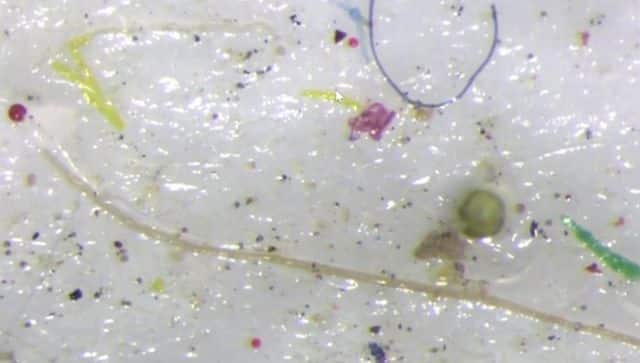 Microplastics are apparently 'ubiquitous'. AFP (Representational Image)[/caption]"The production of airborne microplastics from breaking waves could be a key part of the global transport of microplastics," chemist Joel Rindelaub from the University of Auckland was quoted as saying by ScienceAlert."And it could help explain how some microplastics get into the atmosphere and are carried to remote places, like here in New Zealand”, Rindelaub stated.
The size of microplastics caught ranged between 10 and 50 micrometers in size.While most of it was plastic fragments, only 3 per cent of particles were larger than 100 micrometres, ScienceAlert reported.ALSO READ: Microplastics found in human blood for first time: Explained what it is and how it can affect usPrevious studiesIn 2020, researchers wrote for journal Science that 1,000 metric tons of microplastic particles enter 11 protected areas in the western United States every year – an equivalent of 120 million plastic water bottles.Another study, conducted in 2019 by scientists at Kings College London, said that an estimated average of 771 microplastic particles was found in central London.The rate of deposition of microplastic in London was much higher in London than in China's Dongguan, China, Paris in France and Germany's Hamburg, the study said.Earlier, scientists from the French national research institute CNRS reported the presence of microplastics in the air sampled 2,877 metres above sea level at the Pic du Midi Observatory in the French Pyrenees, as per The Guardian. The study also highlighted sources of microplastic in the Mediterranean Sea and the Atlantic Ocean.Health effectsLast year, a Portsmouth University study revealed that we inhale up to 7,000 airborne microplastic particles every day.[caption id="attachment_11816791" align="alignnone" width="640"]
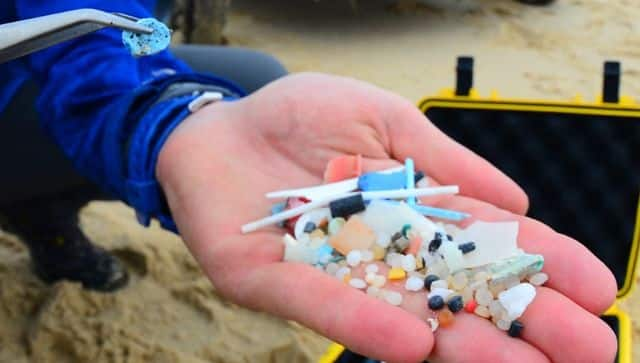 There is a need for more research on the health effects of microplastic waste. AFP (Representational Image)[/caption]Experts said that this was “100 times higher than expected” and can pose a “potential health threat that could rank alongside asbestos or tobacco”, reported Daily Mail.In March this year, scientists announced microplastics were detected flowing through human veins, as per ScienceAlert.
Tiny fibers of plastic particles have also been found in lung cancer samples.ScienceAlert said in April citing a study that it remains unknown how low levels of microplastics deep in our lungs are affecting our health.Stephanie Wright, a researcher at the Centre for Environment and Health at UK's King’s College London, told National Geographic that people are coming across microplastics through food and air, but their health effects are yet to be discovered.Professor Anoop Chauhan, a respiratory specialist with Portsmouth Hospitals Trust, has warned of the dangers of breathing in microplastics as they "do not break down".“Having these particles in your body can cause stress and changes in metabolism, it can affect immunity, the ability to fight infections, it can affect your reproductive capacity and potentially it could be carcinogenic – causing cancer", he was quoted as saying by Daily Mail. He further said that microplastic can potentially cause "inflammation and stress to cells".With inputs from agenciesRead all the Latest News, Trending News, Cricket News, Bollywood News,India News and Entertainment News here. Follow us on Facebook, Twitter and Instagram.
First Published:Dec 15, 2022, 20:21:32 IST
Advertisement
Advertisement

Delhi Police asks personnel to wear uniform: What the law says on cops in plainclothes during protests
The Delhi Police has instructed all its personnel to wear uniforms when they report for duty at Jantar Mantar for crowd control. This comes after outrage grew over videos of men in civilian clothes or without name tags hitting protesters in the Capital. Is it legal for the police to ditch uniforms during protests?
4 min read
Military drones & police check-ups: How Sri Lanka is fighting against worst dengue outbreak in a decade
Sri Lanka is fighting its most severe dengue outbreak in nearly a decade, with infections rising sharply across the nation. Military drones have been deployed to tackle the outbreak, which has claimed 56 lives. Health officials said the outbreak is being driven primarily by the DENV-2 variant of the virus
3 min read
How Facebook job ad lured 2 Karnataka men into Myanmar cyber scam camp
The Karnataka Cyber Command has rescued two youths from a scam compound in Myanmar operated by Chinese fraudsters. The duo from Karnataka were lured on the pretext of data-entry jobs. They were asked to work for 16 hours a day and were expected to sleep for six hours daily
4 min read
Why is India seeing 95% cloud cover despite a Super El Niño?
India is witnessing nearly 95 per cent cloud cover despite a Super El Niño, a climate event usually linked to weaker monsoons. Regional weather systems, cyclonic circulations, the monsoon trough and moisture from two seas are temporarily overpowering one of the world's strongest climate phenomena
5 min read
What is CJP’s fourth demand to the government as protests in Delhi intensify?
The protest by the Cockroach Janta Party at Delhi’s Jantar Mantar refuses to die down. The group have made a fourth demand to the Centre, asking that no FIRs are filed against the agitators and that no legal action be taken. The government has expressed willingness to speak to the protesters, but refused to accede on the resignation of Education Minister Dharmandra Pradhan
5 min read
Advertisement
Advertisement