
Advertisement


Sections
Explained: The special bones that allowed dinosaurs to fly
According to a recent study, dinosaurs as large as buses and five-storey buildings survived because of their unique bones, which are hollow filled with little air sacs

It’s sometimes difficult to imagine how the planet we call home, with its megalopolis cities and serene farmlands, was once dominated by dinosaurs as big as buses and five-storey buildings. But recent research has helped deepen our understanding of why dinosaurs prevailed: the answer may lie in their special bones, structured like Aero chocolate.Brazilian palaeontologist Tito Aureliano found that hollow bones filled with little air sacs were so important to dinosaur survival, they evolved independently several times in different lineages.According to the study, aerated bones evolved in three separate lineages: pterosaurs, technically flying reptiles, and two dinosaur lineages theropods (ranging from the crow-sized Microraptor to the huge Tyrannosaurus rex) and sauropodomorphs (long-necked herbivores including Brachiosaurus). The researchers focused on the late Triassic period, roughly 233 million years ago, in south Brazil.Every time an animal reproduces, evolution throws up random variants in genetic code. Some of these variants are passed on to offspring and develop over time.Also Read: Who will win 'Mollusc of the Year'?Charles Darwin believed evolution created “endless forms most beautiful”. But some adaptations emerge spontaneously time and time again, a bit like getting the same hand of cards on multiple occasions. When the same hand keeps cropping up, it’s a sign that evolution has hit upon an important and effective solution.The variant the Brazilian team studied was aerated vertebrae bones, which would have enhanced the dinosaurs’ strength and reduced their body weight.Light but mightyYour regular deliveries from Amazon or other online retailers come packed in corrugated cardboard, which has the same advantages as aerated bones. It is light, yet tough.[caption id="attachment_12320892" align="alignnone" width="640"]![]() The findings suggest that hollow bones filled with small air sacs were so important to dinosaur survival that they evolved several times independently in different lineages. Pixabay[/caption]Corrugated cardboard or as it was first known, pleated paper, was a man-made design experiment that was hugely successful and is now part of our everyday lives. It was patented in England in 1856 and was initially designed to support top hats which were popular in Victorian England and the US at the time.Three years later, Darwin published his On the Origin of Species which outlined how evolutionary traits that create advantages are more likely to be passed on to future generations than variants which don’t.CT scan technology allowed Aureliano and his colleagues to peer inside the rock-hard fossils they studied. Without the modern technology, it would have been impossible to look inside the fossils and detect the air sacs in the spinal columns.The study found no common ancestor had this trait. All three groups must have developed air sacs independently, and each time in slightly different ways.
The findings suggest that hollow bones filled with small air sacs were so important to dinosaur survival that they evolved several times independently in different lineages. Pixabay[/caption]Corrugated cardboard or as it was first known, pleated paper, was a man-made design experiment that was hugely successful and is now part of our everyday lives. It was patented in England in 1856 and was initially designed to support top hats which were popular in Victorian England and the US at the time.Three years later, Darwin published his On the Origin of Species which outlined how evolutionary traits that create advantages are more likely to be passed on to future generations than variants which don’t.CT scan technology allowed Aureliano and his colleagues to peer inside the rock-hard fossils they studied. Without the modern technology, it would have been impossible to look inside the fossils and detect the air sacs in the spinal columns.The study found no common ancestor had this trait. All three groups must have developed air sacs independently, and each time in slightly different ways.![The Conversation]() This article is republished from The Conversation under a Creative Commons license. Read the original article.Read all the Latest News, Trending News, Cricket News, Bollywood News,India News and Entertainment News here. Follow us on Facebook, Twitter and Instagram.
This article is republished from The Conversation under a Creative Commons license. Read the original article.Read all the Latest News, Trending News, Cricket News, Bollywood News,India News and Entertainment News here. Follow us on Facebook, Twitter and Instagram.
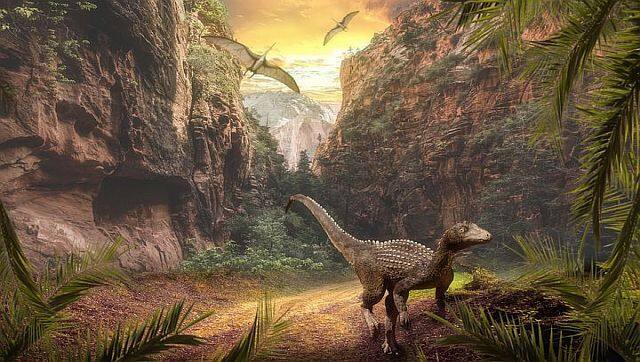 The findings suggest that hollow bones filled with small air sacs were so important to dinosaur survival that they evolved several times independently in different lineages. Pixabay[/caption]Corrugated cardboard or as it was first known, pleated paper, was a man-made design experiment that was hugely successful and is now part of our everyday lives. It was patented in England in 1856 and was initially designed to support top hats which were popular in Victorian England and the US at the time.Three years later, Darwin published his On the Origin of Species which outlined how evolutionary traits that create advantages are more likely to be passed on to future generations than variants which don’t.CT scan technology allowed Aureliano and his colleagues to peer inside the rock-hard fossils they studied. Without the modern technology, it would have been impossible to look inside the fossils and detect the air sacs in the spinal columns.The study found no common ancestor had this trait. All three groups must have developed air sacs independently, and each time in slightly different ways.
The air sacs probably enhanced oxygen levels in the dinosaurs’ blood.The Triassic period had a scorching hot and dry climate. So, more oxygen circulating in the blood would cool dinosaur bodies more efficiently. It would also allow them to mover faster.The air sacs would have buttressed and reinforced the internal structure of the dinosaurs’ bones while creating a greater surface area of attachments for large, powerful muscles. This would have enabled the bones to grow to a far larger size without weighing the animal down.In living birds aerated bones reduce overall mass and volume, while enhancing bone strength and stiffness — essential features for flight.Palaeontology not only tells the story of what might have been for Earth, had it not been for that infamous asteroid, but also helps us learn about the evolution of still living creatures.Prehistoric connectionsEchoes of this dinosaur legacy lie in many animals alive today. It is not only long-dead animals which found this type of adaptation useful.
Many bird species living today rely on hollow bones to fly.Others animals use the air sacs to buttress and strengthen their large bones and skulls, without weighing them down.An excellent example of this is the elephant skull. Inside elephant skulls are large air sacs which allow the animal to move its massive head and heavy tusks without straining the neck muscles.Also Read: How smog is wreaking havoc on insects' mating ritualsThe human brain is also protected by two layers of hard, compact, bone (inner and outer tables) which sandwich a layer of softer, spongey and aerated bone in between, known as the diploe. This allows our skulls to be light, but strong and able to absorb shocks to cranium.These are examples of convergent evolution in which animals are faced repeatedly with the same problem, evolving similar — but not always identical — solutions each time. Animals today are playing by the same evolutionary playbook as the dinosaurs.
 This article is republished from The Conversation under a Creative Commons license. Read the original article.Read all the Latest News, Trending News, Cricket News, Bollywood News,India News and Entertainment News here. Follow us on Facebook, Twitter and Instagram.
First Published:Mar 20, 2023, 16:36:43 IST
Advertisement
Advertisement

Delhi Police asks personnel to wear uniform: What the law says on cops in plainclothes during protests
The Delhi Police has instructed all its personnel to wear uniforms when they report for duty at Jantar Mantar for crowd control. This comes after outrage grew over videos of men in civilian clothes or without name tags hitting protesters in the Capital. Is it legal for the police to ditch uniforms during protests?
4 min read
Military drones & police check-ups: How Sri Lanka is fighting against worst dengue outbreak in a decade
Sri Lanka is fighting its most severe dengue outbreak in nearly a decade, with infections rising sharply across the nation. Military drones have been deployed to tackle the outbreak, which has claimed 56 lives. Health officials said the outbreak is being driven primarily by the DENV-2 variant of the virus
3 min read
How Facebook job ad lured 2 Karnataka men into Myanmar cyber scam camp
The Karnataka Cyber Command has rescued two youths from a scam compound in Myanmar operated by Chinese fraudsters. The duo from Karnataka were lured on the pretext of data-entry jobs. They were asked to work for 16 hours a day and were expected to sleep for six hours daily
4 min read
Why is India seeing 95% cloud cover despite a Super El Niño?
India is witnessing nearly 95 per cent cloud cover despite a Super El Niño, a climate event usually linked to weaker monsoons. Regional weather systems, cyclonic circulations, the monsoon trough and moisture from two seas are temporarily overpowering one of the world's strongest climate phenomena
5 min read
What is CJP’s fourth demand to the government as protests in Delhi intensify?
The protest by the Cockroach Janta Party at Delhi’s Jantar Mantar refuses to die down. The group have made a fourth demand to the Centre, asking that no FIRs are filed against the agitators and that no legal action be taken. The government has expressed willingness to speak to the protesters, but refused to accede on the resignation of Education Minister Dharmandra Pradhan
5 min read
Advertisement
Advertisement