
Advertisement


Sections
Explained: The rising influence of China over West Asia
China's involvement in the region shifts from being purely driven by commercial interests to one that involves security cooperation, to safeguard its expanding assets and expatriate population

China’s billions of dollars in global investments and infrastructure projects seem to be paying off politically and economically.Just recently, Honduras signalled it is set to cut diplomatic ties with Taiwan, having been one of the few remaining countries to recognise the island as a state.This switch of allegiances would be a coup for China, which sees Taiwan as part of its jurisdiction, but also a sign of diminishing US power in Latin America, since the US is a long-time supporter of Taiwan.![]() Honduras foreign minister Eduardo Enrique Reina Garcia (left), and Chinese foreign minister Qin Gang shake hands following the establishment of diplomatic relations between the two countries, at a ceremony at the Diaoyutai State Guesthouse in Beijing. AP[/caption]Since the 1990s, China has gradually become the largest trade partner of the Arab region overall and the top trade partner of Saudi Arabia. China’s exports to Saudi Arabia have annually increased at 15.3 per cent year on year on average, amounting to $905 million (Rs 7,453 crore) in 1995 and $31.8 billion (Rs 2.61 lakh crore) in 2020.Meanwhile, over the same period, China’s imports from Saudi Arabia rose from $393 million (Rs 3,236 crore) to $33.4 billion (Rs 2.75 lakh crore), an average annual increase of 19.4 per cent. In 2019, China and Saudi Arabia signed 35 trade and investments deals.Regional power playsSimilarly, China’s exports to Iran have increased at an average 14.7 per cent annual rate from $276 million (Rs 2,272 crore) in 1995 to $8.51 billion (Rs .70 lakh crore) in 2020. And its imports from Iran have also risen by 14.5 per cent annually between 1995 ($197 million (Rs 1,622 crore)) and 2020 ($5.85 billion (Rs 48.1 lakh crore)).By 2022, exports totalled $9.44 billion (Rs .77 lakh crore) and continued to grow exponentially in early 2023.Russia has recently overtaken China as the largest foreign investor in Iran, but China remains its largest oil customer.China’s main exports to Saudi Arabia and Iran include broadcasting equipment, motor vehicles and air pumps. Its main imports are crude petroleum, ethylene polymers and acrylic alcohols.In the context of the Saudi Arabia and Iran reconciliation, trade with China is likely to continue to follow such increasing trends. If benefits from the agreement spread to other countries in the region, China could also gain from economic relations with those countries as regional stability increases.There is already some evidence of such positive spillover. After the agreement with the Saudis, Iran is ready to expand cooperation, hopes rapprochement with Bahrain will be possible, and is willing to improve relations with Jordan and the United Arab Emirates.Also Read: China is now Russia's 'big brother': What Xi Jinping gained from Moscow visitHowever, it’s worth noting some commentators point out that previous efforts at reconciliation between Iran and Saudi Arabia were unsuccessful, while others question whether they will adhere to the terms of the agreement.Belt and RoadAs well as investing in commercial and transport infrastructure to make trade easier, the objectives of China’s Belt and Road Initiative include the strengthening of its economic leadership and the improvement and creation of free trade blocks among countries along the investment route.The Iran-Saudi Arabia agreement will generate further benefits to China by boosting the initiative’s dividends. Saudi Arabia’s strategic location bordering eight countries not only provides an alternative route for energy supply to China but also makes it a vital partner for the initiative’s infrastructure investment, which deepens China’s presence in the Middle East.[caption id="attachment_12357532" align="alignnone" width="640"]
Honduras foreign minister Eduardo Enrique Reina Garcia (left), and Chinese foreign minister Qin Gang shake hands following the establishment of diplomatic relations between the two countries, at a ceremony at the Diaoyutai State Guesthouse in Beijing. AP[/caption]Since the 1990s, China has gradually become the largest trade partner of the Arab region overall and the top trade partner of Saudi Arabia. China’s exports to Saudi Arabia have annually increased at 15.3 per cent year on year on average, amounting to $905 million (Rs 7,453 crore) in 1995 and $31.8 billion (Rs 2.61 lakh crore) in 2020.Meanwhile, over the same period, China’s imports from Saudi Arabia rose from $393 million (Rs 3,236 crore) to $33.4 billion (Rs 2.75 lakh crore), an average annual increase of 19.4 per cent. In 2019, China and Saudi Arabia signed 35 trade and investments deals.Regional power playsSimilarly, China’s exports to Iran have increased at an average 14.7 per cent annual rate from $276 million (Rs 2,272 crore) in 1995 to $8.51 billion (Rs .70 lakh crore) in 2020. And its imports from Iran have also risen by 14.5 per cent annually between 1995 ($197 million (Rs 1,622 crore)) and 2020 ($5.85 billion (Rs 48.1 lakh crore)).By 2022, exports totalled $9.44 billion (Rs .77 lakh crore) and continued to grow exponentially in early 2023.Russia has recently overtaken China as the largest foreign investor in Iran, but China remains its largest oil customer.China’s main exports to Saudi Arabia and Iran include broadcasting equipment, motor vehicles and air pumps. Its main imports are crude petroleum, ethylene polymers and acrylic alcohols.In the context of the Saudi Arabia and Iran reconciliation, trade with China is likely to continue to follow such increasing trends. If benefits from the agreement spread to other countries in the region, China could also gain from economic relations with those countries as regional stability increases.There is already some evidence of such positive spillover. After the agreement with the Saudis, Iran is ready to expand cooperation, hopes rapprochement with Bahrain will be possible, and is willing to improve relations with Jordan and the United Arab Emirates.Also Read: China is now Russia's 'big brother': What Xi Jinping gained from Moscow visitHowever, it’s worth noting some commentators point out that previous efforts at reconciliation between Iran and Saudi Arabia were unsuccessful, while others question whether they will adhere to the terms of the agreement.Belt and RoadAs well as investing in commercial and transport infrastructure to make trade easier, the objectives of China’s Belt and Road Initiative include the strengthening of its economic leadership and the improvement and creation of free trade blocks among countries along the investment route.The Iran-Saudi Arabia agreement will generate further benefits to China by boosting the initiative’s dividends. Saudi Arabia’s strategic location bordering eight countries not only provides an alternative route for energy supply to China but also makes it a vital partner for the initiative’s infrastructure investment, which deepens China’s presence in the Middle East.[caption id="attachment_12357532" align="alignnone" width="640"]![]() Secretary of Iran's Supreme National Security Council, Ali Shamkhani (right), China's most senior diplomat Wang Yi, centre, and Saudi Arabia's National Security Adviser Musaad bin Mohammed al-Aiban looks on during an agreement signing ceremony between Iran and Saudi Arabia to reestablish diplomatic relations and reopen embassies after seven years of tensions between the Mideast rivals, in Beijing, China. AP[/caption]Iran’s strategic position provides it with considerable seaport facilities and has the potential for the development of an air transportation hub. China has already invested in the development of a 2,000-mile-long railway from Xinjiang’s capital Urumqi to Tehran.The agreement also brings a more subtle benefit to China. With Russia at war, China needs to ensure the continuity of its energy supply to boost economic performance and safeguard socio-political stability at home.Saudi Arabia and Iran provide a strong basis for the diversification of China’s energy options and also to pre-empt any potential move by the United States to constrain its access to the Gulf’s resources.Also Read: Russia-China stitches ‘alliance’: What this means for US hegemonyIran has the world’s fourth largest oil and second gas reserves. Saudi Arabia has the second largest oil reserves, accounting for 16.2 per cent of the world’s total. Access to such vast resources in the context of a more stable region provide China with further assurances for the future flow of the energy supplies its economic growth needs.The Iran-Saudi initiative has the potential to address China’s energy security issues and turn China into a global maritime power and a global monetary power. All of these factors will contribute to the sustainability of China’s economic growth, and add to its status as a superpower.
Secretary of Iran's Supreme National Security Council, Ali Shamkhani (right), China's most senior diplomat Wang Yi, centre, and Saudi Arabia's National Security Adviser Musaad bin Mohammed al-Aiban looks on during an agreement signing ceremony between Iran and Saudi Arabia to reestablish diplomatic relations and reopen embassies after seven years of tensions between the Mideast rivals, in Beijing, China. AP[/caption]Iran’s strategic position provides it with considerable seaport facilities and has the potential for the development of an air transportation hub. China has already invested in the development of a 2,000-mile-long railway from Xinjiang’s capital Urumqi to Tehran.The agreement also brings a more subtle benefit to China. With Russia at war, China needs to ensure the continuity of its energy supply to boost economic performance and safeguard socio-political stability at home.Saudi Arabia and Iran provide a strong basis for the diversification of China’s energy options and also to pre-empt any potential move by the United States to constrain its access to the Gulf’s resources.Also Read: Russia-China stitches ‘alliance’: What this means for US hegemonyIran has the world’s fourth largest oil and second gas reserves. Saudi Arabia has the second largest oil reserves, accounting for 16.2 per cent of the world’s total. Access to such vast resources in the context of a more stable region provide China with further assurances for the future flow of the energy supplies its economic growth needs.The Iran-Saudi initiative has the potential to address China’s energy security issues and turn China into a global maritime power and a global monetary power. All of these factors will contribute to the sustainability of China’s economic growth, and add to its status as a superpower.![The Conversation]() This article is republished from The Conversation under a Creative Commons license. Read the original article.Read all the Latest News, Trending News, Cricket News, Bollywood News,India News and Entertainment News here. Follow us on Facebook, Twitter and Instagram.
This article is republished from The Conversation under a Creative Commons license. Read the original article.Read all the Latest News, Trending News, Cricket News, Bollywood News,India News and Entertainment News here. Follow us on Facebook, Twitter and Instagram.
China’s influence seems to be everywhere.Days before Chinese president Xi Jinping flew into Moscow to discuss the Ukraine war with Russia’s Vladimir Putin, China had brokered a deal between Iran and Saudi Arabia.The high-profile deal sought to re-establish diplomatic, trade and security relations between Iran and Saudi Arabia in an effort to de-escalate tensions and bring more stability to the West Asia.The agreement transforms the nature of China’s involvement in the region from one purely driven by commercial interests into a security-related cooperation that can protect its growing assets and expatriate population in the region.Commentators see the agreement as a positive step but wonder about the influence that Iran and Saudi Arabia can have in lessening the internal conflicts in several nearby countries.This is particularly where they support rival parties, including in Lebanon, Syria and Yemen. What the deal does highlight is the rising influence that China can exert and the waning of the US’s power over the West Asia regional order.Also Read: How China-brokered Saudi-Iran deal is good news for India — and the worldStudies have shown that political instability in neighbouring countries negatively affects the economic performance of a nation by disrupting trade flows and increasing defence expenditures while lessening investment, for example, in education.Under such conditions, economic incentives can drive a peace-building process. Peacefully resolving conflicts benefits countries not directly entangled in the disputes.[caption id="attachment_12357512" align="alignnone" width="640"]
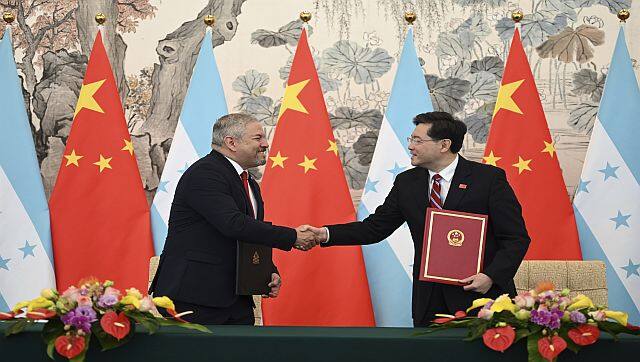 Honduras foreign minister Eduardo Enrique Reina Garcia (left), and Chinese foreign minister Qin Gang shake hands following the establishment of diplomatic relations between the two countries, at a ceremony at the Diaoyutai State Guesthouse in Beijing. AP[/caption]Since the 1990s, China has gradually become the largest trade partner of the Arab region overall and the top trade partner of Saudi Arabia. China’s exports to Saudi Arabia have annually increased at 15.3 per cent year on year on average, amounting to $905 million (Rs 7,453 crore) in 1995 and $31.8 billion (Rs 2.61 lakh crore) in 2020.Meanwhile, over the same period, China’s imports from Saudi Arabia rose from $393 million (Rs 3,236 crore) to $33.4 billion (Rs 2.75 lakh crore), an average annual increase of 19.4 per cent. In 2019, China and Saudi Arabia signed 35 trade and investments deals.Regional power playsSimilarly, China’s exports to Iran have increased at an average 14.7 per cent annual rate from $276 million (Rs 2,272 crore) in 1995 to $8.51 billion (Rs .70 lakh crore) in 2020. And its imports from Iran have also risen by 14.5 per cent annually between 1995 ($197 million (Rs 1,622 crore)) and 2020 ($5.85 billion (Rs 48.1 lakh crore)).By 2022, exports totalled $9.44 billion (Rs .77 lakh crore) and continued to grow exponentially in early 2023.Russia has recently overtaken China as the largest foreign investor in Iran, but China remains its largest oil customer.China’s main exports to Saudi Arabia and Iran include broadcasting equipment, motor vehicles and air pumps. Its main imports are crude petroleum, ethylene polymers and acrylic alcohols.In the context of the Saudi Arabia and Iran reconciliation, trade with China is likely to continue to follow such increasing trends. If benefits from the agreement spread to other countries in the region, China could also gain from economic relations with those countries as regional stability increases.There is already some evidence of such positive spillover. After the agreement with the Saudis, Iran is ready to expand cooperation, hopes rapprochement with Bahrain will be possible, and is willing to improve relations with Jordan and the United Arab Emirates.Also Read: China is now Russia's 'big brother': What Xi Jinping gained from Moscow visitHowever, it’s worth noting some commentators point out that previous efforts at reconciliation between Iran and Saudi Arabia were unsuccessful, while others question whether they will adhere to the terms of the agreement.Belt and RoadAs well as investing in commercial and transport infrastructure to make trade easier, the objectives of China’s Belt and Road Initiative include the strengthening of its economic leadership and the improvement and creation of free trade blocks among countries along the investment route.The Iran-Saudi Arabia agreement will generate further benefits to China by boosting the initiative’s dividends. Saudi Arabia’s strategic location bordering eight countries not only provides an alternative route for energy supply to China but also makes it a vital partner for the initiative’s infrastructure investment, which deepens China’s presence in the Middle East.[caption id="attachment_12357532" align="alignnone" width="640"]
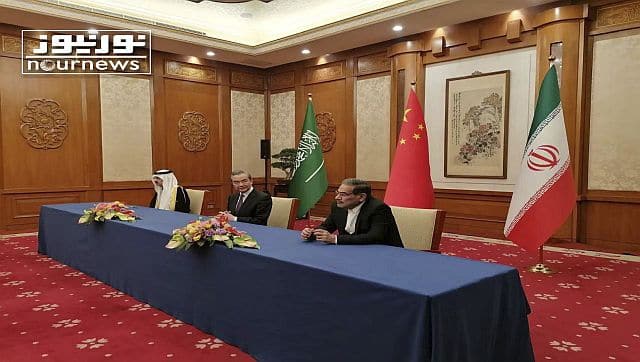 Secretary of Iran's Supreme National Security Council, Ali Shamkhani (right), China's most senior diplomat Wang Yi, centre, and Saudi Arabia's National Security Adviser Musaad bin Mohammed al-Aiban looks on during an agreement signing ceremony between Iran and Saudi Arabia to reestablish diplomatic relations and reopen embassies after seven years of tensions between the Mideast rivals, in Beijing, China. AP[/caption]Iran’s strategic position provides it with considerable seaport facilities and has the potential for the development of an air transportation hub. China has already invested in the development of a 2,000-mile-long railway from Xinjiang’s capital Urumqi to Tehran.The agreement also brings a more subtle benefit to China. With Russia at war, China needs to ensure the continuity of its energy supply to boost economic performance and safeguard socio-political stability at home.Saudi Arabia and Iran provide a strong basis for the diversification of China’s energy options and also to pre-empt any potential move by the United States to constrain its access to the Gulf’s resources.Also Read: Russia-China stitches ‘alliance’: What this means for US hegemonyIran has the world’s fourth largest oil and second gas reserves. Saudi Arabia has the second largest oil reserves, accounting for 16.2 per cent of the world’s total. Access to such vast resources in the context of a more stable region provide China with further assurances for the future flow of the energy supplies its economic growth needs.The Iran-Saudi initiative has the potential to address China’s energy security issues and turn China into a global maritime power and a global monetary power. All of these factors will contribute to the sustainability of China’s economic growth, and add to its status as a superpower.
 This article is republished from The Conversation under a Creative Commons license. Read the original article.Read all the Latest News, Trending News, Cricket News, Bollywood News,India News and Entertainment News here. Follow us on Facebook, Twitter and Instagram.
First Published:Mar 27, 2023, 14:09:00 IST
Advertisement
Advertisement

Delhi Police asks personnel to wear uniform: What the law says on cops in plainclothes during protests
The Delhi Police has instructed all its personnel to wear uniforms when they report for duty at Jantar Mantar for crowd control. This comes after outrage grew over videos of men in civilian clothes or without name tags hitting protesters in the Capital. Is it legal for the police to ditch uniforms during protests?
4 min read
Military drones & police check-ups: How Sri Lanka is fighting against worst dengue outbreak in a decade
Sri Lanka is fighting its most severe dengue outbreak in nearly a decade, with infections rising sharply across the nation. Military drones have been deployed to tackle the outbreak, which has claimed 56 lives. Health officials said the outbreak is being driven primarily by the DENV-2 variant of the virus
3 min read
How Facebook job ad lured 2 Karnataka men into Myanmar cyber scam camp
The Karnataka Cyber Command has rescued two youths from a scam compound in Myanmar operated by Chinese fraudsters. The duo from Karnataka were lured on the pretext of data-entry jobs. They were asked to work for 16 hours a day and were expected to sleep for six hours daily
4 min read
Why is India seeing 95% cloud cover despite a Super El Niño?
India is witnessing nearly 95 per cent cloud cover despite a Super El Niño, a climate event usually linked to weaker monsoons. Regional weather systems, cyclonic circulations, the monsoon trough and moisture from two seas are temporarily overpowering one of the world's strongest climate phenomena
5 min read
What is CJP’s fourth demand to the government as protests in Delhi intensify?
The protest by the Cockroach Janta Party at Delhi’s Jantar Mantar refuses to die down. The group have made a fourth demand to the Centre, asking that no FIRs are filed against the agitators and that no legal action be taken. The government has expressed willingness to speak to the protesters, but refused to accede on the resignation of Education Minister Dharmandra Pradhan
5 min read
Advertisement
Advertisement