


Explained: The significance of the Agni-V missile trial amid China clashes
India successfully carried out trials of the nuclear-capable Agni-V missile on Thursday. This missile is of prime importance to the country, as it has a range of 5,000 km — putting almost all of China within its target range

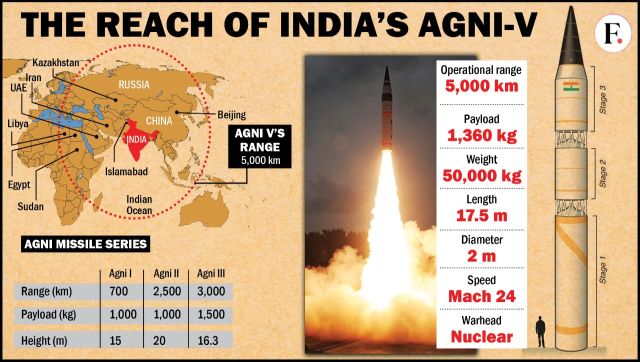
Graphic: Pranay Bhardwaj[/caption]According to defence experts, what sets the Agni-V missile apart from its predecessors is that it launches from a sealed canister that reduces the time needed for launching. The Agni-V also has the potential to be launched via a submarine. Furthermore, its top speed stands at around Mach 24.The Agni-V is also India’s first inter-continental ballistic missile — a guided missile that is designed to deliver nuclear warheads, although they could also deliver other payloads. With the Agni, India has joined the club of seven countries — United States, Russia, China, France, Israel, UK and North Korea — that possess this technology.What is special about ICBMs is that they are much faster and have a greater range than other types of ballistic missiles. They can also be launched in different ways: from underground missile silos, submarines, heavy trucks, or mobile launchers on rails.Agni-V vs China’s DF-ZF hypersonic missileIf India has the Agni-V missile, China has the DF-ZF hypersonic glide vehicle. For those unaware, a hypersonic missile is one that travels at speeds of Mach 5 and higher — five times faster than the speed of sound (3,836 mph), which is around one mile per second. They are highly manoeuvrable and do not follow a predictable arc as they travel. They are said to combine the speed of ballistic missiles with the manoeuvring capabilities of cruise missiles. The speed makes them hard to track compared to traditional missile tech.Hypersonic missiles are of two variants: the Hypersonic Glide Vehicles (HGV) and Hypersonic Cruise Missiles. The HGV are launched from a rocket before gliding to the intended target while the hypersonic cruise missile is powered by air.China’s DF-ZF HGV is an ultra-high-speed missile allegedly capable of penetrating US air defence systems based on interceptor missiles.Experts state that the missile entered operational service in 2019, though some still question the capability of its targeting apparatus.China’s hypersonic weaponry has the United States expressing concern, as according to the National Public Radio, the weapon could attack the US from an unexpected direction, such as the South Pole.India-China tiesThe testing of the Agni-V missile comes when India-China ties are at its lowest after the Tawang clash of 9 December.Since then, tensions are running fraught with India carrying out IAF exercises in the eastern sector. Aircraft such as the Rafale, Chinook and Sukhois have taken to the skies, putting the Chinese on alert.Sources have told The Print that Beijing has increased their state of alertness and have deployed airborne early-warning aircraft at its Shigatse airport.Intelligence analyst Damien Symon, who goes by the popular twitter handle @detresfa, has mapped the increased Chinese activity which includes high deployment of long-range surveillance drones among others.
Reports have also emerged that China is constructing a new military base near the Line of Actual Control close to strategically important Pangong Tso in Ladakh.With inputs from agenciesRead all the Latest News, Trending News, Cricket News, Bollywood News,India News and Entertainment News here. Follow us on Facebook, Twitter and Instagram.
Military drones & police check-ups: How Sri Lanka is fighting against worst dengue outbreak in a decade
How Facebook job ad lured 2 Karnataka men into Myanmar cyber scam camp
Why is India seeing 95% cloud cover despite a Super El Niño?
What is CJP’s fourth demand to the government as protests in Delhi intensify?
The new geography of war: Why the Houthis can no longer be ignored