


Explained: How the National Logistics Policy launched by PM Narendra Modi will transform India
Currently, high logistics costs in India bring down the competitiveness of domestic goods in the global market. The National Logistics Policy, launched by PM Narendra Modi, aims at promoting the seamless movement of goods across the country

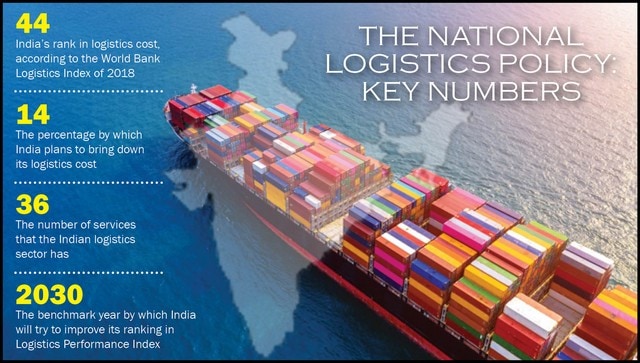
Graphic: Pranay Bhardwaj[/caption]The logistic sector has more than 20 government agencies, 40 Partner Government Agencies (PGA), 37 export promotion councils, 500 certifications, over 10,000 commodities and a $160-billion market size, reports Economic Times.It also involves 200 shipping agencies, 36 logistics services, 129 Inland Container Depots (ICD), 166 Container Freight Stations (CFS), 50 IT ecosystems, banks and insurance agencies.According to PTI, the government has, in the past, emphasised on the need to reduce logistics costs in the country.What are the aims of the policy?According to the World Bank Logistics Index of 2018, India is ranked 44th in logistics costs, far behind countries like the United States and China which are at the 14th and 26th positions, respectively. The policy aims to improve the country’s Logistics Performance Index (LPI) ranking and try to make it to the top 25 countries' list by 2030.The COVID-19 pandemic coupled with dependence on road transportation and under-utilisation of railways and sea networks along with poor infrastructure has led to the spiking costs of logistics in India over the years, reports The New Indian Express. The target is to reduce the cost of logistics from 14-18 per cent of GDP to global best practices of eight per cent by 2030. Countries like the US, South Korea, Singapore, and certain European nations have such a low logistics cost-to-GDP ratio, reports Moneycontrol.
The target is to ensure that logistical issues are minimised, exports grow manifold, and small industries and the people working in them benefit significantly. The Ministry of Commerce and Industry stated that the logistics sector provides livelihood to more than 22 million people and the new policy is aimed at improving the sector by facilitating a 10 per cent decrease in indirect logistics costs, which will enable the growth of five to eight per cent in exports.How will India meet its targets?The policy comprises four major steps, reports CNBC-TV18. These are:Integration of Digital System (IDS): Under this, 30 different systems of seven different departments will be integrated including the road transport, railway, customs, aviation, foreign trade and commerce ministries. These departments will have their own digital data which will be integrated under IDS. This is expected to improve shorter cargo movement.Unified Logistics Interface Platform (ULIP): Similar to IDS, this system will also be utilised for smooth cargo movement.Ease of Logistics (ELOG): Under this, the new policy will simplify the rules and the logistics business will be eased.System Improvement Group (SIG): This system will be used to monitor all logistics-related projects regularly and will facilitate the removal of any hurdle.Additionally, the policy aims at skill development and is expected to generate employment.What steps are underway to improve logistics?The PM had earlier mentioned the Gati Shakti plan during the 15 August speech. This 100 lakh-crore national infrastructure master plan will make a foundation for holistic infrastructure and give an integrated pathway to our economy, he had said.Programmes and schemes such as the FASTag for electronic toll tax collection and faceless assessment for customs are largely in place.With inputs from agenciesRead all the Latest News, Trending News, Cricket News, Bollywood News,India News and Entertainment News here. Follow us on Facebook, Twitter and Instagram.
Delhi Police asks personnel to wear uniform: What the law says on cops in plainclothes during protests
Military drones & police check-ups: How Sri Lanka is fighting against worst dengue outbreak in a decade
How Facebook job ad lured 2 Karnataka men into Myanmar cyber scam camp
Why is India seeing 95% cloud cover despite a Super El Niño?
What is CJP’s fourth demand to the government as protests in Delhi intensify?