
Advertisement


Sections
Explained: How Xi Jinping-Vladimir Putin meeting marks the beginning of the China-Russia axis
Vladimir Putin's invasion of Ukraine – backed openly by China’s economic power – is just the first geopolitical product of a restored Russia-China axis and the return of two states whose ambitions haven't been sated by the post-cold war peace

The heirs to two of the most violent revolutions in modern history shook hands and took stock of their “comprehensive strategic partnership of coordination for a new era”, at a recent meeting in Moscow.Many in the West have puzzled over this relationship between Chinese Communist Party chairman Xi Jinping and Russia’s Vladimir Putin. Some have imagined, for example, that Xi would be a neutral party in Putin’s war in Ukraine, or that he could even be a peacemaker.But rather than imagining a troubling new partnership has emerged unpredictably after decades of peacetime globalisation, we should look to a longer arc of history to understand Russia and China’s shared confrontation with the world.Putin’s invasion of Ukraine — backed openly by China’s economic power — is just the first geopolitical product of a restored Russia-China axis and the return of two states whose ambitions were never sated by the post-cold war peace.Once again, the world’s democracies are faced with the challenge of organising their defences against these two dictatorships in both Europe and Asia.Writing in 1950, as American grand strategy began to cohere around the cold war challenge presented by the Soviet Union, US state department official Paul Nitze explained the period of upheaval that defined his generation’s experience of international affairs:Within the past thirty-five years the world has experienced two global wars of tremendous violence. It has witnessed two revolutions — the Russian and Chinese — of extreme scope and intensity. It has also seen the collapse of five empires — the Ottoman, the Austro-Hungarian, German, Italian, and Japanese — and the drastic decline of two major imperial systems, the British and the French.[caption id="attachment_12345342" align="alignnone" width="640"]![]() Vladimir Putin’s invasion of Ukraine is just the first geopolitical product of a restored Russia-China axis and the return of two states whose ambitions were never sated by the post-cold war peace. AP[/caption]Nitze, the architect of one of the cold war’s primary strategy documents, NSC-68, observed a world in which “the international distribution of power has been fundamentally altered”.Among the reasons for that alteration and upheaval were the two revolutions he wisely acknowledged, the Russian and Chinese. Two revolutions whose consequences, we should now recognise, have not fully ended.We should remind ourselves that 21st-Century Russia and China — and the leaders that run them — are products of the original Russian and Chinese revolutions that Nitze understood would shape the history and geopolitics of his lifetime.
Vladimir Putin’s invasion of Ukraine is just the first geopolitical product of a restored Russia-China axis and the return of two states whose ambitions were never sated by the post-cold war peace. AP[/caption]Nitze, the architect of one of the cold war’s primary strategy documents, NSC-68, observed a world in which “the international distribution of power has been fundamentally altered”.Among the reasons for that alteration and upheaval were the two revolutions he wisely acknowledged, the Russian and Chinese. Two revolutions whose consequences, we should now recognise, have not fully ended.We should remind ourselves that 21st-Century Russia and China — and the leaders that run them — are products of the original Russian and Chinese revolutions that Nitze understood would shape the history and geopolitics of his lifetime.![]() Once again, the world’s democracies are faced with the challenge of organising their defences against these two dictatorships in both Europe and Asia. AP[/caption]Simultaneous containment of both communist China and the Soviet Union provided a check against their ambitions. The Sino-Soviet alliance eventually became unsustainable and broke apart largely because Mao aspired to return China to a position of power and centrality in world affairs; he would not tolerate a role as junior partner to Moscow.Today these roles have reversed, and these ambitions have been restored, not in the name of communist ideology, but in light of an aggressive, militarist nationalism that animates both regimes.Xi and Putin showed the world the philosophical depth and contours of their relationship in their joint declaration of partnership at the Beijing Olympics in 2022 just weeks before Putin’s invasion of Ukraine. But the strategic partnership goes back even earlier.
Once again, the world’s democracies are faced with the challenge of organising their defences against these two dictatorships in both Europe and Asia. AP[/caption]Simultaneous containment of both communist China and the Soviet Union provided a check against their ambitions. The Sino-Soviet alliance eventually became unsustainable and broke apart largely because Mao aspired to return China to a position of power and centrality in world affairs; he would not tolerate a role as junior partner to Moscow.Today these roles have reversed, and these ambitions have been restored, not in the name of communist ideology, but in light of an aggressive, militarist nationalism that animates both regimes.Xi and Putin showed the world the philosophical depth and contours of their relationship in their joint declaration of partnership at the Beijing Olympics in 2022 just weeks before Putin’s invasion of Ukraine. But the strategic partnership goes back even earlier.![The Conversation]() This article is republished from The Conversation under a Creative Commons license. Read the original article.Read all the Latest News, Trending News, Cricket News, Bollywood News,India News and Entertainment News here. Follow us on Facebook, Twitter and Instagram.
This article is republished from The Conversation under a Creative Commons license. Read the original article.Read all the Latest News, Trending News, Cricket News, Bollywood News,India News and Entertainment News here. Follow us on Facebook, Twitter and Instagram.
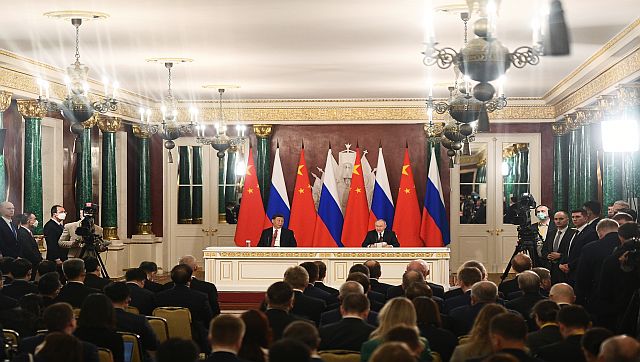 Vladimir Putin’s invasion of Ukraine is just the first geopolitical product of a restored Russia-China axis and the return of two states whose ambitions were never sated by the post-cold war peace. AP[/caption]Nitze, the architect of one of the cold war’s primary strategy documents, NSC-68, observed a world in which “the international distribution of power has been fundamentally altered”.Among the reasons for that alteration and upheaval were the two revolutions he wisely acknowledged, the Russian and Chinese. Two revolutions whose consequences, we should now recognise, have not fully ended.We should remind ourselves that 21st-Century Russia and China — and the leaders that run them — are products of the original Russian and Chinese revolutions that Nitze understood would shape the history and geopolitics of his lifetime.
Xi and Putin, as products of these revolutions, are also heirs to their anti-western ideas and strategies of confrontation.As American spymaster Jack Devine points out, Putin’s career took shape in Dresden, East Germany, ensconced in the Warsaw Pact world and he has called the Soviet empire’s collapse “the greatest geopolitical catastrophe of the 20th Century”.Now, as chairman of the Chinese Communist Party, Xi is heir to what the party calls “the great rejuvenation of the Chinese nation”, a project of national revival that originated with Mao’s “New China” and has continued on in various forms since the founding of the People’s Republic of China in 1949.Xi’s China seeks confrontation with the US and the establishment of a new order with China to “take centre stage in the world”. In this endeavour, Putin’s Russia is Xi’s chief collaborator and “strategic partner”.As totalitarian communist states in the 20th Century, Russia and China challenged the world’s democracies and sought to establish an order of their own.The decade-long Sino-Soviet alliance spanned the Korean War and multiple Taiwan crises, producing a two-theatre strategic challenge for the US and its allies spanning both Europe and Asia.The US, having just fought the second world war in both the Atlantic and Pacific, was perhaps more prepared to manage a two-theatre strategic contest.[caption id="attachment_12345362" align="alignnone" width="640"]
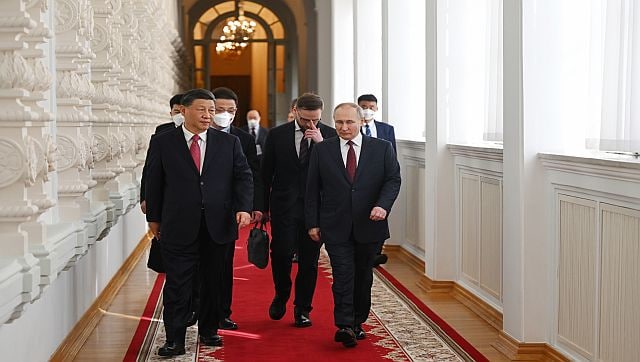 Once again, the world’s democracies are faced with the challenge of organising their defences against these two dictatorships in both Europe and Asia. AP[/caption]Simultaneous containment of both communist China and the Soviet Union provided a check against their ambitions. The Sino-Soviet alliance eventually became unsustainable and broke apart largely because Mao aspired to return China to a position of power and centrality in world affairs; he would not tolerate a role as junior partner to Moscow.Today these roles have reversed, and these ambitions have been restored, not in the name of communist ideology, but in light of an aggressive, militarist nationalism that animates both regimes.Xi and Putin showed the world the philosophical depth and contours of their relationship in their joint declaration of partnership at the Beijing Olympics in 2022 just weeks before Putin’s invasion of Ukraine. But the strategic partnership goes back even earlier.
Throughout the 2010s, both nations worked to expand their military, economic and diplomatic ties.In the statement at the Beijing Olympics, China and Russia pledged mutual support for the other’s “core interests”. Moscow pledged its support for Beijing’s claims over Taiwan, which it called “an inalienable part of China”, and Beijing pledged that “both sides oppose further enlargement of NATO and call on the North Atlantic Alliance to abandon its ideologised cold war approaches”.Joint nuclear-capable bomber exercises, land and naval exercises, increasing trade in energy, technology, China’s propaganda support for Moscow, and new reports of Chinese assault rifles and body armour for Russia, are just some elements of what has taken shape since Putin’s invasion of Ukraine.The shared China-Russia division of Europe and Asia is reminiscent of the original geography of the Sino-Soviet Alliance. As Stalin told his counterparts in communist China: “There should be some division of labour between us … you may take more responsibility in working in the East … and we will take more responsibility in the West.”Putin’s war in Ukraine is not the only conflict, of course, that this axis may produce. China’s economic engagement with the democracies in the post-cold war supercharged a modern-day People’s Republic of China that now contests the world’s democracies in critical technologies and strategic industries and has built a military of unmatched scope in Asia that is meant to settle scores of its own in the Pacific.This is the return of 20th-Century antagonists whose ambitions never truly went away.
 This article is republished from The Conversation under a Creative Commons license. Read the original article.Read all the Latest News, Trending News, Cricket News, Bollywood News,India News and Entertainment News here. Follow us on Facebook, Twitter and Instagram.
First Published:Mar 24, 2023, 15:31:51 IST
Advertisement
Advertisement

Military drones & police check-ups: How Sri Lanka is fighting against worst dengue outbreak in a decade
Sri Lanka is fighting its most severe dengue outbreak in nearly a decade, with infections rising sharply across the nation. Military drones have been deployed to tackle the outbreak, which has claimed 56 lives. Health officials said the outbreak is being driven primarily by the DENV-2 variant of the virus
3 min read
How Facebook job ad lured 2 Karnataka men into Myanmar cyber scam camp
The Karnataka Cyber Command has rescued two youths from a scam compound in Myanmar operated by Chinese fraudsters. The duo from Karnataka were lured on the pretext of data-entry jobs. They were asked to work for 16 hours a day and were expected to sleep for six hours daily
4 min read
Why is India seeing 95% cloud cover despite a Super El Niño?
India is witnessing nearly 95 per cent cloud cover despite a Super El Niño, a climate event usually linked to weaker monsoons. Regional weather systems, cyclonic circulations, the monsoon trough and moisture from two seas are temporarily overpowering one of the world's strongest climate phenomena
5 min read
What is CJP’s fourth demand to the government as protests in Delhi intensify?
The protest by the Cockroach Janta Party at Delhi’s Jantar Mantar refuses to die down. The group have made a fourth demand to the Centre, asking that no FIRs are filed against the agitators and that no legal action be taken. The government has expressed willingness to speak to the protesters, but refused to accede on the resignation of Education Minister Dharmandra Pradhan
5 min read
The new geography of war: Why the Houthis can no longer be ignored
The rise of the Houthis marks the emergence of a new geography of war — one in which influence flows not only from capitals and conventional armies, but also from rugged mountains overlooking vital sea lanes
6 min read
Advertisement
Advertisement