
Advertisement


Sections
How will Supreme Court live-streaming constitutional bench hearings help India?
The Supreme Court wants to increase transparency and accessibility with regard to its functioning. This, as several important cases are slated to be heard by the five-judge constitution benches

The Supreme Court on Tuesday began live-streaming proceedings of all constitution bench hearings in a bid to enhance transparency and accessibility in its functioning.[caption id="attachment_11343601" align="alignnone" width="640"]![Screen-grab from Live. webcast.gov.in/scindia/]() Screen-grab from Live. webcast.gov.in/scindia/[/caption]This comes a month after the apex court, for the first time since its inception, live-streamed its proceedings of a bench headed by then chief justice NV Ramana through a webcast portal.Ramana demitted the office on 26 August.A unanimous decision was taken by the 30 judges of the apex court in the full court meeting headed by Chief Justice of India UU Lalit to implement an apex court verdict of 2018 in the Swapnil Tripathi case.But how will live-streaming cases help India?Let’s take a closer look:The Supreme Court wants to increase transparency and accessibility.
Screen-grab from Live. webcast.gov.in/scindia/[/caption]This comes a month after the apex court, for the first time since its inception, live-streamed its proceedings of a bench headed by then chief justice NV Ramana through a webcast portal.Ramana demitted the office on 26 August.A unanimous decision was taken by the 30 judges of the apex court in the full court meeting headed by Chief Justice of India UU Lalit to implement an apex court verdict of 2018 in the Swapnil Tripathi case.But how will live-streaming cases help India?Let’s take a closer look:The Supreme Court wants to increase transparency and accessibility.![KK Venugopal]() File photo of Attorney-General KK Venugopal. PTI[/caption]He gave his support on the basis of decongesting the courts and improving physical access to courts for litigants who have to otherwise travel long distances to come to the court.The Attorney-General had said the process can be adopted in other court rooms depending on the success of the pilot project.As per Indian Express, the Supreme Court then approved a set of guidelines suggested by the A-G, which included allowing transcripts and archiving the proceedings.As per the report the then A-G suggested that the court must retain the power to withhold broadcasting, and to also not permit it in cases involving:
File photo of Attorney-General KK Venugopal. PTI[/caption]He gave his support on the basis of decongesting the courts and improving physical access to courts for litigants who have to otherwise travel long distances to come to the court.The Attorney-General had said the process can be adopted in other court rooms depending on the success of the pilot project.As per Indian Express, the Supreme Court then approved a set of guidelines suggested by the A-G, which included allowing transcripts and archiving the proceedings.As per the report the then A-G suggested that the court must retain the power to withhold broadcasting, and to also not permit it in cases involving:![File image of the Bombay High Court. PTI]() File image of the Bombay High Court. PTI[/caption]During the streaming, Justice Gautum S Patel heard nine listed cases and one urgent matter during the public video-conferencing held through the Zoom application.
File image of the Bombay High Court. PTI[/caption]During the streaming, Justice Gautum S Patel heard nine listed cases and one urgent matter during the public video-conferencing held through the Zoom application.
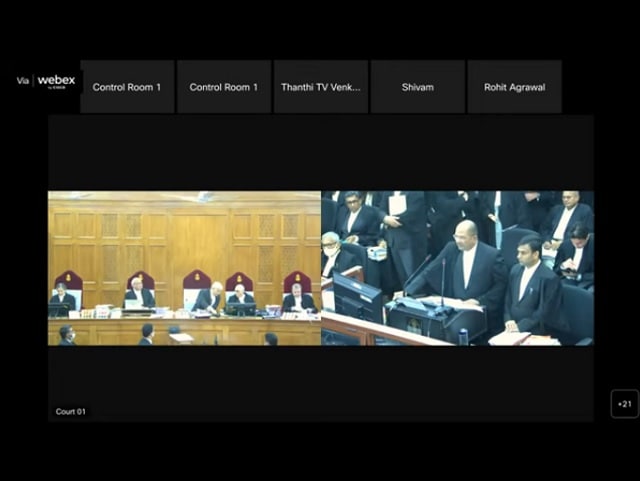 Screen-grab from Live. webcast.gov.in/scindia/[/caption]This comes a month after the apex court, for the first time since its inception, live-streamed its proceedings of a bench headed by then chief justice NV Ramana through a webcast portal.Ramana demitted the office on 26 August.A unanimous decision was taken by the 30 judges of the apex court in the full court meeting headed by Chief Justice of India UU Lalit to implement an apex court verdict of 2018 in the Swapnil Tripathi case.But how will live-streaming cases help India?Let’s take a closer look:The Supreme Court wants to increase transparency and accessibility.
This is vital because several important cases are slated to be heard by five-judge constitution benches of the apex court.These include the validity of the 103rd constitution amendment granting 10 per cent quota to the Economically Weaker Section (EWS) and pleas challenging the constitutional validity of the Citizenship Amendment Act.The rationale was spelled out on 26 September, 2018, when the apex court headed by then chief justice of India Dipak Misra in a path-breaking verdict and a major leap in imparting transparency in the functioning of the judiciary allowed live-streaming of court proceedings of cases of "constitutional and national importance".The court said this openness was like "sunlight" which is the "best disinfectant".An apex court bench of then chief justice Dipak Misra and Justices AM Khanwilkar and DY Chandrachud had said it will soon make the necessary rules for balancing the rights of the public and protecting the dignity of litigants.While CJI Misra and Justice Khanwilkar pronounced a common judgment, Justice Chandrachud gave a separate, albeit concurring verdict.Live-streaming of court proceedings will effectuate “public right to know” and bring in more transparency in judicial proceedings, the court had said.The verdict was passed on a batch of petitions, including those filed by senior advocate Indira Jaising, law student Snehil Tripathi and NGO ‘Centre For Accountability and Systemic Change’ on the issue.As per Indian Express, in March 2018, the apex court sought the view of Attorney-General of India KK Venugopal.Venugopal in return suggested live-streaming of important cases in the CJI's court can be started on a pilot basis.[caption id="attachment_11343661" align="alignnone" width="640"]
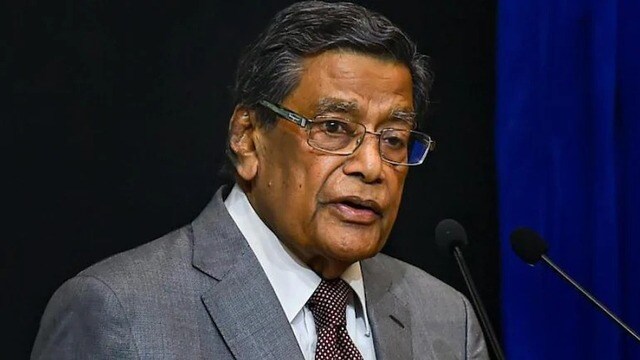 File photo of Attorney-General KK Venugopal. PTI[/caption]He gave his support on the basis of decongesting the courts and improving physical access to courts for litigants who have to otherwise travel long distances to come to the court.The Attorney-General had said the process can be adopted in other court rooms depending on the success of the pilot project.As per Indian Express, the Supreme Court then approved a set of guidelines suggested by the A-G, which included allowing transcripts and archiving the proceedings.As per the report the then A-G suggested that the court must retain the power to withhold broadcasting, and to also not permit it in cases involving:
- Matrimonial matters
- Matters involving interests of juveniles or the protection and safety of the private life of the young offenders
- Matters of National security
- To ensure that victims, witnesses or defendants can depose truthfully and without any fear. Special protection must be given to vulnerable or intimidated witnesses.
- It may provide for face distortion of the witness if she/he consents to the broadcast anonymously,
- To protect confidential or sensitive information, including all matters relating to sexual assault and rape,
- Matters where publicity would be antithetical to the administration of justice, and
- Cases which may provoke sentiments and arouse passion and provoke enmity among communities.
 File image of the Bombay High Court. PTI[/caption]During the streaming, Justice Gautum S Patel heard nine listed cases and one urgent matter during the public video-conferencing held through the Zoom application.
The West and some developed nations also allow court proceedings to be live-streamed.The US Supreme Court does not allow video broadcasts, however, audio recordings and oral transcripts of arguments are permitted.While Canada, South Africa and United Kingdom court proceedings to be broadcast, Australia and Brazil place certain limitations which vary depending on the courts, as per the report.‘Will have own platform’The Supreme Court on Monday said it will have its own “platform” to live-stream its proceedings and the use of YouTube for the purpose is temporary.A bench headed by Chief Justice Uday Umesh Lalit said this when former BJP leader KN Govindacharya's counsel argued that the copyright of apex court proceedings cannot be surrendered to private platforms like YouTube.“YouTube has clearly sought the copyright over the webcast,” lawyer Virag Gupta told the bench that also comprised Justices S Ravindra Bhat and JB Pardiwala.“These are the initial stages. We will certainly have our own platforms...We will take care of that (copyright issue),” the CJI said and listed Govindacharya's interim plea for hearing on 17 October.Referring to a 2018 judgment, the lawyer said it was held that “the copyright over all the material recorded and broadcast in this court shall vest with this court only”.The lawyer also referred to the terms of use of YouTube and said this private platform also gets the copyright.The apex court may live-stream proceedings through YouTube and later host them on its server, sources had said. People would be able to access proceedings of the apex court on their cell phones, laptops, and computers without any hassle.With inputs from agenciesRead all the Latest News, Trending News, Cricket News, Bollywood News,India News and Entertainment News here. Follow us on Facebook, Twitter and Instagram.
First Published:Sep 27, 2022, 18:02:22 IST
Advertisement
Advertisement

Delhi Police asks personnel to wear uniform: What the law says on cops in plainclothes during protests
The Delhi Police has instructed all its personnel to wear uniforms when they report for duty at Jantar Mantar for crowd control. This comes after outrage grew over videos of men in civilian clothes or without name tags hitting protesters in the Capital. Is it legal for the police to ditch uniforms during protests?
4 min read
Military drones & police check-ups: How Sri Lanka is fighting against worst dengue outbreak in a decade
Sri Lanka is fighting its most severe dengue outbreak in nearly a decade, with infections rising sharply across the nation. Military drones have been deployed to tackle the outbreak, which has claimed 56 lives. Health officials said the outbreak is being driven primarily by the DENV-2 variant of the virus
3 min read
How Facebook job ad lured 2 Karnataka men into Myanmar cyber scam camp
The Karnataka Cyber Command has rescued two youths from a scam compound in Myanmar operated by Chinese fraudsters. The duo from Karnataka were lured on the pretext of data-entry jobs. They were asked to work for 16 hours a day and were expected to sleep for six hours daily
4 min read
Why is India seeing 95% cloud cover despite a Super El Niño?
India is witnessing nearly 95 per cent cloud cover despite a Super El Niño, a climate event usually linked to weaker monsoons. Regional weather systems, cyclonic circulations, the monsoon trough and moisture from two seas are temporarily overpowering one of the world's strongest climate phenomena
5 min read
What is CJP’s fourth demand to the government as protests in Delhi intensify?
The protest by the Cockroach Janta Party at Delhi’s Jantar Mantar refuses to die down. The group have made a fourth demand to the Centre, asking that no FIRs are filed against the agitators and that no legal action be taken. The government has expressed willingness to speak to the protesters, but refused to accede on the resignation of Education Minister Dharmandra Pradhan
5 min read
Advertisement
Advertisement