
Advertisement


Sections
Explained: How Brazil's Lula da Silva has fared in the first 100 days in office
Luiz Inacio Lula da Silva has not had much of a honeymoon in his comeback as president of Brazil, delivering mixed results and nursing several wounds after 100 days in office

Rio de Janeiro: Luiz Inacio Lula da Silva has not had much of a honeymoon in his comeback as president of Brazil, delivering mixed results and nursing several wounds — some self-inflicted — after 100 days in office.The 77-year-old left-wing icon, who basked in record approval ratings when he stepped down from his first two terms (2003-2010), came back for a third on 1 January, taking over a country deeply divided by his brutal election battle with far-right predecessor Jair Bolsonaro.Lula hit the ground running, announcing a flurry of measures aimed at reversing Bolsonaro's legacy, reviving defunct social and environmental programs, and restoring Brazil's international standing after four years of relative isolation.But his first months were tarnished by a series of gaffes and a public spat with the central bank over the key interest rate — which he insists is too high, to the growing alarm of the business world.Also Read: Globetrotter Lula: What to expect from Brazil's new foreign policyLula's approval rating stood at 38 per cent three months in, according to polling firm Datafolha, a dip from the same period in his first two terms — 43 per cent in 2003 and 48 per cent in 2007.While those figures are better than Bolsonaro's — who was polling at 32 per cent at the same point in 2019 — Lula has a nearly identical disapproval rating as his predecessor at this point: 29 per cent versus 30 per cent for Bolsonaro.Shots in the footThings got off to a tumultuous start a week after Lula's inauguration, when rioting Bolsonaro supporters invaded the presidential palace, Congress and the Supreme Court.Political scientist Denilde Holzhacker says Lula could have made better use of the surge of national unity that followed the attacks, which even right-wing leaders condemned.[caption id="attachment_12415452" align="alignnone" width="640"]![]()
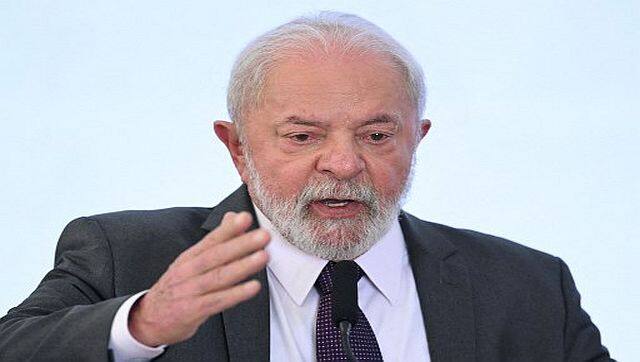
Luiz Inacio Lula da Silva, who basked in record approval ratings when he stepped down from his first two terms (2003-2010), came back for a third on 1 January. AFP[/caption]"That spirit of unity is gone. The divisions are even bigger now than before," said Holzhacker, a political communication specialist at marketing school ESPM.
Lula has shown a gift for shooting himself in the foot.A case in point: last month, he claimed a police operation to take out a gang accused of plotting to murder opposition Senator Sergio Moro — the former judge who sentenced Lula to prison in 2017 on since-quashed corruption charges — was just a "show" orchestrated by Moro himself.That outraged a right-wing that had been "demobilised and isolated" after the 8 January riots, Holzhacker told AFP.The reenergised right only grew more so when Bolsonaro returned last week from three months in the United States, ending his post-election political reclusion.Lula "has made a series of unforced errors," economist Rodrigo Zeidan wrote in a column for newspaper Folha de Sao Paulo.He cited the president's attacks on the central bank as an example of gaffes that can cause "perverse, unintended effects that stunt economic growth."Lula "has his style," said economist Andre Perfeito of consulting firm Necton."He talks tough, he picks fights."But "Lula Three" has actually been a relatively austere, market-friendly government so far, he told AFP.He cited new fiscal rules unveiled last week by Finance Minister Fernando Haddad, which aim to let the government boost social spending without exploding the deficit, and got a warm welcome from markets.Balancing actLula has chalked up some wins: he managed to relaunch his trademark social program, "Bolsa Familia" (Family Allowance), with increased benefits.He also won plaudits for deploying the army to reclaim Brazil's biggest Indigenous reservation, the Yanomami territory, from thousands of illegal gold miners who had invaded it and triggered a humanitarian crisis.His performance on foreign policy has been "relatively positive," said Oliver Stuenkel, a professor of international relations at the Getulio Vargas Foundation."Lula has managed to normalise relations that had seriously suffered with some countries" under Bolsonaro, he said.That includes top trading partners China — where Lula will travel next week, after pushing back his trip because of a mild case of pneumonia — the United States, and Argentina.But Stuenkel warned Lula faces a tough balancing act as he seeks to position Brazil as a go-between and deal-broker on the international stage."It will be difficult to maintain a balance between the West, on the one hand, and Russia and China on the other," he said, recalling Lula's reluctance to condemn Moscow for invading Ukraine.Read all the Latest News, Trending News, Cricket News, Bollywood News,India News and Entertainment News here. Follow us on Facebook, Twitter and Instagram.
First Published:Apr 06, 2023, 13:03:19 IST
Advertisement
Advertisement

Military drones & police check-ups: How Sri Lanka is fighting against worst dengue outbreak in a decade
Sri Lanka is fighting its most severe dengue outbreak in nearly a decade, with infections rising sharply across the nation. Military drones have been deployed to tackle the outbreak, which has claimed 56 lives. Health officials said the outbreak is being driven primarily by the DENV-2 variant of the virus
3 min read
How Facebook job ad lured 2 Karnataka men into Myanmar cyber scam camp
The Karnataka Cyber Command has rescued two youths from a scam compound in Myanmar operated by Chinese fraudsters. The duo from Karnataka were lured on the pretext of data-entry jobs. They were asked to work for 16 hours a day and were expected to sleep for six hours daily
4 min read
Why is India seeing 95% cloud cover despite a Super El Niño?
India is witnessing nearly 95 per cent cloud cover despite a Super El Niño, a climate event usually linked to weaker monsoons. Regional weather systems, cyclonic circulations, the monsoon trough and moisture from two seas are temporarily overpowering one of the world's strongest climate phenomena
5 min read
What is CJP’s fourth demand to the government as protests in Delhi intensify?
The protest by the Cockroach Janta Party at Delhi’s Jantar Mantar refuses to die down. The group have made a fourth demand to the Centre, asking that no FIRs are filed against the agitators and that no legal action be taken. The government has expressed willingness to speak to the protesters, but refused to accede on the resignation of Education Minister Dharmandra Pradhan
5 min read
The new geography of war: Why the Houthis can no longer be ignored
The rise of the Houthis marks the emergence of a new geography of war — one in which influence flows not only from capitals and conventional armies, but also from rugged mountains overlooking vital sea lanes
6 min read
Advertisement
Advertisement