


Europe’s 40°C summer misery: How an omega block is trapping the heat
An extreme heatwave has engulfed parts of Europe, with temperatures hitting the 40-degree-Celsius mark in several countries like France, the UK and Italy. The rising mercury has triggered deaths, school closures and transport disruption. But behind this extreme weather is an omega block, trapping African heat in the region

The heat in Europe is getting deadly, quite literally. An overwhelming 40 people have died in heatwave-related incidents in France over the past few days, Prime Minister Sébastien Lecornu said, as temperatures hit record levels in several major cities across European countries.
France, Spain, and Italy have been hardest hit by the heatwave so far. The mercury soared in France on Tuesday, reaching a record high of 29.7 degrees Celsius, breaking a record last reached in 2019. One town saw temperatures of over 43.8 degrees Celsius.
In Spain, temperatures are set to peak above 40 degrees Celsius in some areas, with red alerts in Andalusia in the south, and Cantabria and the Basque Country in the north, on the third day of a national heatwave.
And in Italy, a red heatwave alert has been declared in 15 cities, including Rome, Milan, Florence, Turin, and Venice.
 More from Explainers
Weather experts note that the record-breaking heat across Europe is due to a weather pattern known as an omega block.
Here’s what we know of this weather phenomenon and how it is affecting Europe.
What’s an omega block?
The heatwave in Europe, according to meteorologists, is being driven by a persistent high-pressure system, known as an omega block. This is causing a heat dome over Europe, resulting in Europeans sweltering.
Taking its name from the shape of the Greek letter Ω, it traps hot Saharan air beneath it like a lid on a pressure cooker. Samantha Burgess from the European Centre for Medium-Range Weather Forecasts explains the weather phenomenon as “the equivalent of a traffic jam in the atmosphere which locks in heat”.
Under normal circumstances, the jet stream — a current in the atmosphere that moves air and weather systems from west to east — carries weather systems steadily from west to east. However, during an omega block, that flow is disrupted and can buckle dramatically north and south, isolating the pressure systems. Weaker steering winds and temperature contrasts in the atmosphere contribute to these slow-moving, locked patterns.

Typically, this weather phenomenon lasts between three and 10 days, but can persist for weeks. Moreover, Europe’s deadliest heatwaves are almost always caused by omega blocks. For instance, the 2003 heatwave that resulted in the hottest European summer since at least 1540 was driven by an omega block.
Similarly, a study in the Earth’s Future journal revealed that the heatwaves of 2010 and 2018 were also because of an omega block.
So, what exactly happens in an omega block?
Burgess explains that in an omega block, “the area of high pressure gets stuck because of the pressure on either side”. This results in hot and dry conditions.
Experts add that if this pattern persists for a long period, it causes a heat dome — a “lid” of high pressure trapping hot air near the surface.
This also suppresses cloud formation, owing to which more sunshine cooks the Earth’s surface, creating a loop of heat. Will Lang, chief meteorologist at the UK’s Met Office, told the AFP, “Under the right conditions — and you do need the right conditions — it just gets hotter and hotter.”
How hot is hot?
The omega block, forecasters say, is centred over France, causing it to experience higher temperatures than the rest of its European neighbours. Tuesday was France’s hottest day, prompting the Eiffel Tower and the Louvre museum to restrict visiting hours and disrupting school hours.
Météo-France, the French weather department, said the heatwave has reached what it described as a “plateau of severity,” with unrelenting heat, day and night. A growing number of regions will tip into the red again today (June 24) as the heat spreads across more than half of the country, including the northernmost tip of France.

But it’s not just France that is baking. Across southern England and southeast Wales, the weather agency has issued a red extreme heat warning for Wednesday and Thursday. Southern England is expected to experience temperatures of at least 39°C by Wednesday and Thursday.
This has led to dozens of schools issuing orders to remain shut for two days. “Most of our buildings cannot be cooled adequately, and there is little shade outside,” one school in the southeastern county of Buckinghamshire told AFP.

Nearly all of Spain is also under a heat alert, with parts of the south and north on the highest warning level for “extraordinary danger,”, national weather agency AEMET said.
Italy’s health ministry also declared a red heatwave alert in 15 cities, including Milan and Rome. Blackouts struck Milan and Turin because of the spike in the use of air conditioning.
Austria, Poland, Hungary, and Croatia each have also issued heat warnings for parts of their territory. Emergency services in Hungary and Slovenia reported elderly people seeking help.
The unrelenting heat has also led to numerous deaths across Europe. In France, 40 people, mostly young, had drowned since the heatwave started on June 18. In Germany, on Monday, police said five people had died in fatal swimming accidents over the weekend.
What measures is Europe taking to combat this heat?
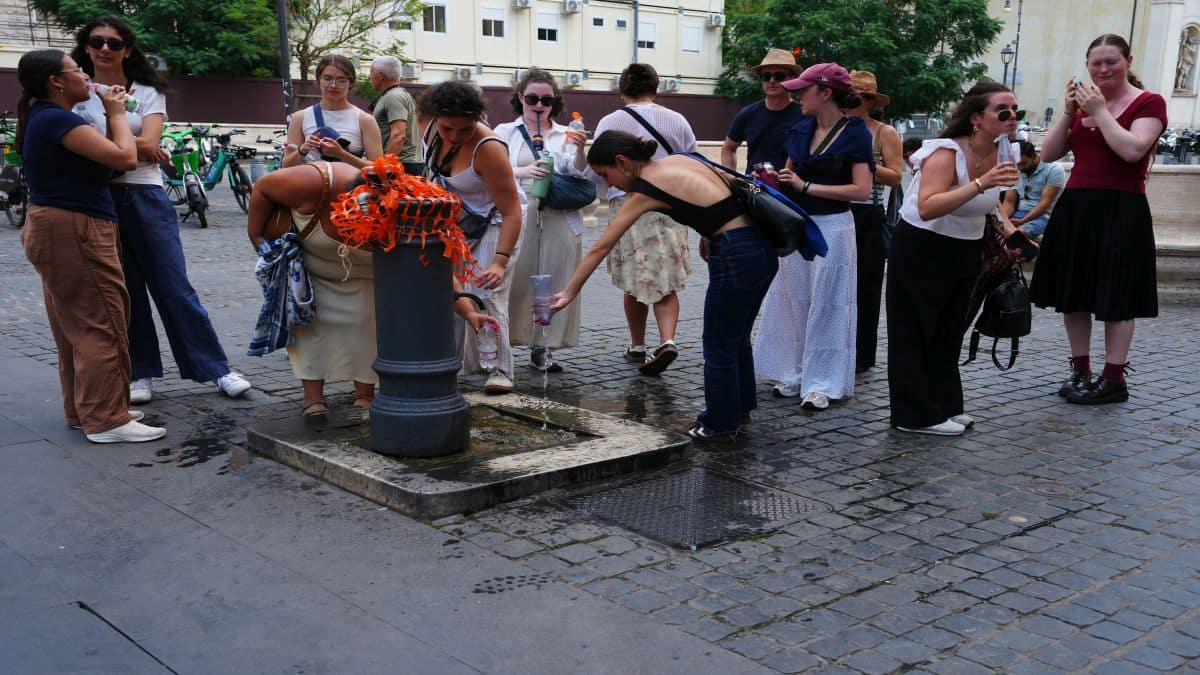
As the temperatures rise in Europe, several cooling measures are being adopted to help citizens. Some countries have restricted some public activities to help the situation and even issued health warnings.
The sales of air conditioners have also increased drastically as people look to keep themselves cool.
Will Europe wilt in the heat? Only time will tell.
With inputs from agencies

Why India may not witness a medal rush at 2026 Commonwealth Games
Delhi Police asks personnel to wear uniform: What the law says on cops in plainclothes during protests
Military drones & police check-ups: How Sri Lanka is fighting against worst dengue outbreak in a decade
How Facebook job ad lured 2 Karnataka men into Myanmar cyber scam camp
Why is India seeing 95% cloud cover despite a Super El Niño?