


Delhi murder: Why people walked by as teenage girl was stabbed multiple times
The murder captured on CCTV cameras in Delhi's Rohini shows people not interfering as a 16-year-old girl was stabbed and then hit with a boulder. It has revived the debate around ‘bystander effect’ – a theory which says the greater the number of witnesses, the less likely someone is to intervene

“I didn’t want to get involved,” one neighbour told the newspaper.In the aftermath of the incident, experts coined the ‘bystander effect’ theory to explain the inaction of the witnesses, as per Los Angeles Times.The theory is as follows – the greater the number of witnesses to an incident, the less likely someone is to intervene.According to Brittanica, it was American social psychologists Bibb Latané and John Darley who conducted the pioneering research on the bystander effect.Latané and Darley discovered that while bystanders do care about people in distress, whether or not they actually intervene comes down to a succession of decisions.These include:
- Noticing the incident
- Determining it is an emergency
- Gauging whether he or she is personally responsible for acting
- Choosing how to intervene
- And finally acting.
- The witnesses are male
- Have chauvinistic attitudes towards women
- Are under the influence of drugs or alcohol themselves.
That in itself may spur others to act.“…an active bystander is most effective when they assume that they themselves are the sole person taking charge; giving direction to other bystanders to assist can, therefore, be critically important,” the piece noted.A relook at the incidentThe irony is that the facts surrounding the murder of Genovese – which in itself formed the genesis for the ‘bystander effect’ theory – were greatly exaggerated, as per Los Angeles Times.The story itself and the large number of eyewitnesses came from a conversation between the then police commissioner and the newspaper’s city editor.Fifty-tw0 years after the murder, The New York Times added an editor’s note to the original story which stated: “Later reporting by The Times and others has called into question significant elements of this account.”In 2020, the obituary of Sophia Farrar, the woman who came to Genovese’s assistance, published in The New York Times, noted, “With the benefit of hindsight, the number of eyewitnesses turned out to have been exaggerated; none actually saw the attack completely; some who heard it thought it was a drunken brawl or a lovers’ quarrel; and several people said they did call the police.”Despite the new facts that have come to light about the murder, the concept of the ‘bystander effect’ has taken root.Sheer lack of empathy, say expertsFrom the murders of Keenan Santos and Reuben Fernandes in 2011, to a young college student being hacked to death at a bus stop in Tamil Nadu in 2016, anda B Com student being stabbed to death outside a college in Chennai in 2018, India has witnessed a slew of cases where young women and men have been murdered and sexually assaulted in broad daylight.
Not only have witnesses not intervened, but some have even taken videos.In October 2022, a video of a young woman from a village in Moradabad, Uttar Pradesh being gangraped, stripped and made to walk for two kilometres naked, battered, bruised and bleeding went viral.[caption id="attachment_12664412" align="alignnone" width="640"]
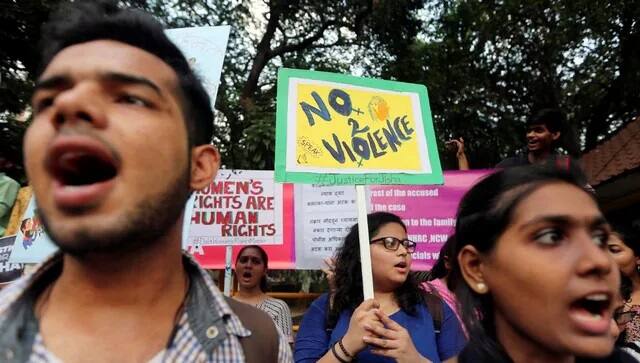
Representational image. PTI[/caption]That just a month after a 21-year-old was stabbed to death in broad daylight.The ‘passive watcher’ gaze is about inaction, the audacity of filming a violent crime and sheet lack of empathy, say experts.All of this has been exacerbated by access to technology and social media. The hunger for social media recognition and a sense of novelty of witnessing a horrendous act firsthand drives a crowd to film the victim.According to forensic psychologist Deepti Puranik, the easy accessibility of technology in the form of smartphones has enabled people to readily make videos and upload them on social media to “get maximum likes to become popular”.“In the competition to get maximum likes, individuals have lost their sense of right or wrong,” Puranik told PTI.Uploading such videos on social media can also be a way to threaten the victim against speaking out.“Technological advances have made it easy for perpetrators to use social media as a method of seeking revenge with the victim. This certainly shows pathological symptoms of perpetrators who have no remorse for their actions,” Puranik noted.She explained that while in both incidents bystanders watched passively, it is only in the case of the woman that people made videos.“Murder and rape are two different types of crime. While in murder people want to disassociate with it for its violent nature, when it comes to a woman raped and walking naked they feel she deserves it and don’t want to be involved. Besides standing passively, they make videos as well,” Puranik said.NIMHANS’ Sharma said the act of making a video shows people are more attuned to capture “an atrocious event which seems plausible and accessible to them”.“This can indicate that some people might feel drawn to the sensational aspect of the event or feel a novelty of uploading a video… but would like to distance themselves from getting directly involved with the situation,” Sharma told PTI.In April 2022, a woman in a village in Karnataka’s Dakshina Kannada district was allegedly stripped naked and assaulted by a group of people as several villagers looked on. The videos of the incident were readily shared on social media.In July 2021, a 23-year-old in Gujarat’s Dahod was paraded naked by her husband and other villagers as punishment for eloping with another man. A purported video circulated widely on social media showed the husband and other men dragging the woman, stripping and thrashing her in the presence of other women and children, police said.Backing the ‘bystander effect’ theory, Puranik said the patriarchal belief that the woman is responsible for such acts is still prevalent in society, buttressing the less empathetic response from bystanders.Sociologist-author Rukmini Sen said the behaviour of people, generally men, may be “psychologised and made to appear as something which is deeply personal, a pathological mindset”.
But there is more to it.“There is definitely a structural failure in being able to address questions of power, authority, gender, patriarchy in our everyday lives–through education, media, popular culture or government campaigns,” the Ambedkar University professor told PTI.“What kind of continuous awareness programmes, school education or government radio and television campaigns which talk about the ills of social media even exist in our cultures?” she questioned.She suggested that critical discussions on “gendered roles, masculine power and state support to criminals” are needed in order to be able to address violent incidents of similar nature.“Making a punitive law or providing technological access without inculcating lessons of gendered responsibilities when using them can prove dangerous and these kinds of incidents only reaffirm that,” Sen said.With inputs from agenciesRead all the Latest News, Trending News, Cricket News, Bollywood News,India News and Entertainment News here. Follow us on Facebook, Twitter and Instagram.

Delhi Police asks personnel to wear uniform: What the law says on cops in plainclothes during protests
Military drones & police check-ups: How Sri Lanka is fighting against worst dengue outbreak in a decade
How Facebook job ad lured 2 Karnataka men into Myanmar cyber scam camp
Why is India seeing 95% cloud cover despite a Super El Niño?
What is CJP’s fourth demand to the government as protests in Delhi intensify?