
Advertisement

'Defying physics': What is the mysterious object that is 10 million times brighter than the sun?

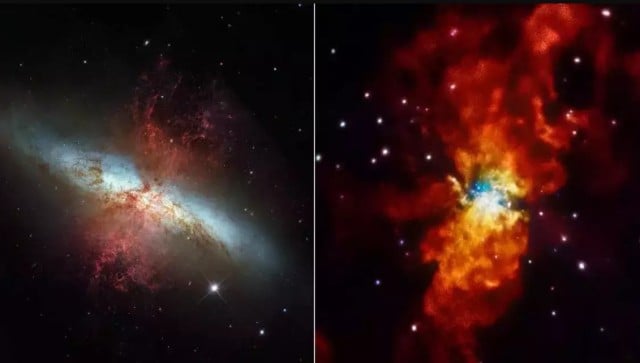
NASA recently found a ultraluminous X-ray light called M82 X-2, which is 10 million times as bright as the sun. Scientists are scrambling to understand this celestial object that is upending the current understanding of physics

Advertisement
FP Explainers|May 12, 2023, 15:24:36 IST
An enigmatic celestial object that is so bright that it should have burst has left researchers puzzled.New observations made by NASA's Nuclear Spectroscopic Telescope Array, which views the universe in high-energy X-rays, were reported in The Astrophysical Journal.The analysis confirmed that one ultraluminous X-ray light (ULX) called M82 X-2 can be 10 million times as bright as the sun.Initially, they thought it is an optical illusion, however, the new study says that isn't the case.Let's take a look.Also read: The Vanishing Act: Why Saturn’s rings are disappearingThe impossible is being achievedThese lawbreakers are known as ultraluminous X-ray sources (ULXs), and they emit roughly 10 million times as much energy as the sun.It is going against the Eddington limit, a principle of astrophysics that states an object may be only so brilliant before it fragments and is broken by these things, making them theoretically unattainable.According to scientists, everything that exceeds the Eddington limit will self-destruct.
The Eddington limit has led scientists to wonder if the ULX's brilliance was really brought on by massive volumes of material falling into it.ULXs were once thought to be black holes, however, M82 X-2 is actually a neutron star.The remnant, lifeless centres of the sun-like stars are known as neutron stars. Because neutron stars are so dense, their surface gravity is approximately 100 trillion times stronger than Earth's.Anything falling onto the surface of a dead star will explode due to the intense gravity.M82 X-2 pulled in about 9 billion trillion tons of material per year from a neighbouring star, or about 1.5 times the mass of Earth, a NASA statement said.The study team interprets this as evidence that M82 X-2 must be engaging in some behaviour that permits it to defy the Eddington limit.They postulate that the neutron star's potent magnetic field modifies the atomic structure of the star, keeping it together as it becomes brighter and brighter.Also read: What is NISAR, the NASA-ISRO satellite that will help scientists better understand climate change?"Superstrong" magnetic fields may crush atomsGiven this information, another explanation has become the leading theory to explain ULXs.And it's even more bizarre.[caption id="attachment_12586152" align="alignnone" width="640"]

An X-ray (right) and visible-light (left) view of the Messier 82 galaxy. Image Courtesy: NASA/STScI/SAO[/caption]In this theory, superstrong magnetic fields shoot out of the neutron star.These would be so strong that they would squish the atoms of the matter falling into the star, turning the shape of these atoms from a sphere into an elongated string, NASA's statement said.In this scenario, the radiation from these compressed atoms would have a harder time ejecting the matter, which explains why such a large amount of mass could enter the star without disintegrating."These observations let us see the effects of these incredibly strong magnetic fields that we could never make on Earth with the technology we have now. This is the beauty of astronomy. Observing the sky, we expand our ability to investigate how the universe works. On the other hand, we cannot really set up experiments to get quick answers," Matteo Bachetti, an author of the study and astrophysicist with Italy's National Institute for Astrophysics' Cagliari Observatory, said in NASA's statement."We have to wait for the universe to show us its secrets," he said.With inputs from agenciesRead all the Latest NewsTrending NewsCricket NewsBollywood News,India News and Entertainment News here. Follow us on FacebookTwitter and Instagram.

Handpicked stories, in your inbox
Global stories. Indian perspective. Zero noise.
No Spam. Unsubscribe Any Time.
First Published:May 12, 2023, 15:24:36 IST
Advertisement
Advertisement
Trending Stories

Why is India seeing 95% cloud cover despite a Super El Niño?

India is witnessing nearly 95 per cent cloud cover despite a Super El Niño, a climate event usually linked to weaker monsoons. Regional weather systems, cyclonic circulations, the monsoon trough and moisture from two seas are temporarily overpowering one of the world's strongest climate phenomena
5 min read
Advertisement
Advertisement
Up Next
