


China's Xi to host Trump at Temple of Heaven. What is this Unesco world heritage site?
As part of the itinerary, Donald Trump will visit the Temple of Heaven along with Chinese President Xi Jinping. The Temple of Heaven, or Tiantan Park, is a religious complex dating to the 15th century, symbolising the relationship between earth and heaven

The US President Donald Trump is in China. His visit becomes the first by an American president in almost nine years amid worsening rivalry between Washington and Beijing.
All eyes are on not just the meeting agenda, but also the meticulously choreographed details surrounding the reception, including the sites featured in the itinerary. The focus is likely to fall on the Temple of Heaven Unesco World Heritage site.
Both leaders would tour the Temple of Heaven and attend a state banquet after Trump's arrival in Beijing this evening (May 13). The Cosmic order and political authority are the messaging in the temple setting for Trump’s China visit.
But what is this centuries-old imperial complex at the centre of the visit? We take a look.
 More from Explainers
What is the Temple of Heaven?
Founded in the first half of the 15th century, the Temple of Heaven is a dignified complex of fine cult buildings associated with rituals. It was built during the Ming Dynasty.
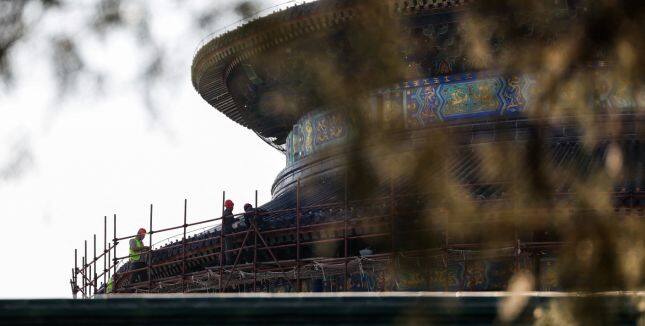
The Temple of Heaven is surrounded by the historic pine woods. The overall layout and arrangement of the entire structure, as well as the building within it, symbolise the relationship between earth and heaven (the human and God's worlds).
Its structure stands at the heart of Chinese beliefs, and is in Beijing’s Chongwen District. Encircled by ancient pine and cypress trees, it is today a popular tourist attraction and a public park where residents of Beijing gather to practice tai chi, play chess or dance.
What are its universal values?
The complex is built in a straight north-south line. Its structures are linked to an elevated ceremonial pathway. Inside the temple, there is a Hall of Prayer for Good Harvests, a large circular building with a three-tiered, conical roof. This is where emperors prayed for good harvests.
Emperors of the Ming and Qing dynasties performed religious rituals and offered sacrifices to heaven, praying for prosperous harvests.
On the west side of the complex is the Hall of Abstinence, where emperors fasted after performing sacrificial rituals. The whole structure is surrounded by a double-walled, pine-treed enclosure.
Within the temple complex, there are 92 ancient buildings and 600 rooms. The Temple of Heaven is the most complete existing imperial sacrificial building complex of China. It is also the world's largest surviving architectural complex for offering sacrifice to heaven.
How it was named the Temple of Heaven
Situated about 7 km (4.35 miles) south of the Forbidden City, the temple was constructed in 1420 during the reign of the same Ming emperor who oversaw the construction of the imperial palace, Reuters reported.
A decision was made to offer separate sacrifices to heaven and earth in the ninth year of Emperor Jiajing's reign (1530). Due to this, the Circular Mound Altar was constructed to the south of the main hall for sacrifices- this was particularly to heaven.
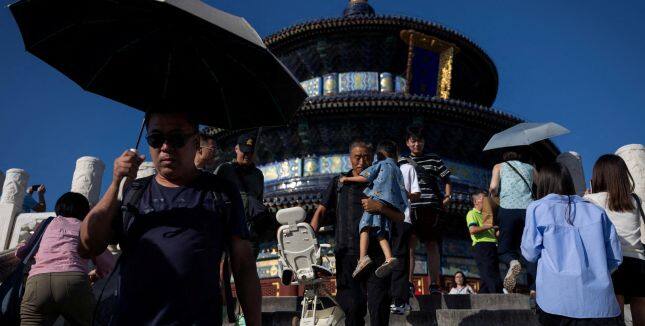
In 1534, during the 13th year of Emperor Jiajing’s reign, the Altar of Heaven and Earth was thereby renamed the Temple of Heaven. The present-day layout of the Temple of Heaven complex, covering 273 hectares, was established in 1749 following reconstruction efforts carried out by the Qing emperors Qianlong and Guangxu.
Every aspect of the Temple of Heaven — from where it was built and how it was designed to the rituals and music — followed ancient Chinese beliefs and traditions. Chinese emperors were considered the “Sons of Heaven” and were believed to embody divine authority on Earth, according to reports.
The Temple is safeguarded by the Law of the People’s Republic of China on the Protection of Cultural Relics. It was in 1961, when the Temple of Heaven was included by the State Council of the People’s Republic of China in the first group of State Priority Protected Sites.
Currently, the temple’s sacrificial structures — including the Hall of Prayer for Good Harvests, the Circular Mound Altar, the Fasting Palace, and the Divine Music Administration — are all integrally preserved.
This time, XI's hosting of the US President at the Temple of Heaven offers a stage that conveys the message of China's endurance and civilisational depth.
With inputs from agencies

Delhi Police asks personnel to wear uniform: What the law says on cops in plainclothes during protests
Military drones & police check-ups: How Sri Lanka is fighting against worst dengue outbreak in a decade
How Facebook job ad lured 2 Karnataka men into Myanmar cyber scam camp
Why is India seeing 95% cloud cover despite a Super El Niño?
What is CJP’s fourth demand to the government as protests in Delhi intensify?