


China on the brink of deflation: What does this mean?
Deflation occurs when prices of goods and assets go down – thus increasing the purchasing power of consumers. While laymen might consider this a good thing, experts say deflation can trigger a recession and create a ‘doom loop’

It is monitored via economic indicators like the consumer price index (CPI).Deflation can also be caused by the supply of money being reduced or credit availability being lowered, as per Economic Times.Deflation occurs when prices of goods and assets go down – thus increasing the purchasing power of consumers.Sounds like a good thing, right? Not so.According to Forbes, deflation occurring means a recession could be on the horizon.People, witnessing prices of goods decrease, delay spending.However, this lack of spending means less income for producers of products which in turn can cause unemployment to rise and interest rates to increase.This feeds on itself – creating what experts refer to as a ‘doom loop’.[caption id="attachment_12850782" align="alignnone" width="640"]
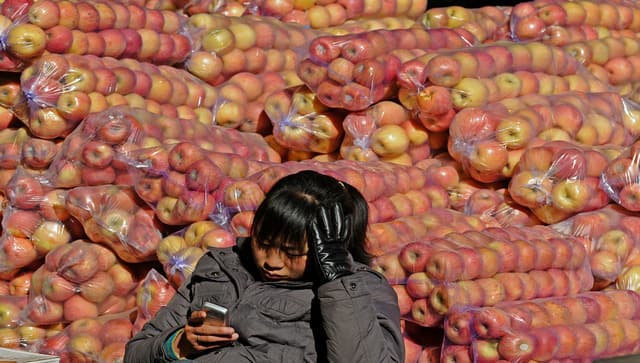
An apple seller looks at her mobile phone at a wholesale market in Changzhi. Reuters[/caption]According to Economic Times, central banks usually counter deflation by increasing the flow of money into the economy.Central banks also make borrowing easier, increase expenditures and cut taxes to fight deflation.What does it mean for Beijing?Momentum in China's post-pandemic recovery has slowed from a brisk pickup seen in the first quarter with demand for industrial and consumer products weakening, raising concerns about the health of the world's second-largest economy.“The data is weaker than expected. Further evidence that domestic demand is weak,” Larry Hu, chief China economist at Macquarie Group, told SCMP.
Experts say this bodes badly for China.As Pinpoint Asset Management chief economist Zhang Zhiwei, told The Straits Times, “The risk of deflation is very real.”"We think the more challenging deflation environment and sharp slowdown in growth momentum support our view that the PBOC has entered a rate-cutting cycle," said economists at Barclays in a research note.Nomura expects consumer prices to fall 0.5 per cent year-on-year in July, even taking into account a potential rise in service inflation as a result of the summer holiday season.The weaker-than-expected inflation readings knocked financial markets with the yuan falling and Asian stocks also dipping into the red."We expect headline inflation to rise to around 1 per cent by the end of this year. But this would still be soft and won't constrain the PBOC's ability to loosen policy further," said economists at Capital Economics."That said, with credit demand weak, and the currency under pressure, we think the bulk of support will come through fiscal policy. We expect only another 10 basis points of policy rate cuts this year."Beijing has set a target for average consumer inflation in 2023 of about three per cent. Prices rose two per cent year-on-year in 2022.“Today’s data certainly argues for more policy easing, which policymakers are already doing, but only in a measured manner,” Michelle Lam, Greater China economist at Societe Generale SA, told Bloomberg.ANZ senior China strategist Xing Zhaopeng told The Straits Times Beijing needs to shift focus from supply-side policies.“China is facing excess supply now,” Xing said.
He warned of an intensifying “deflation-recession loop”.China last month cut policy rates to boost liquidity and vowed to take measures to promote household consumption.But Duncan Wrigley, chief China economist at Pantheon Macroeconomics told The Telegraph a massive fiscal stimulus is unlikely.“So far the public information points towards a targeted, limited stimulus, which will largely be funnelled into support for industry, technology upgrades and private firms, rather than a significant consumer handout,” Wrigley added.For producer prices, the biggest year-on-year declines were seen in energy, metals and chemicals as domestic and foreign demand weakened."The accelerating decline in PPI reflects the still weak real estate and construction sector as well as the strength of industrial production," said Bruce Pang at chief economist at Jones Lang Lasalle."However, the year-on-year decline in the PPI is likely to have bottomed out and is expected to narrow gradually in the second half of the year," said Pang.China's central bank is likely to cut lending rates further, said Hu Yuexiao, analyst at Shanghai Securities, who expects reductions in the reserve requirements ratio and interest rates in the second half.However, economists say small cuts in rates will not have a big impact on demand for loans as families and businesses repair balance sheets damaged by COVID and repay debts, forcing Beijing to rely on fiscal stimulus and other means to spur demand.With inputs from agencies

Why India may not witness a medal rush at 2026 Commonwealth Games
Delhi Police asks personnel to wear uniform: What the law says on cops in plainclothes during protests
Military drones & police check-ups: How Sri Lanka is fighting against worst dengue outbreak in a decade
How Facebook job ad lured 2 Karnataka men into Myanmar cyber scam camp
Why is India seeing 95% cloud cover despite a Super El Niño?