
Advertisement


Sections
Rise of the People: As COVID protests spread, a brief history of rare acts of dissent in China
In one of the most widespread dissent in decades, people in China have launched an agitation against strict COVID curbs. Tiananmen Square in 1989, the Falun Gong protests in 1999, and Wukan in 2011 are some other instances when people hit the streets

Fed up and angered with the stringent zero-COVID policy, thousands of protesters hit the streets in China over the weekend.As per media reports, some have even called for Chinese president Xi Jinping to step down. The protests began on Friday (25 November) and soon spread to many cities including Shanghai, Beijing, Chengdu, Guangzhou and Wuhan. Dozens of university campuses in China also witnessed demonstrations.This widespread dissent against the ruling Chinese Communist Party (CCP) in decades was triggered after a deadly fire broke out and killed at least 10 people in an apartment building in the north-western city of Urumqi, reports Associated Press (AP). Lockdown rules were blamed for hindering rescue efforts, but Chinese authorities have denied these claims.How China has resisted the strict zero-COVID approach so far? When have the people held major protests in the country earlier? Let’s take a closer look.China protests against zero-COVID policyEven though the recent protests have made the most noise globally, this is not the first time China has revolted against Xi’s stringent COVID-19 policy which includes snap lockdowns, travel restrictions, mass testing and quarantines.According to China Dissent Monitor (CDM), a total of 668 cases of dissent were reported from June to September this year in the country, out of which 37 incidents were related to COVID measures.Citing the CDM report, Freedom House said that the other cases of dissent were related to stalled housing projects (215), pay and benefits (109), fraud (105), building quality (43), and school district disputes (37), among other reasons.Meanwhile, during the current protests, chants of “step down, Xi Jinping! step down, Communist Party!” were heard in the financial hub Shanghai, reported CNN.![china covid protests]() Blank white papers are being used by protesters to express dissent. AP[/caption]After the deadly fire, hundreds of protesters also gathered outside Urumqi's government offices calling for authorities to "lift lockdowns!", reported NDTV.According to CNN, some agitators also rallied behind cries of “Don’t want Covid test, want freedom!” and “Don’t want dictatorship, want democracy!”BBC reported that in Shanghai police officers on Sunday arrested several protesters and cordoned off streets. A BBC journalist, who was covering the protests there, was reportedly assaulted and detained, before being released after hours.As per NDTV report, censorship has begun in China with words such as "Liangma River", "Urumqi Road" – protest sites in Beijing and Shanghai – being removed from Weibo, a Twitter-like platform.Despite its stringent policy, China has recently seen a rise in coronavirus cases with 40,052 daily infections being reported on Monday, NDTV reported. Following the spurt in COVID-19 cases, many cities in China have resorted to stern measures to stem the transmission.ALSO READ: China's COVID Conundrum: Why the virus is showing no signs of slowing downSitong bridge protestIn October this year, a lone man in China had reportedly sparked protests around the world. Dubbed ‘Bridge Man’, the mystery protester strung two large banners on the Sitong bridge in the Haidian district of Beijing on 13 October.The banners featured slogans that called for the withdrawal of China’s zero-COVID policy and the ouster of President Xi, Reuters reported.“We want food, not PCR tests. We want freedom, not lockdowns. We want respect, not lies. We want reform, not a Cultural Revolution. We want a vote, not a leader. We want to be citizens, not slaves,” one of the banners said, as per The Guardian.The Beijing authorities quickly removed the signs of the rare protest that came a few days ahead of the 20th Communist Party congress.According to VoiceofCN, a group of anonymous Chinese nationals who run a pro-democracy Instagram account, in October, the slogans against the Chinese government had ‘clandestinely’ appeared in at least eight Chinese cities including Shenzhen, Beijing and Guangzhou, as well as Hong Kong, Bloomberg reported.Tiananmen Square protestsOne of the most significant pro-democracy protests in China took place in Beijing's Tiananmen Square in 1989.The student-led protests expanded in the spring of 1989 following the death of Hu Yaobang, a Communist Party leader who wanted to liberalise politics in the country.In late April, thousands of mourning students assembled at Tiananmen Square, one of Beijing's most famous landmarks, notes BBC.They called for more freedoms and an end to press censorship. Over the coming weeks, the number of protesters swelled at the site, leading to martial law being declared in Beijing in late May.Between 3 to 4 June, the People’s Liberation Army reached Tiananmen Square with orders to clear the site. Around 2,00,000 troops and over 100 tanks moved towards the protest site, opened fire, and arrested demonstrators to crush the dissent.On 5 June, a lone man – an image that remains one of the most powerful photos of a protest – stood in front of a line of tanks and was successful in halting the convoy for a while, reports National Geographic.
Blank white papers are being used by protesters to express dissent. AP[/caption]After the deadly fire, hundreds of protesters also gathered outside Urumqi's government offices calling for authorities to "lift lockdowns!", reported NDTV.According to CNN, some agitators also rallied behind cries of “Don’t want Covid test, want freedom!” and “Don’t want dictatorship, want democracy!”BBC reported that in Shanghai police officers on Sunday arrested several protesters and cordoned off streets. A BBC journalist, who was covering the protests there, was reportedly assaulted and detained, before being released after hours.As per NDTV report, censorship has begun in China with words such as "Liangma River", "Urumqi Road" – protest sites in Beijing and Shanghai – being removed from Weibo, a Twitter-like platform.Despite its stringent policy, China has recently seen a rise in coronavirus cases with 40,052 daily infections being reported on Monday, NDTV reported. Following the spurt in COVID-19 cases, many cities in China have resorted to stern measures to stem the transmission.ALSO READ: China's COVID Conundrum: Why the virus is showing no signs of slowing downSitong bridge protestIn October this year, a lone man in China had reportedly sparked protests around the world. Dubbed ‘Bridge Man’, the mystery protester strung two large banners on the Sitong bridge in the Haidian district of Beijing on 13 October.The banners featured slogans that called for the withdrawal of China’s zero-COVID policy and the ouster of President Xi, Reuters reported.“We want food, not PCR tests. We want freedom, not lockdowns. We want respect, not lies. We want reform, not a Cultural Revolution. We want a vote, not a leader. We want to be citizens, not slaves,” one of the banners said, as per The Guardian.The Beijing authorities quickly removed the signs of the rare protest that came a few days ahead of the 20th Communist Party congress.According to VoiceofCN, a group of anonymous Chinese nationals who run a pro-democracy Instagram account, in October, the slogans against the Chinese government had ‘clandestinely’ appeared in at least eight Chinese cities including Shenzhen, Beijing and Guangzhou, as well as Hong Kong, Bloomberg reported.Tiananmen Square protestsOne of the most significant pro-democracy protests in China took place in Beijing's Tiananmen Square in 1989.The student-led protests expanded in the spring of 1989 following the death of Hu Yaobang, a Communist Party leader who wanted to liberalise politics in the country.In late April, thousands of mourning students assembled at Tiananmen Square, one of Beijing's most famous landmarks, notes BBC.They called for more freedoms and an end to press censorship. Over the coming weeks, the number of protesters swelled at the site, leading to martial law being declared in Beijing in late May.Between 3 to 4 June, the People’s Liberation Army reached Tiananmen Square with orders to clear the site. Around 2,00,000 troops and over 100 tanks moved towards the protest site, opened fire, and arrested demonstrators to crush the dissent.On 5 June, a lone man – an image that remains one of the most powerful photos of a protest – stood in front of a line of tanks and was successful in halting the convoy for a while, reports National Geographic.![1989 Tiananmen Square protests]() A lone man had stood in front of tanks during 1989 Tiananmen Square protests. AP File Photo[/caption]According to the Chinese government, 200 civilians were killed in the protests. However, student leaders put the death toll at 3,400, reported National Geographic.A secret diplomatic cable released by the United Kingdom in 2017 claims that around 10,000 people had died, as per BBC. Falun Gong protestsFalun Gong, a spiritual exercise practice, has been banned in China since 1999.As per Australian Broadcasting Corporation (ABC), in April 1999, around 10,000 Falun Gong practitioners had held a silent protest outside the Communist Party headquarters in Beijing against ‘defamatory’ reports about the group in the state media.The government responded by saying that Falun Gong had "created disturbance and jeopardised social stability". Soon, the movement was banned and termed an "evil cult".In 2000, The New York Times reported that the Chinese government's actions against the Falun Gong, “have led to at least a dozen deaths, alleged death by torture, thousands of cases of abuse and the harassment of tens of thousands… ”Human-rights groups reported in 2009 that as many as 2,000 people had been killed in the crackdown on the Falun Gong members, Seattle Times reported.In 2014, Chinese lawyers told AP they were subjected to torture by the police for protesting along with relatives of Falun Gong members.Wukan protestsWukan, a village in China’s southern Guangdong province, had made headlines in late 2011 when the people demanded their land back which was secretly sold by members of the village committee, as per Al Jazeera. The villagers were successful in ousting the village committee and later democratic elections were held. Local Communist Party secretary Lin Zuluan, one of the leaders of the 2011 rebellion, was elected as the village chief in the elections.In 2016, Lin threatened to launch protests to press for compensation for the land the villagers said was stolen from them by corrupt officials, BBC reported.However, Lin was arrested and sentenced to 37 months in prison for "corruption" in September of that year.As per BBC, from primary school children to elderly fishermen, protesters stormed the street demanding "Free Lin Zuluan!" and "Return our land!"However, the agitation was crushed and the demonstrators were told -- to stop or face the consequences', BBC reported.Al Jazeera report said that over 100 people were arrested for joining the protest and the police also beat protesters including old women and children.With inputs from agenciesRead all the Latest News, Trending News, Cricket News, Bollywood News,India News and Entertainment News here. Follow us on Facebook, Twitter and Instagram.
A lone man had stood in front of tanks during 1989 Tiananmen Square protests. AP File Photo[/caption]According to the Chinese government, 200 civilians were killed in the protests. However, student leaders put the death toll at 3,400, reported National Geographic.A secret diplomatic cable released by the United Kingdom in 2017 claims that around 10,000 people had died, as per BBC. Falun Gong protestsFalun Gong, a spiritual exercise practice, has been banned in China since 1999.As per Australian Broadcasting Corporation (ABC), in April 1999, around 10,000 Falun Gong practitioners had held a silent protest outside the Communist Party headquarters in Beijing against ‘defamatory’ reports about the group in the state media.The government responded by saying that Falun Gong had "created disturbance and jeopardised social stability". Soon, the movement was banned and termed an "evil cult".In 2000, The New York Times reported that the Chinese government's actions against the Falun Gong, “have led to at least a dozen deaths, alleged death by torture, thousands of cases of abuse and the harassment of tens of thousands… ”Human-rights groups reported in 2009 that as many as 2,000 people had been killed in the crackdown on the Falun Gong members, Seattle Times reported.In 2014, Chinese lawyers told AP they were subjected to torture by the police for protesting along with relatives of Falun Gong members.Wukan protestsWukan, a village in China’s southern Guangdong province, had made headlines in late 2011 when the people demanded their land back which was secretly sold by members of the village committee, as per Al Jazeera. The villagers were successful in ousting the village committee and later democratic elections were held. Local Communist Party secretary Lin Zuluan, one of the leaders of the 2011 rebellion, was elected as the village chief in the elections.In 2016, Lin threatened to launch protests to press for compensation for the land the villagers said was stolen from them by corrupt officials, BBC reported.However, Lin was arrested and sentenced to 37 months in prison for "corruption" in September of that year.As per BBC, from primary school children to elderly fishermen, protesters stormed the street demanding "Free Lin Zuluan!" and "Return our land!"However, the agitation was crushed and the demonstrators were told -- to stop or face the consequences', BBC reported.Al Jazeera report said that over 100 people were arrested for joining the protest and the police also beat protesters including old women and children.With inputs from agenciesRead all the Latest News, Trending News, Cricket News, Bollywood News,India News and Entertainment News here. Follow us on Facebook, Twitter and Instagram.
Many demonstrators held blank pieces of white paper – a symbol of defiance against the ruling party’s censorship.“The lockdown policy is so strict,” Li, a protester told AP. “You cannot compare it to any other country. We have to find a way out.”[caption id="attachment_11710201" align="alignnone" width="640"]
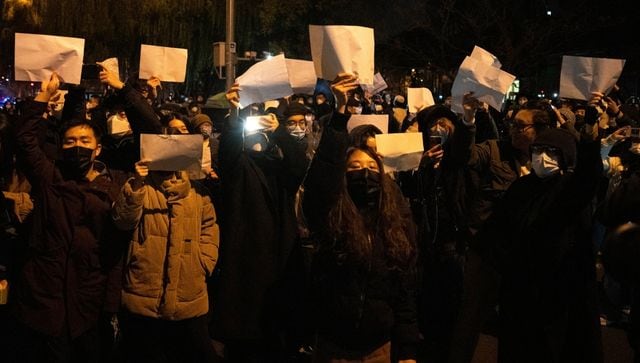 Blank white papers are being used by protesters to express dissent. AP[/caption]After the deadly fire, hundreds of protesters also gathered outside Urumqi's government offices calling for authorities to "lift lockdowns!", reported NDTV.According to CNN, some agitators also rallied behind cries of “Don’t want Covid test, want freedom!” and “Don’t want dictatorship, want democracy!”BBC reported that in Shanghai police officers on Sunday arrested several protesters and cordoned off streets. A BBC journalist, who was covering the protests there, was reportedly assaulted and detained, before being released after hours.As per NDTV report, censorship has begun in China with words such as "Liangma River", "Urumqi Road" – protest sites in Beijing and Shanghai – being removed from Weibo, a Twitter-like platform.Despite its stringent policy, China has recently seen a rise in coronavirus cases with 40,052 daily infections being reported on Monday, NDTV reported. Following the spurt in COVID-19 cases, many cities in China have resorted to stern measures to stem the transmission.ALSO READ: China's COVID Conundrum: Why the virus is showing no signs of slowing downSitong bridge protestIn October this year, a lone man in China had reportedly sparked protests around the world. Dubbed ‘Bridge Man’, the mystery protester strung two large banners on the Sitong bridge in the Haidian district of Beijing on 13 October.The banners featured slogans that called for the withdrawal of China’s zero-COVID policy and the ouster of President Xi, Reuters reported.“We want food, not PCR tests. We want freedom, not lockdowns. We want respect, not lies. We want reform, not a Cultural Revolution. We want a vote, not a leader. We want to be citizens, not slaves,” one of the banners said, as per The Guardian.The Beijing authorities quickly removed the signs of the rare protest that came a few days ahead of the 20th Communist Party congress.According to VoiceofCN, a group of anonymous Chinese nationals who run a pro-democracy Instagram account, in October, the slogans against the Chinese government had ‘clandestinely’ appeared in at least eight Chinese cities including Shenzhen, Beijing and Guangzhou, as well as Hong Kong, Bloomberg reported.Tiananmen Square protestsOne of the most significant pro-democracy protests in China took place in Beijing's Tiananmen Square in 1989.The student-led protests expanded in the spring of 1989 following the death of Hu Yaobang, a Communist Party leader who wanted to liberalise politics in the country.In late April, thousands of mourning students assembled at Tiananmen Square, one of Beijing's most famous landmarks, notes BBC.They called for more freedoms and an end to press censorship. Over the coming weeks, the number of protesters swelled at the site, leading to martial law being declared in Beijing in late May.Between 3 to 4 June, the People’s Liberation Army reached Tiananmen Square with orders to clear the site. Around 2,00,000 troops and over 100 tanks moved towards the protest site, opened fire, and arrested demonstrators to crush the dissent.On 5 June, a lone man – an image that remains one of the most powerful photos of a protest – stood in front of a line of tanks and was successful in halting the convoy for a while, reports National Geographic.
It remains unknown what happened to the unidentified protester who is famously known as 'Tank Man'.[caption id="attachment_11710221" align="alignnone" width="640"]
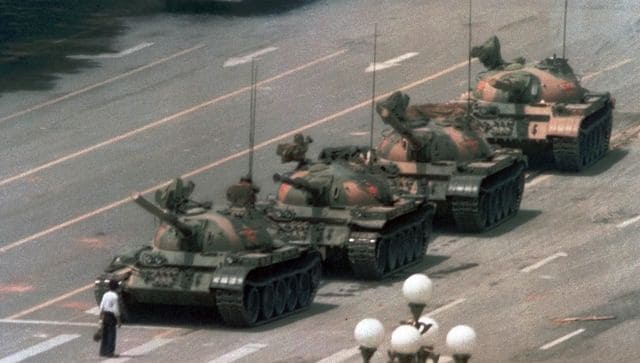 A lone man had stood in front of tanks during 1989 Tiananmen Square protests. AP File Photo[/caption]According to the Chinese government, 200 civilians were killed in the protests. However, student leaders put the death toll at 3,400, reported National Geographic.A secret diplomatic cable released by the United Kingdom in 2017 claims that around 10,000 people had died, as per BBC. Falun Gong protestsFalun Gong, a spiritual exercise practice, has been banned in China since 1999.As per Australian Broadcasting Corporation (ABC), in April 1999, around 10,000 Falun Gong practitioners had held a silent protest outside the Communist Party headquarters in Beijing against ‘defamatory’ reports about the group in the state media.The government responded by saying that Falun Gong had "created disturbance and jeopardised social stability". Soon, the movement was banned and termed an "evil cult".In 2000, The New York Times reported that the Chinese government's actions against the Falun Gong, “have led to at least a dozen deaths, alleged death by torture, thousands of cases of abuse and the harassment of tens of thousands… ”Human-rights groups reported in 2009 that as many as 2,000 people had been killed in the crackdown on the Falun Gong members, Seattle Times reported.In 2014, Chinese lawyers told AP they were subjected to torture by the police for protesting along with relatives of Falun Gong members.Wukan protestsWukan, a village in China’s southern Guangdong province, had made headlines in late 2011 when the people demanded their land back which was secretly sold by members of the village committee, as per Al Jazeera. The villagers were successful in ousting the village committee and later democratic elections were held. Local Communist Party secretary Lin Zuluan, one of the leaders of the 2011 rebellion, was elected as the village chief in the elections.In 2016, Lin threatened to launch protests to press for compensation for the land the villagers said was stolen from them by corrupt officials, BBC reported.However, Lin was arrested and sentenced to 37 months in prison for "corruption" in September of that year.As per BBC, from primary school children to elderly fishermen, protesters stormed the street demanding "Free Lin Zuluan!" and "Return our land!"However, the agitation was crushed and the demonstrators were told -- to stop or face the consequences', BBC reported.Al Jazeera report said that over 100 people were arrested for joining the protest and the police also beat protesters including old women and children.With inputs from agenciesRead all the Latest News, Trending News, Cricket News, Bollywood News,India News and Entertainment News here. Follow us on Facebook, Twitter and Instagram.
First Published:Nov 28, 2022, 14:33:40 IST
Advertisement
Advertisement

Why has Bangladesh’s choice of India spokespersons raised eyebrows?
Bangladesh’s appointment of journalists Md Saidur Rahman and Umme Marufa to media roles in New Delhi and Kolkata has triggered controversy over their past anti-India social media posts, many of which were later deleted, prompting diplomatic scrutiny as India and Bangladesh seek to improve bilateral ties
6 min read
Who is Sandeep Lamba, the Delhi cop removed from protest site duty after slapping female protester?
Sandeep Lamba, an Additional Deputy Commissioner of Police (DCP) (North East District), was seen slapping a female CJP protester in a video on July 20. Lamba has now been removed from the protest site and sent back to his original station. In 2021, Lamba was awarded the Union Home Minister’s medal for excellent investigation
4 min read
Explorers discover wreckage of plane 72 years later. Will this help in finding MH370?
On April 11, 1952, a Pan Am Flight 526A, crashed into the Atlantic Ocean, killing 52 of the 69 people on board. After decades of effort, explorers have found the wreck of the plane at the bottom of the seabed near Puerto Rico. The discovery offers new hope to families who lost loved ones in the Malaysia Airlines Flight 370 crash in 2014
5 min read
Cruise missiles, drones and more... The deadly arsenal of the Houthis
The Houthis have evolved into one of the world's most formidable non-state military forces, deploying anti-ship ballistic missiles, cruise missiles, drones and explosive boats to threaten Red Sea shipping. Their latest attacks on Saudi oil tankers have raised concerns over shipping through the Bab el-Mandeb Strait amid the Strait of Hormuz crisis
10 min read
Why India may not witness a medal rush at 2026 Commonwealth Games
A 125-strong Indian contingent is in Glasgow for the 2026 Commonwealth Games, starting today (July 23), chasing international glory. However, with a roster of sports such as badminton and wrestling being cut from the event, the country’s medal chances have been drastically reduced
4 min read
Advertisement
Advertisement