


Chandrayaan 3’s Vikas engine is ‘Made-in-Mumbai’: Here’s all you need to know
Godrej Aerospace, a firm hidden away in a green area in Mumbai's Vikhroli, has produced the Vikas engine, which is named after the late physicist Vikram Sarabhai. Installed at the top-most part of the missile, the family of liquid-fuelled rocket engines is conceptualised and designed by ISRO

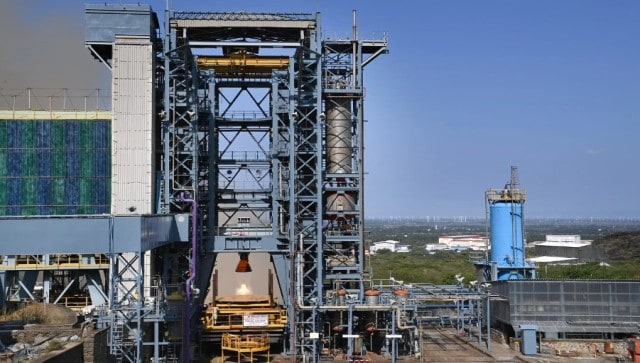
The three goals of the Chandrayaan-3 mission, according to ISRO, are to show a soft and safe lunar landing, lunar rover wandering, and to carry out in-situ scientific research. Image Courtesy: isro.gov.in[/caption]At this plant, even the cryogenic engine that will aid in placing the lunar module in an orbit around the Earth has been prepared. Thiruvananthapuram is where the satellite is put together.News18 quoted Maneck Behramkamdin, AVP and Business head at Godrej Aerospace as saying, “We have come a long way since this plant and the partnership started in 1985. A few decades ago, for a CE-20, rather referred to as a cryogenic engine, we had to depend on other countries. But now India has made tremendous progress in space technology and space missions, and these engines are produced within the country as a part of Aatmanirbhar Bharat."“In the last nine years, India has witnessed a quantum jump in its space sector, bringing it at par with countries like the USA that started their space journey much earlier. The government’s focus on public-private participation has led to collaborations between premier space organisations like NASA and ISRO, with ISRO now working with nearly 150 private startups,” said Anil Verma, Executive Director and Chief Executive Officer of Godrej and Boyce.Vikas engine is a family of liquid-fueled rocket engines conceptualised and designed at the Liquid Propulsion Systems Centre of ISRO in the 1970s. Initially, France-sourced parts were used in these engines; however, later, domestic alternatives took their place, according to Financial Express.
The second stage of the Polar Satellite Launch Vehicle (PSLV), boosters, the second stage of the Geosynchronous Satellite Launch Vehicle (GSLV) Mark I and II, as well as the first stage of the GSLV Mark III or Launch Vehicle Mark 3 (LVM3), are all propelled by Vikas propulsion motors.Also read: India’s 'Bahubali' rocket: What is LVM3 that will launch Chandrayaan-3 spacecraft?The role of GodrejSince 1985, the facility has been one of ISRO's major private suppliers and producers. In addition to taking part in ISRO's other projects, Godrej Aerospace made significant contributions to the Chandrayaan-1 and 2 and Mangalyaan space missions, as per News18.It provided the Vikas engine, thrustors, vital components for the remote sensing antenna, and ground system antenna for Chandrayaan-1. It provided Chandrayaan-2 with the L110 and CE20 engines for the GSLV Mk III launcher, as well as thrusters for the orbiter and lander and parts for the DSN antenna, according to The Hindu.According to information provided by Behramkamdin to The Hindu, Godrej Aerospace has contributed to more than 175 engines for Polar Satellite Launch Vehicle (PSLV) and Geosynchronous Satellite Launch Vehicle (GSLV) launches to date. These engines include satellite thrusters, antenna systems, and liquid propulsion engines for PSLV and GSLV rockets.Moreover, Godrej Aerospace has also sharpened its emphasis on domestic production, innovation, and technological development. It is set to invest Rs 250 crore in the construction of a new facility for advanced manufacturing, assembly, and integration facilities at Khalapur in Maharashtra.Also read: How is ISRO’s Chandrayaan-3 mission different from Chandrayaan-2?Chandrayaan-3 is specialThe third planned moon exploration mission of ISRO is the Chandrayaan-3 spacecraft.The three goals of the Chandrayaan-3 mission, according to ISRO, are to show a soft and safe lunar landing, lunar rover wandering, and to carry out in-situ scientific research. This mission was necessary, especially after the unfortunate landing of the Vikram lander during Chandrayaan-2.According to News18, India intends to carry out the proposed lunar polar exploration mission with the assistance of Japan in 2024, and this new mission is intended to demonstrate the critical landing procedures required for that mission.The LVM3 (Launch Vehicle Mark 3) will launch Chandrayaan-3 from the Satish Dhawan Space Centre (SDSC) SHAR in Sriharikota. It is set up with a Lander and a Rover. The propulsion module will transport the Lander and Rover configuration to a lunar orbit of around 100 miles, according to a report by India.com.The propulsion module is topped by the Spectro-polarimetry of the Habitable Planet Earth (SHAPE) payload, which will conduct spectral and polarimetric studies of Earth from the lunar orbit. This payload will provide crucial data and insights into the characteristics and habitability of the Earth from a unique vantage point on the Moon.Also read: When & where to watch ISRO’s Chandrayaan-3 launch LIVEWith inputs from agencies
Why India may not witness a medal rush at 2026 Commonwealth Games
Delhi Police asks personnel to wear uniform: What the law says on cops in plainclothes during protests
Military drones & police check-ups: How Sri Lanka is fighting against worst dengue outbreak in a decade
How Facebook job ad lured 2 Karnataka men into Myanmar cyber scam camp
Why is India seeing 95% cloud cover despite a Super El Niño?