


Chandrayaan-3: What will the lander and rover do after landing on Moon?
India’s third Moon mission is all set to attempt a soft landing on the lunar surface at 6:04 pm today. Once India achieves the feat, what will Chandrayaan-3’s lander and rover do on the Moon’s south pole? Let’s find out

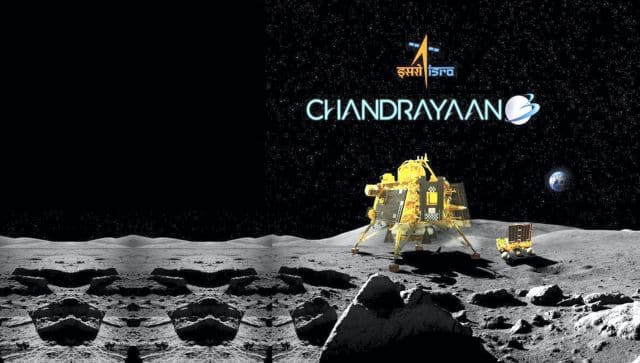
An illustration showing a soft landing of Chandrayaan-3 on the lunar surface. PTI File Photo[/caption]ISRO chairman S Somanath told TOI that the “actual distance travelled by the rover during the 14 Earth days can’t be estimated now. Because that will be done based on various things (calculations)”.Scientists at ISRO will be busy analysing the data sent by the instruments and experiments, called payloads, aboard the lander module. Both the lander and rover are carrying a total of six payloads to conduct their own lunar exploration.According to ISRO, the objectives of India’s third Moon mission are to mark a safe and soft-landing, to demonstrate the rover moving on the lunar surface and to conduct in-situ scientific experiments.India's landing has come on the heels of Russia's Luna-25 mission which failed and crashed on the Moon a few days back.ALSO READ: Chandrayaan-3: Why is soft-landing on the Moon so challenging?What will the payloads do?Vikram has four scientific payloads meant to study Moonquakes, changes in the plasma near the surface, and assess the thermal properties of the lunar surface.The payload Radio Anatomy of Moon Bound Hypersensitive ionosphere and Atmosphere (RAMBHA), which will examine the near-surface plasma activities, will help in developing a better understanding of plasma formation and its changes over time, as per the India Today report.Chandra’s Surface Thermo-physical Experiment (ChaSTE) will examine the thermal properties and determine the vertical temperature gradient near the lunar south pole, noted Indian Express.“At its tip, the ChasTE probe has a heater, which will be turned on after a few days to measure thermal conductivity,” Physical Research Laboratory (PRL) director Anil Bhardwaj told the English daily.The payload Instrument for Lunar Seismic Activity (ILSA)’s job is to study lunar quakes.LASER Retroreflector Array (LRA) is designed to measure the distance between Earth and the Moon.The rover has two payloads – Alpha Particle X-ray Spectrometer (APXS) and LASER Induced Breakdown Spectroscope (LIBS). These scientific instruments will ascertain the composition of elements in the lunar soil and rocks and study the chemical and mineral composition of the Moon.Why is the Moon mission significant?Moon’s south pole remains a mystery. A successful landing will be a momentous achievement for India, which will pave the way for the country's emergence as a space power."Landing on the south pole (of the Moon) would actually allow India to explore if there is water ice on the Moon. And this is very important for cumulative data and science on the geology of the Moon," Carla Filotico, a partner and managing director at consultancy SpaceTec Partners, told Reuters.This water ice could supply fuel, oxygen and drinking water for space missions in the future.The feat will also boost the Central government’s plan to encourage investment in private space launches and other satellite-based ventures, as per Reuters.With inputs from agencies

Delhi Police asks personnel to wear uniform: What the law says on cops in plainclothes during protests
Military drones & police check-ups: How Sri Lanka is fighting against worst dengue outbreak in a decade
How Facebook job ad lured 2 Karnataka men into Myanmar cyber scam camp
Why is India seeing 95% cloud cover despite a Super El Niño?
What is CJP’s fourth demand to the government as protests in Delhi intensify?