


Chandrayaan-3 lands on Moon: A much-needed guide to space lingo
‘India is on the Moon,’ declared ISRO chief S Somanath as Chandrayaan-3’s lander soft landed on the south pole of the lunar surface. But what is a soft landing and what is a lander? As India scripts history with its third lunar journey, let’s relearn what these terms stand for

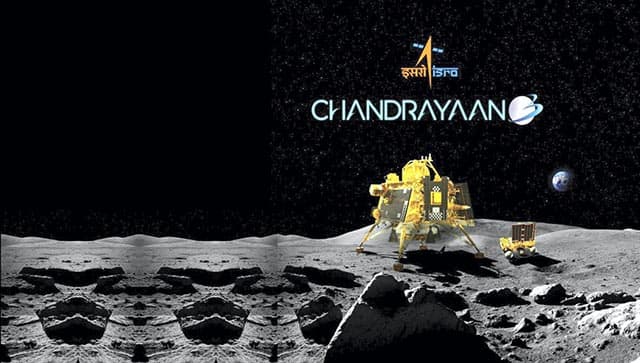
An illustration showing the soft landing of ISRO's 'Chandrayaan-3' on the lunar surface. PTI File Photo[/caption]Propulsion moduleThe main job of Chandrayaan-3’s propulsion module was to carry the lander and rover from the Earth into the Moon’s orbit. However, this does not mean it is not serving any purpose after the lander module separated from it on 17 August. The propulsion module, which has more than 150kg of fuel left, will continue its path on the lunar orbit for possibly years. Its payload, Spectro-polarimetry of HAbitable Planet Earth (SHAPE), will study spectral and polarimetric measurements of Earth from the lunar orbit.LanderA lander is a strong vehicle designed to land on a celestial body, such as a planet or Moon. Chandrayaan-3’s lander is named Vikram and has four payloads or scientific instruments for lunar exploration. It does not have wheels but legs – or stilts – that vertically touch down on the lunar surface to mark a successful and safe landing.The Vikram lander touched down on the lunar surface at around 6:04 pm.RoverA rover is a small robotic vehicle designed for exploring the surface of a planet or Moon. Chandrayaan-3’s rover is called Pragyan, which is Sanskrit for "wisdom". After the lander’s touchdown on the Moon’s south pole, the six-wheeled rover – which was in Vikram’s belly – will slide out and move on the lunar surface to carry out scientific experiments.
PayloadsAccording to ISRO, a payload is a scientific or technological instrument aboard a satellite to perform specific functions after landing on the celestial body. It refers to those instruments that are “dedicated to producing mission data and then relaying that data back to Earth”, as per the European Space Agency (ESA).Chandrayaan-3’s lander and rover, which have a life of one lunar day or 14 Earth days, have a total of six payloads to carry out experiments on the Moon’s south pole. The propulsion module has one payload which will examine the Earth’s atmosphere from its current lunar orbit.ALSO READ: Why Chandrayaan 3's success matters to the United StatesLunar dustLunar dust, a component of regolith, is present on the surface of the Moon. Regolith is loose, unconsolidated rock and dust present on the Earth, Moon, and other celestial bodies. Lunar dust makes the landing of spacecraft more difficult. As per NASA, “The presence of dust, even in very small quantities, can have a significant effect on temperature control and optical performance of hardware on the lunar surface.” This dust can cling to surfaces and easily enter the human body through the respiratory system due to its small particles.Throttleable engineChandrayaan-3’s lander has only four throttleable engines for powered descent. Once this phase began, the Vikram lander used its thrusters to initiate a touchdown on the lunar surface. “The lander’s four engines are used to reduce the velocity and there are also eight small engines to control the direction of the descent. The engines are throttleable and the thrust can be varied from 800 Newton to a lower value. It can keep the lander hovering on the Moon’s gravity,” ISRO chairman Somanath was quoted as saying by Indian Express.With inputs from agencies
Delhi Police asks personnel to wear uniform: What the law says on cops in plainclothes during protests
Military drones & police check-ups: How Sri Lanka is fighting against worst dengue outbreak in a decade
How Facebook job ad lured 2 Karnataka men into Myanmar cyber scam camp
Why is India seeing 95% cloud cover despite a Super El Niño?
What is CJP’s fourth demand to the government as protests in Delhi intensify?