
Advertisement


Sections
British actor Jameela Jamil has Ehlers-Danlos Syndrome: What is this rare genetic condition?
Ehlers-Danlos syndrome is a group of 13 inherited connective tissue disorders. People with this disorder usually experience overly flexible or unstable joints, extremely stretchy, soft and fragile skin

British actor Jameela Jamil has opened up about suffering from Ehlers-Danlos syndrome (EDS), a rare group of conditions affecting connective tissues.In a TikTok video, The Good Place actor stretched her cheeks to show their elasticity and bent her arms in an awkward direction indicate how the condition affects her."Jesus Christ, that is not an app, that is not a filter, that is just my face. Look how elastic that is," the She-Hulk: Attorney at Law actor said.“The reason it is so elastic is because I have something called EDS, that is Ehlers-Danlos syndrome. I have EDS3, hEDS3, and it’s the ‘H’ because I’m so hypermobile,” she added.Jamil said she was diagnosed with EDS when she was nine which helped her to avoid a lot of the things that would’ve made her much sicker when she got older.She also stressed that “it’s a really serious condition and it impacts every single part of your body and it even affects your mind”.“It’s very dangerous to not know you have it if you have it because of the way that it impacts bruising, bleeding, healing, if you want to have a baby,” the 36-year-old actor added.What is Ehlers-Danlos syndrome (EDS)? What are its symptoms, causes and treatment? Let’s understand.What is EDS?Ehlers-Danlos syndrome is a group of 13 heritable connective tissue disorders, says research and advocacy organization The Ehlers-Danlos Society.“Connective tissue is a complex mixture of proteins and other substances that provide strength and elasticity to the underlying structures in your body,” explains Mayo Clinic.EDS, which is named after two doctors, Dr Edvard Lauritz Ehlers and Dr Henri-Alexandre Danlos, is a genetic disorder i.e. it can be passed down among family members.![eds]()
Each type of EDS has its own feature and genetic causes.SymptomsMany people with EDS usually suffer from frequent joint pain, dislocations and fragile skin that does not heal properly.The most common EDS is hypermobility, or hypermobile EDS (hEDS), while other types are classical EDS, vascular EDS and kyphoscoliotic EDS.People suffering from hEDS experience overly flexible and unstable joints, extremely stretchy and soft skin, and excessive bruising, as per Mayo Clinic.[caption id="attachment_11898561" align="alignnone" width="640"]
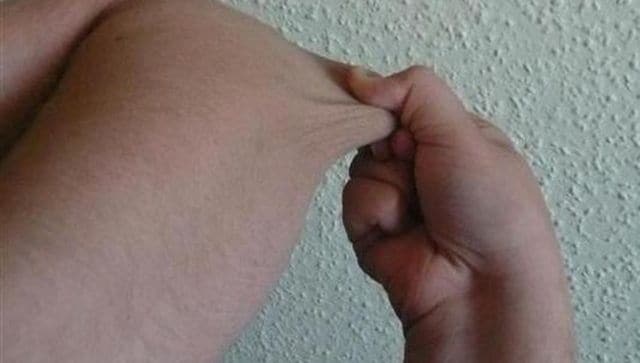
People with EDS have very elastic skin. Wikimedia Commons (Representational Image)[/caption]About 90 per cent of EDS cases are that of hEDS which affects at least one in 3,100–5,000 people, notes the Ehlers-Danlos Society.
It further says that hEDS is classified as a rare disorder but its actual prevalence remains unknown.While Classical EDS (cEDS) affects one in 20,000-40,000 people, vEDS impacts the lives of one in 1,00,000-2,00,000 people.All other types of EDS that are considered “ultra-rare” affect less than one in one million people.The severity of the symptoms of EDS also varies, with milder cases being able to lead relatively normal lives, while others might even be unable to digest food and have to be fed using tubes, as per CNN.Vascular Ehlers-Danlos syndrome (vEDS), a more severe and rarer form of EDS, can cause the walls of blood vessels, intestines or uterus to burst. It can also trigger potential complications during pregnancy.Those with EDS are also likely to be prone to sleep disorders, mast cell diseases, and POTS (postural orthostatic tachycardia syndrome).ALSO READ: Celine Dion has stiff person syndrome: What is the rare neurological disorder?Causes of EDSEach type of EDS is associated with different genetic causes.“A defect in collagen (proteins that add flexibility and strength to connective tissue) causes Ehlers-Danlos syndrome,” says the Cleveland Clinic website.The genetic cause(s) of hEDS remains unidentified, notes the Ehlers-Danlos Society.There is a 50 per cent possibility that people who have hypermobile EDS will transfer the gene to their offspring, as per Mayo Clinic.TreatmentThe treatment for EDS varies on the type of EDS one is diagnosed with.To protect the skin, doctors may recommend sunscreen and mild soaps, and physical therapy to strengthen muscles supporting joints.For blood vessels, experts can prescribe medication to keep blood pressure low and stable.Contact sports and heavy weight lifting can also be prohibited for those suffering from EDS.Misdiagnosed genetic disorderExperts say EDS is often misdiagnosed and misunderstood.Professor Rodney Grahame, a leading EDS expert, observed in 2014 at a conference that “no other disease in the history of modern medicine has been neglected in such a way as Ehlers-Danlos syndrome”, reported CNN.Studies have found that more women are affected by EDS than men.The European Organisation for Rare Diseases in a 2009 study said that women with EDS tend to be “diagnosed later because their pain and hypotonia (poor muscle tone) aren’t considered as physical symptoms but rather as psychological symptoms or common complaints.”Linda Bluestein, a US physician who specializes in EDS, told CNN that women get “dismissed easily”. “People jump to the conclusion that we’re histrionic females.”Meanwhile, EDS takes a long time to be diagnosed.The average time to diagnosis of the genetic disorder from when the symptoms begin is 10 to 12 years, according to The Ehlers-Danlos Society.With inputs from agenciesRead all the Latest News, Trending News, Cricket News, Bollywood News,India News and Entertainment News here. Follow us on Facebook, Twitter and Instagram.
First Published:Dec 29, 2022, 20:19:07 IST
Advertisement
Advertisement

Military drones & police check-ups: How Sri Lanka is fighting against worst dengue outbreak in a decade
Sri Lanka is fighting its most severe dengue outbreak in nearly a decade, with infections rising sharply across the nation. Military drones have been deployed to tackle the outbreak, which has claimed 56 lives. Health officials said the outbreak is being driven primarily by the DENV-2 variant of the virus
3 min read
How Facebook job ad lured 2 Karnataka men into Myanmar cyber scam camp
The Karnataka Cyber Command has rescued two youths from a scam compound in Myanmar operated by Chinese fraudsters. The duo from Karnataka were lured on the pretext of data-entry jobs. They were asked to work for 16 hours a day and were expected to sleep for six hours daily
4 min read
Why is India seeing 95% cloud cover despite a Super El Niño?
India is witnessing nearly 95 per cent cloud cover despite a Super El Niño, a climate event usually linked to weaker monsoons. Regional weather systems, cyclonic circulations, the monsoon trough and moisture from two seas are temporarily overpowering one of the world's strongest climate phenomena
5 min read
What is CJP’s fourth demand to the government as protests in Delhi intensify?
The protest by the Cockroach Janta Party at Delhi’s Jantar Mantar refuses to die down. The group have made a fourth demand to the Centre, asking that no FIRs are filed against the agitators and that no legal action be taken. The government has expressed willingness to speak to the protesters, but refused to accede on the resignation of Education Minister Dharmandra Pradhan
5 min read
The new geography of war: Why the Houthis can no longer be ignored
The rise of the Houthis marks the emergence of a new geography of war — one in which influence flows not only from capitals and conventional armies, but also from rugged mountains overlooking vital sea lanes
6 min read
Advertisement
Advertisement