
Advertisement


Sections
Bird flu kills girl in Cambodia, others fall sick: Is this the beginning of a new pandemic?
First, bird flu killed more than 110 poultry birds. Then it spread to other mammals. Now, an 11-year-old girl in Cambodia has died of it and another 12 people in her area are suspected to be sick with avian influenza. Concerns are rising that a mutation could lead to human-to-human transmission

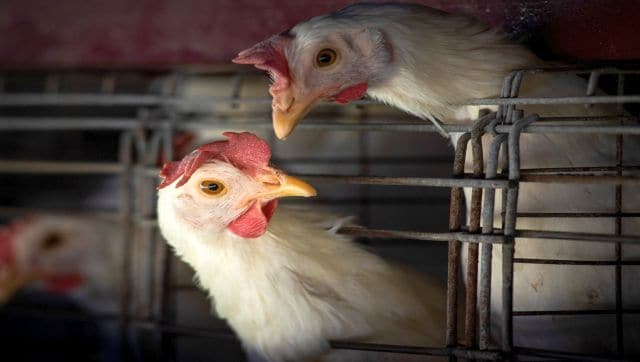 Bird flu is a viral respiratory disease mainly of poultry and certain other birds. It is considered one of the largest known threats to domestic birds. Reuters[/caption]The virus in birds spreads rapidly owing to which farmers usually have to cull uninfected birds along with infected ones to prevent a wider outbreak. It is considered one of the largest known threats to domestic birds.How widespread is the recent bird flu outbreak?Currently, bird flu has wreaked havoc across the world infecting birds as well as other animals too. In the United States alone, it has affected nearly 60 million birds — including wildlife, commercial poultry and backyard flocks — since January 2022, according to the Centers for Disease Control and Prevention (CDC). It’s because of this outbreak that egg prices have soared in the US, causing many people to give up their daily dose of protein.Also, bird flu is responsible for the death of 50 million birds across 36 European countries between October 2021 and September 2022.It has also spread to other mammals across the map of the world. In Alaska, cases have been reported among bears and foxes. The virus has also been found in a bobcat in California, a skunk in Colorado, a raccoon in Washington, possums in Illinois and Iowa, a mountain lion and grizzly bear in Nebraska, seals in Maine and even a bottlenose dolphin in Florida.[caption id="attachment_12201982" align="alignnone" width="640"]
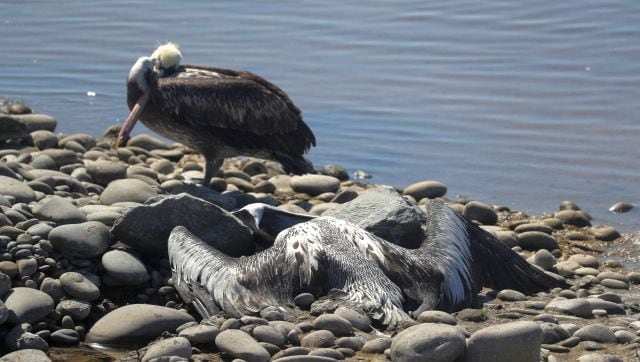 A sick pelican sits next to a dead one, on the shores of the river Camana after Peruvian authorities recorded first cases of bird flu in November 2022, in Camana, Peru. File image/Reuters[/caption]Besides this, an outbreak of avian flu was also reported on a mink farm in Spain, earlier in January. Officials in Peru said three sea lions found dead in November tested positive for the virusAlso read: Why the spread of Bird flu in animals is worryingThe UK Health Security Agency said that a fox had recently tested positive for H5N1. It joined eight foxes and otters which tested positive in the UK last year.The infection in mammals also prompted the WHO to react, with Director General Tedros Adhanom Ghebreyesus saying in an 8 February news conference that the situation needed to be “monitored closely” owing to their physiological similarities with humans.Are humans safe from bird flu?Bird flu has affected humans who have come in contact with the infected birds. According to experts, bird flu is almost always transmitted by direct contact with sick birds. Only rarely have human cases occurred over the quarter century it’s been known to exist, with no sustained transmission reported among humans.Globally, nearly 870 human infections and 457 deaths have been reported to the WHO in 20 countries. But the pace has slowed and there have been about 170 infections and 50 deaths in the last seven years.However, rare in humans the fatality rate is high if it does happen. In a virtual press conference earlier this month, Dr Sylvie Briand, director of the pandemic and epidemic diseases department at the WHO said that when humans are infected, they are more likely to have severe disease. “It’s between a 30-50 per cent case fatality ratio, but again, those viruses are not very transmissible,” Dr Briand said.
Until now, public health officials weren’t particularly worried about the risk of human-to-human transmission. However, the Cambodia incident now does raise apprehensions. As Rajiv Chowdhury, senior epidemiologist and professor of global health at Florida International University, told Fortune, “The Cambodia case does raise the concern that we are transitioning from what has been a bird-to-human status quo to more of a human-to-human transmission scenario.”[caption id="attachment_12202012" align="alignnone" width="640"]
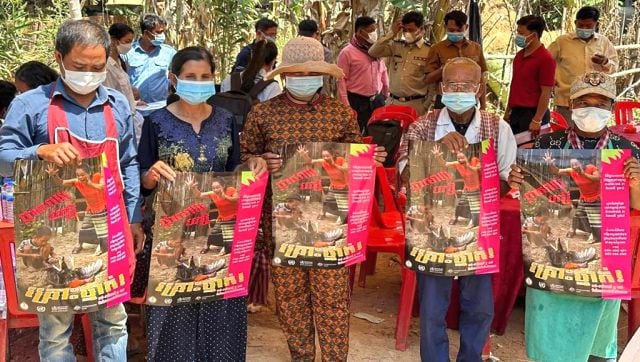 Villagers pose with posters about H5N1 virus threats, in Prey Veng province in Cambodia after an eleven-year-old girl died from bird flu, the country's first fatality from the virus in years. AFP[/caption]Dr Eric Feigl-Ding, an epidemiologist and Chief of COVID Task Force at the New England Complex Systems Institute, tweeted: “Hope this wasn’t human to human, but I’m now getting to be worried.”This worry was also echoed by WHO chief Dr Ghebreyesus, who has advised people not to touch dead or sick wild animals and for countries to strengthen their surveillance of settings where people and animals interact.Also read: 'Around 28% chances that world will see a pandemic in the next 10 years': What experts have to say on future outbreaksThere’s a worry that bird flu could mutate and evolve. If it’s not a threat to humans today, it could become one. That’s because influenza viruses are incredibly changeable. Like other viruses, H5N1 — which is currently taking the biggest toll on the bird population — picks up small mutations as it replicates within a host; over time, that can give the virus certain benefits (though mutations are often bad for the virus).American website Vox also explains that influenza viruses can also undergo much bigger and more consequential shifts through a process called reassortment. Explaining this phenomenon, Vox says it’s when two influenza viruses infect the same cell in the same host, they can trade entire chunks of their genomes with each other, yielding a variety of Franken-flus.Experts note that if the avian influenza does mutate allowing for human-to-human transmission, it could spell trouble for the world. As Chowdhury said in the Fortune report, “The potential impact could be significant… it could be the start of a “new global influenza pandemic.”The world needs to get it guard up against bird flu. Today, it is already a nutritional, economical and ecological crisis. We need to ensure that it doesn’t turn into a public health one soon.With inputs from agenciesRead all the Latest News, Trending News, Cricket News, Bollywood News,India News and Entertainment News here. Follow us on Facebook, Twitter and Instagram.
First Published:Feb 24, 2023, 14:38:04 IST
Advertisement
Advertisement

Military drones & police check-ups: How Sri Lanka is fighting against worst dengue outbreak in a decade
Sri Lanka is fighting its most severe dengue outbreak in nearly a decade, with infections rising sharply across the nation. Military drones have been deployed to tackle the outbreak, which has claimed 56 lives. Health officials said the outbreak is being driven primarily by the DENV-2 variant of the virus
3 min read
How Facebook job ad lured 2 Karnataka men into Myanmar cyber scam camp
The Karnataka Cyber Command has rescued two youths from a scam compound in Myanmar operated by Chinese fraudsters. The duo from Karnataka were lured on the pretext of data-entry jobs. They were asked to work for 16 hours a day and were expected to sleep for six hours daily
4 min read
Why is India seeing 95% cloud cover despite a Super El Niño?
India is witnessing nearly 95 per cent cloud cover despite a Super El Niño, a climate event usually linked to weaker monsoons. Regional weather systems, cyclonic circulations, the monsoon trough and moisture from two seas are temporarily overpowering one of the world's strongest climate phenomena
5 min read
What is CJP’s fourth demand to the government as protests in Delhi intensify?
The protest by the Cockroach Janta Party at Delhi’s Jantar Mantar refuses to die down. The group have made a fourth demand to the Centre, asking that no FIRs are filed against the agitators and that no legal action be taken. The government has expressed willingness to speak to the protesters, but refused to accede on the resignation of Education Minister Dharmandra Pradhan
5 min read
The new geography of war: Why the Houthis can no longer be ignored
The rise of the Houthis marks the emergence of a new geography of war — one in which influence flows not only from capitals and conventional armies, but also from rugged mountains overlooking vital sea lanes
6 min read
Advertisement
Advertisement