


Beware of 2024: The five big issues that could cause chaos this year
The global power tensions between the US and China, the Russia-Ukraine conflict, the Israel-Hamas war, and extreme job market fluctuations are likely to continue in 2024. Here are the big geopolitical and economic trends to watch out for in the year

The tensions between the US and China made the global economy shudder in 2023. The ramifications of the Ukrainian war echoed beyond the country’s border. In Africa, the coup d’état in Niger and Gabon contributed to the global democratic retreat of recent years and the Hamas-Israel conflict has so far resulted in thousands of deaths.Such trends of global power tensions, open war, democratic decline, and extreme job market fluctuations are likely to continue in 2024. With this in mind, here are five global geopolitical and economic trends to watch out for.Shift in controlAs the BRICS (Brazil, Russia, India, China, South Africa) organisation expands to include Egypt, Ethiopia, Iran, Saudi Arabia, and the UAE, its growing economic influence could dramatically change the global balance of power.From January 2024, BRICS will represent about 46.5 per cent of the world’s population, US$30.8 trillion (£23.7 trillion), about a third of global GDP, and 45 percent of global oil production. A related economic consequence is that the BRICS’ expanded trade network can reduce their dependence on Western markets, particularly through preferential trade agreements and possibly the use of a common currency.For countries that have been sanctioned by the west, such as Iran, becoming a BRICS member increases their diplomatic options. This may make BRICS attractive to other sanctioned countries. The BRICS’ expansion can also enable members to strengthen their impact by pursuing their political and economic interests more easily. Challenging the west may not take the form of direct confrontation, but occur by gradually moving away from current institutions such as the IMF.[caption id="attachment_13580932" align="alignnone" width="640"] A consumer walks at a shopping mall in Shenzhen, south China's Guangdong province. Reuters[/caption]General elections in various countriesThe list of general elections in 2024 includes countries from all continents and the participation of billions of people. At the core is the US election, where former President Donald Trump is likely to be the Republican candidate. If re-elected, he may continue with his policy of “global engagement abstention,” as evidenced by his past willingness to disengage from Nato.Such a stance may weaken the global economic and political system and contribute to the rise of other countries searching for greater global clout. Another important aspect emerging from the cornucopia of general elections is the potential erosion of democracy. In the US, for instance, there is talk of a possible Trump dictatorship. In Russia, a win by President Vladimir Putin can see him remaining president until 2030, with the possibility of a further sixth term up to 2036 (or about 32 years in power).In other countries, such as El Salvador, some politicians are willing to circumvent their constitutions to be re-elected or to ban efforts to monitor elections, as is happening in Tunisia. Such practices are likely to weaken democratic institutions or constrain their development.An increase in West Asian tensionsThe Israel-Hamas war will continue to have repercussions beyond West Asia. The risk of further escalation of the conflict regionally has intensified after an air strike in Beirut. Some nearby states, for example, have strongly condemned Israel’s overall response to Hamas’ attack. Jordan called that response a “war crime” and Egypt a “collective punishment.” The war is likely to compound regional uncertainty and instability.Some evidence suggests that increasing political instability will also affect the health of the region’s financial institutions.In turn, greater instability could increase refugee flows to the US and Europe. The latter will exacerbate the already tense political debate over immigration policy. The Israel/Gaza war is also likely to discourage investment in the Middle East and disrupt trade routes leading to increasing shipping costs.[caption id="attachment_13580972" align="alignnone" width="640"]
 Israeli soldiers cover their ears as they fire mortar shells, amid the ongoing conflict between Israel and the Palestinian Islamist group Hamas, near Israel's border with Gaza in southern Israel. Reuters[/caption]China's financial strainsRecently, China’s economy has been described as a “ticking time bomb” as a result of slow economic growth, high youth unemployment, the property sector crisis, lower Foreign Direct Investment (FDI) and weaker exports. Growth prospects are expected to remain “structurally weaker” with low consumer confidence and spending and declining external demand.Lower internal Chinese consumption means lower demand for raw material and commodities which, in turn, will affect larger exporters such as Australia and Brazil.Multinational corporations are likely to experience some negative impact on their profits as relocation of production and supply chain diversification continue as a result of trade frictions and armed conflicts. This may have a knock-on effect, not only on their suppliers but also on their workforce in terms of salary growth, if not, downsizing and job losses.More generally, the increased risks for China’s economy will hit global growth, according to the OECD.[caption id="attachment_13580992" align="alignnone" width="640"]
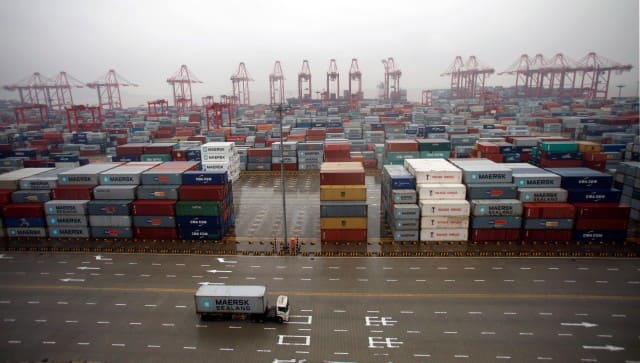 A container truck drives at a container area at the Yangshan Deep Water Port, near Shanghai. Reuters[/caption]Ageing populaceIn 2022, Japan, Italy, Finland, and Germany were among the countries with the greatest share of populations over 65 years of age, and by 2050, it is projected that the list will include Hong Kong, South Korea, and Taiwan. By 2050 the percentage of the world’s over-60 population will increase from 12 per cent to 22 per cent. At the same time, life expectancy is increasing. Such a population trend has implications for social security and other parts of the economy.Demands on governments and health providers to deliver greater volumes of care will grow because of potentially escalating risks of disease among the elderly. The ratio of workers to pensioners is falling, which is also putting pressure on the sustainability of current pension systems.In addition, there is evidence that the ageing of the population affects labour productivity and labour supply. It can, therefore, have an effect on economic growth, trade, savings, and investment. All in all, 2024 could be another rocky year.This article is republished from The Conversation under a Creative Commons license. Read the original article.

Military drones & police check-ups: How Sri Lanka is fighting against worst dengue outbreak in a decade
How Facebook job ad lured 2 Karnataka men into Myanmar cyber scam camp
Why is India seeing 95% cloud cover despite a Super El Niño?
What is CJP’s fourth demand to the government as protests in Delhi intensify?
The new geography of war: Why the Houthis can no longer be ignored