
Advertisement


Sections
Are there aliens in Mexico? Why scientists have called fraud on extraterrestrial corpses
Mexican journalist José Jaime Maussan presented two boxes with mummies found in Peru, which he considers ‘non-human beings that are not part of our terrestrial evolution’. Scientists, however, find it hard to believe that they are 'aliens'

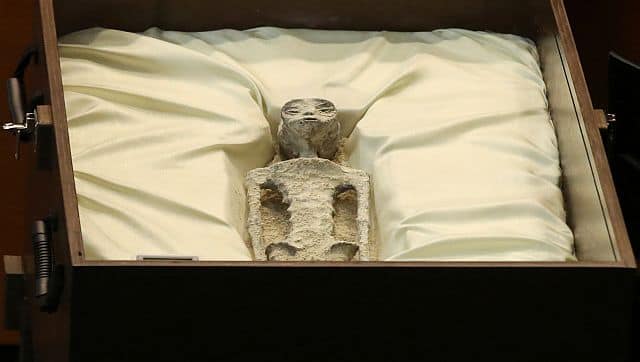
Are there aliens in Mexico? On Tuesday, creatures with tiny bodies, three-fingered hands and elongated heads were brought to the Mexican senate. Jaime Maussan, a sports journalist turned UFO enthusiast, while presenting them at the hearing in the country's first official event on UFOs, said, "we are not alone" in the universe after being shown the claimed remains of "non-human" mummies, which have only added to the internet fascination.Scientists, however, remain sceptical.Here's what we know so far about the extraterrestrials presented to the Mexican Congress, and why scientists are not welcoming them.The ‘alien corpses’On Tuesday, the Mexican lawmakers heard the testimony from individuals suggesting the possibility that extraterrestrials might exist. The researchers hailed from Mexico, the United States, Japan and Brazil."This is the first time (extraterrestrial life) is presented in such a form and I think there is a clear demonstration that we are dealing with non-human specimens that are not related to any other species in our world," Mexican journalist José Jaime Maussan testified in Spanish, as reported by USA Today.He presented two boxes with supposed mummies found in Peru, which he and others consider "non-human beings that are not part of our terrestrial evolution."The shrivelled bodies with shrunken, warped heads left those in the chamber aghast and quickly kicked up a social media fervour.According to Maussan, the remains date back more than 1,000 years and belonged to "non-human beings that are not part of our terrestrial evolution." The specimens were discovered fossilised in mines near Cusco, Peru, amid a layer of diatomaceous earth, or ancient phytoplankton algae, according to Maussan. The National Autonomous University of Mexico tested them, and Maussan stated that more than 30 per cent of the DNA in the specimens was "unknown," implying that they are "not part of our terrestrial evolution," he said."It's the queen of all evidence," Maussan claimed. "That is, if the DNA is showing us that they are non-human beings and that there is nothing that looks like this in the world, we should take it as such."During the hearing, X-rays of the specimens were also shown, and specialists testifying under oath claimed that one specimen had what seemed to be eggs or ovaries, while the other had implants composed of rare metals such as Osmium, reports USA Today.But he warned that he didn't want to refer to them as "extraterrestrials" just yet.The hearing was to debate language on UAP in the Aerial Space Protection Law. If the language is approved, Mexico would become the first nation to formally acknowledge the presence of alien life ever existing on Earth, the Reuters news agency said, citing local media.[caption id="attachment_13121702" align="alignnone" width="640"]![]() Experts from Mexico, the United States, Japan and Brazil gathered before the Mexican Congress to share their findings on the existence of UFOs and extraterrestrials that date back to 2017 in the sandy Peruvian coastal desert of Nazca. AP[/caption]Maussan’s history of being debunkedThe apparently desiccated bodies date back to 2017 and were found deep underground in the sandy Peruvian coastal desert of Nazca. The area is known for gigantic enigmatic figures scraped into the earth and seen only from a birds-eye-view. Most attribute the Nazca Lines to ancient indigenous communities, but the formations have captured the imaginations of many.But, if Maussan's recent assertions turn out to be incorrect, it won't be the first time. He has previously been associated with claims of discoveries that have later been debunked.In 2015, Maussan unveiled the existence of what was alleged to be an alien body unearthed in Nazca, Peru. According to the fact-checking website snopes.com, the "alien" discovery was later disproved, and the mummified corpse was shown to be that of a human infant with a head deformity.In 2017, Maussan made similar claims in Peru, and a report by the country's prosecutor's office found that the bodies were actually "recently manufactured dolls, which have been covered with a mixture of paper and synthetic glue to simulate the presence of skin."[caption id="attachment_13121742" align="alignnone" width="640"]
Experts from Mexico, the United States, Japan and Brazil gathered before the Mexican Congress to share their findings on the existence of UFOs and extraterrestrials that date back to 2017 in the sandy Peruvian coastal desert of Nazca. AP[/caption]Maussan’s history of being debunkedThe apparently desiccated bodies date back to 2017 and were found deep underground in the sandy Peruvian coastal desert of Nazca. The area is known for gigantic enigmatic figures scraped into the earth and seen only from a birds-eye-view. Most attribute the Nazca Lines to ancient indigenous communities, but the formations have captured the imaginations of many.But, if Maussan's recent assertions turn out to be incorrect, it won't be the first time. He has previously been associated with claims of discoveries that have later been debunked.In 2015, Maussan unveiled the existence of what was alleged to be an alien body unearthed in Nazca, Peru. According to the fact-checking website snopes.com, the "alien" discovery was later disproved, and the mummified corpse was shown to be that of a human infant with a head deformity.In 2017, Maussan made similar claims in Peru, and a report by the country's prosecutor's office found that the bodies were actually "recently manufactured dolls, which have been covered with a mixture of paper and synthetic glue to simulate the presence of skin."[caption id="attachment_13121742" align="alignnone" width="640"]![]() Journalist and UFO researcher Jaime Maussan speaks during a briefing on UFOs, at the San Lazaro legislative palace, in Mexico City, Mexico. Reuters[/caption]The report added that the figures were almost certainly human-made and that "they are not the remains of ancestral aliens that they have tried to present". The bodies were not publicly unveiled at the time, so it is unclear if they are the same as those presented to Mexico's congress.Earlier this year, Maussan stated that a photograph of a supposed UFO flying over the FC Juárez football stadium depicted "a ship of nonhuman origin," as per a USA Today report.The session, unprecedented in the Mexican Congress, took place two months after a similar one before the US Congress in which a former US Air Force intelligence officer claimed his country has probably been aware of "non-human" activity since the 1930s.Scientists call it fraudOn Wednesday, Julieta Fierro, researcher at the Institute of Astronomy at the National Autonomous University of Mexico, was among those to express scepticism, saying that many details about the figures "made no sense."Fierro added that the researchers' claims that her university endorsed their supposed discovery were false, and noted that scientists would need more advanced technology than the X-rays they claimed to use to determine if the allegedly calcified bodies were "non-human"."Maussan has done many things. He says he has talked to the Virgin of Guadalupe," she said. "He told me extraterrestrials do not talk to me like they talk to him because I don't believe in them."[caption id="attachment_13121682" align="alignnone" width="640"]
Journalist and UFO researcher Jaime Maussan speaks during a briefing on UFOs, at the San Lazaro legislative palace, in Mexico City, Mexico. Reuters[/caption]The report added that the figures were almost certainly human-made and that "they are not the remains of ancestral aliens that they have tried to present". The bodies were not publicly unveiled at the time, so it is unclear if they are the same as those presented to Mexico's congress.Earlier this year, Maussan stated that a photograph of a supposed UFO flying over the FC Juárez football stadium depicted "a ship of nonhuman origin," as per a USA Today report.The session, unprecedented in the Mexican Congress, took place two months after a similar one before the US Congress in which a former US Air Force intelligence officer claimed his country has probably been aware of "non-human" activity since the 1930s.Scientists call it fraudOn Wednesday, Julieta Fierro, researcher at the Institute of Astronomy at the National Autonomous University of Mexico, was among those to express scepticism, saying that many details about the figures "made no sense."Fierro added that the researchers' claims that her university endorsed their supposed discovery were false, and noted that scientists would need more advanced technology than the X-rays they claimed to use to determine if the allegedly calcified bodies were "non-human"."Maussan has done many things. He says he has talked to the Virgin of Guadalupe," she said. "He told me extraterrestrials do not talk to me like they talk to him because I don't believe in them."[caption id="attachment_13121682" align="alignnone" width="640"]![]() Many scientists express scepticism, saying that many details about the figures "made no sense." Reuters[/caption]The scientist added that it seemed strange that they extracted what would surely be a "treasure of the nation" from Peru without inviting the Peruvian ambassador.Congressman Sergio Gutiérrez Luna of the ruling Morena party, made it clear that Congress has not taken a position on the theses put forward during the more than three-hour session.Believing or not was up to each member of the legislative body, but those who testified had to swear an oath to tell the truth.Gutiérrez Luna stressed the importance of listening to "all voices, all opinions" and said it was positive that there was a transparent dialogue on the issue of extraterrestrials.WATCH: Mummified 'Alien' corpses put on display in Mexico City, believed to be 1000 years-oldIn the US in July, retired Major David Grusch alleged that the US is concealing a longstanding program that retrieves and reverse engineers unidentified flying objects. The Pentagon has denied his claims.Grusch's highly anticipated testimony before a House Oversight subcommittee was the US Congress' latest foray into the world of UAPs — or "unidentified aerial phenomena," which is the official term the US government uses instead of UFOs.Democrats and Republicans in recent years have pushed for more research as a national security matter due to concerns that sightings observed by pilots may be tied to US adversaries.With inputs from AP
Many scientists express scepticism, saying that many details about the figures "made no sense." Reuters[/caption]The scientist added that it seemed strange that they extracted what would surely be a "treasure of the nation" from Peru without inviting the Peruvian ambassador.Congressman Sergio Gutiérrez Luna of the ruling Morena party, made it clear that Congress has not taken a position on the theses put forward during the more than three-hour session.Believing or not was up to each member of the legislative body, but those who testified had to swear an oath to tell the truth.Gutiérrez Luna stressed the importance of listening to "all voices, all opinions" and said it was positive that there was a transparent dialogue on the issue of extraterrestrials.WATCH: Mummified 'Alien' corpses put on display in Mexico City, believed to be 1000 years-oldIn the US in July, retired Major David Grusch alleged that the US is concealing a longstanding program that retrieves and reverse engineers unidentified flying objects. The Pentagon has denied his claims.Grusch's highly anticipated testimony before a House Oversight subcommittee was the US Congress' latest foray into the world of UAPs — or "unidentified aerial phenomena," which is the official term the US government uses instead of UFOs.Democrats and Republicans in recent years have pushed for more research as a national security matter due to concerns that sightings observed by pilots may be tied to US adversaries.With inputs from AP
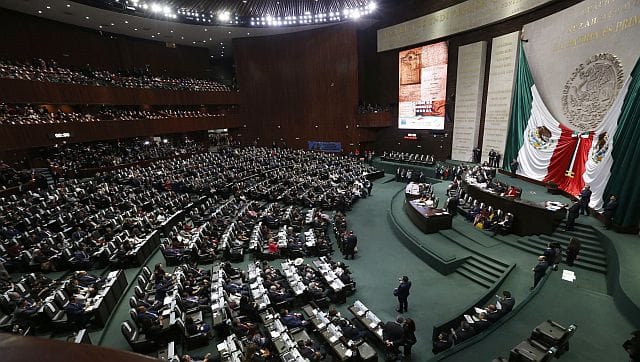 Experts from Mexico, the United States, Japan and Brazil gathered before the Mexican Congress to share their findings on the existence of UFOs and extraterrestrials that date back to 2017 in the sandy Peruvian coastal desert of Nazca. AP[/caption]Maussan’s history of being debunkedThe apparently desiccated bodies date back to 2017 and were found deep underground in the sandy Peruvian coastal desert of Nazca. The area is known for gigantic enigmatic figures scraped into the earth and seen only from a birds-eye-view. Most attribute the Nazca Lines to ancient indigenous communities, but the formations have captured the imaginations of many.But, if Maussan's recent assertions turn out to be incorrect, it won't be the first time. He has previously been associated with claims of discoveries that have later been debunked.In 2015, Maussan unveiled the existence of what was alleged to be an alien body unearthed in Nazca, Peru. According to the fact-checking website snopes.com, the "alien" discovery was later disproved, and the mummified corpse was shown to be that of a human infant with a head deformity.In 2017, Maussan made similar claims in Peru, and a report by the country's prosecutor's office found that the bodies were actually "recently manufactured dolls, which have been covered with a mixture of paper and synthetic glue to simulate the presence of skin."[caption id="attachment_13121742" align="alignnone" width="640"]
 Journalist and UFO researcher Jaime Maussan speaks during a briefing on UFOs, at the San Lazaro legislative palace, in Mexico City, Mexico. Reuters[/caption]The report added that the figures were almost certainly human-made and that "they are not the remains of ancestral aliens that they have tried to present". The bodies were not publicly unveiled at the time, so it is unclear if they are the same as those presented to Mexico's congress.Earlier this year, Maussan stated that a photograph of a supposed UFO flying over the FC Juárez football stadium depicted "a ship of nonhuman origin," as per a USA Today report.The session, unprecedented in the Mexican Congress, took place two months after a similar one before the US Congress in which a former US Air Force intelligence officer claimed his country has probably been aware of "non-human" activity since the 1930s.Scientists call it fraudOn Wednesday, Julieta Fierro, researcher at the Institute of Astronomy at the National Autonomous University of Mexico, was among those to express scepticism, saying that many details about the figures "made no sense."Fierro added that the researchers' claims that her university endorsed their supposed discovery were false, and noted that scientists would need more advanced technology than the X-rays they claimed to use to determine if the allegedly calcified bodies were "non-human"."Maussan has done many things. He says he has talked to the Virgin of Guadalupe," she said. "He told me extraterrestrials do not talk to me like they talk to him because I don't believe in them."[caption id="attachment_13121682" align="alignnone" width="640"]
 Many scientists express scepticism, saying that many details about the figures "made no sense." Reuters[/caption]The scientist added that it seemed strange that they extracted what would surely be a "treasure of the nation" from Peru without inviting the Peruvian ambassador.Congressman Sergio Gutiérrez Luna of the ruling Morena party, made it clear that Congress has not taken a position on the theses put forward during the more than three-hour session.Believing or not was up to each member of the legislative body, but those who testified had to swear an oath to tell the truth.Gutiérrez Luna stressed the importance of listening to "all voices, all opinions" and said it was positive that there was a transparent dialogue on the issue of extraterrestrials.WATCH: Mummified 'Alien' corpses put on display in Mexico City, believed to be 1000 years-oldIn the US in July, retired Major David Grusch alleged that the US is concealing a longstanding program that retrieves and reverse engineers unidentified flying objects. The Pentagon has denied his claims.Grusch's highly anticipated testimony before a House Oversight subcommittee was the US Congress' latest foray into the world of UAPs — or "unidentified aerial phenomena," which is the official term the US government uses instead of UFOs.Democrats and Republicans in recent years have pushed for more research as a national security matter due to concerns that sightings observed by pilots may be tied to US adversaries.With inputs from AP
First Published:Sep 14, 2023, 11:40:39 IST
Advertisement
Advertisement

Why India may not witness a medal rush at 2026 Commonwealth Games
A 125-strong Indian contingent is in Glasgow for the 2026 Commonwealth Games, starting today (July 23), chasing international glory. However, with a roster of sports such as badminton and wrestling being cut from the event, the country’s medal chances have been drastically reduced
4 min read
Delhi Police asks personnel to wear uniform: What the law says on cops in plainclothes during protests
The Delhi Police has instructed all its personnel to wear uniforms when they report for duty at Jantar Mantar for crowd control. This comes after outrage grew over videos of men in civilian clothes or without name tags hitting protesters in the Capital. Is it legal for the police to ditch uniforms during protests?
4 min read
Military drones & police check-ups: How Sri Lanka is fighting against worst dengue outbreak in a decade
Sri Lanka is fighting its most severe dengue outbreak in nearly a decade, with infections rising sharply across the nation. Military drones have been deployed to tackle the outbreak, which has claimed 56 lives. Health officials said the outbreak is being driven primarily by the DENV-2 variant of the virus
3 min read
How Facebook job ad lured 2 Karnataka men into Myanmar cyber scam camp
The Karnataka Cyber Command has rescued two youths from a scam compound in Myanmar operated by Chinese fraudsters. The duo from Karnataka were lured on the pretext of data-entry jobs. They were asked to work for 16 hours a day and were expected to sleep for six hours daily
4 min read
Why is India seeing 95% cloud cover despite a Super El Niño?
India is witnessing nearly 95 per cent cloud cover despite a Super El Niño, a climate event usually linked to weaker monsoons. Regional weather systems, cyclonic circulations, the monsoon trough and moisture from two seas are temporarily overpowering one of the world's strongest climate phenomena
5 min read
Advertisement
Advertisement