
Advertisement


Sections
2 dead, 22 hurt, villages in the dark: How Cyclone Biparjoy ravaged Gujarat
Cyclone Biparjoy made its landfall on the Gujarat coast on Thursday evening, bringing with it strong winds and heavy rainfall. It has left a trail of destruction – two people have died, another 22 have been injured and scores of villages were plunged into darkness as electricity poles were uprooted

After days of anxiety and worry, Cyclone Biparjoy – packed with high wind speeds – struck the Jakhau port in Gujarat on Thursday evening, causing damage and destruction along the state’s coastline.Cyclone Biparjoy, which translates to disaster in English, lived up to its name – killing two people, injuring at least another 22, uprooting a large number of trees and snapping supply of power to several villages. In fact, according to experts, Cyclone Biparjoy is one of the worst cyclones in recorded history.After wreaking havoc on the Gujarat coastline, the intensity of Cyclone Biparjoy reduced on Friday morning, and is likely to weaken into a depression this evening over Rajasthan. Rajasthan chief minister Ashok Gehlot said that his state was geared up for the cyclone and the heavy rainfall that will come with it. According to the India Meteorological Department (Met), heavy rainfall is likely to occur in Jodhpur and Udaipur divisions on Friday and Saturday due to the cyclone.Trail of destructionOn Thursday, around 6.30 pm, Cyclone Biparjoy with wind speeds of 115-125 kilometres per hour made landfall at Gujarat’s Jakhau port after travelling in the Arabian Sea for 10 days.As the storm struck, it brought total darkness to several parts of Gujarat as electric poles across the state were brought down. Officials were quoted as saying that at least 940 villages in the western state had been plunged into blackness with the entire town of Mandvi in the dark.The cyclone also led to the deaths of two people. According to an Indian Express report, a shepherd and his son – Ram Parmar and Rajesh – died after they were swept away in a flooded stream while trying to save their herd of sheep from drowning in Sodvadar village, on the outskirts of Bhavnagar city, on Thursday evening. The district flood control room of Bhavnagar said that it received the information about the missing father-son duo at 6:25pm. A search and rescue mission was launched, and the bodies were later fished out.Also read: A look at the deadliest cyclones that have hit IndiaFurthermore, Cyclone Biparjoy caused injury to around 22 people in the state. Alok Pandey, Relief Commissioner of Gujarat, was quoted as saying that the cyclone had also caused the death of 23 animals. However, the wildlife in Gir National Park went unscathed.[caption id="attachment_12745612" align="alignnone" width="640"]![]() A tree uprooted due to strong winds on the arrival of cyclone Biparjoy in Gujarat. Reuters[/caption]In the Kutch district, roads had been blocked after trees were uprooted and electricity poles came crashing down. Similar scenes were prevalent in Jakhau too. At some places, the roofs of houses had blown away owing to the strong winds.The storm also brought fear to the people of Gujarat with Juma Koli, a worker at the salt pans in Jakhau telling Indian Express, “Whether we are afraid of the cyclone or not, where else can we go. We’ll stay indoors and try to weather the storm.”Cyclone alert in GujaratAs the cyclone travelled in the Arabian Sea for 10 days, officials in Gujarat had enough time to prep for it and to mitigate the destruction. Gujarat state officials said that 94,000 people had been evacuated from coastal areas.Additionally, several train services were suspended in Gujarat, while the ports of Kandla and Mundra – two of India’s largest –stopped operations. Fishing was also suspended along the Gujarat coast.An India Today report also stated that 76 Multipurpose Cyclone Shelters (MPCS) had been set to house people who had been evacuated on account of the cyclone. This includes 25 shelters in Junagadh, 29 at Gir-Somnath, four each in Porbandar, Devbhoomi Dwarka, and Kutch, two in Amreli, one each in Jamnagar and Navsari, five in Bharuch, and one in Ahmedabad.[caption id="attachment_12745572" align="alignnone" width="640"]
A tree uprooted due to strong winds on the arrival of cyclone Biparjoy in Gujarat. Reuters[/caption]In the Kutch district, roads had been blocked after trees were uprooted and electricity poles came crashing down. Similar scenes were prevalent in Jakhau too. At some places, the roofs of houses had blown away owing to the strong winds.The storm also brought fear to the people of Gujarat with Juma Koli, a worker at the salt pans in Jakhau telling Indian Express, “Whether we are afraid of the cyclone or not, where else can we go. We’ll stay indoors and try to weather the storm.”Cyclone alert in GujaratAs the cyclone travelled in the Arabian Sea for 10 days, officials in Gujarat had enough time to prep for it and to mitigate the destruction. Gujarat state officials said that 94,000 people had been evacuated from coastal areas.Additionally, several train services were suspended in Gujarat, while the ports of Kandla and Mundra – two of India’s largest –stopped operations. Fishing was also suspended along the Gujarat coast.An India Today report also stated that 76 Multipurpose Cyclone Shelters (MPCS) had been set to house people who had been evacuated on account of the cyclone. This includes 25 shelters in Junagadh, 29 at Gir-Somnath, four each in Porbandar, Devbhoomi Dwarka, and Kutch, two in Amreli, one each in Jamnagar and Navsari, five in Bharuch, and one in Ahmedabad.[caption id="attachment_12745572" align="alignnone" width="640"]![]() People evacuated from Kandla port, in preparation of Cyclone Biparjoy, rest at a shelter in Gandhidham. AP[/caption]Also, 1,512 shelter homes have been built across Gujarat, which includes 196 in Junagadh, 173 in Kutch, 56 in Jamnagar, 140 in Porbandar, 182 in Devbhoomi Dwarka, 507 in Gir-Somnath, 31 in Morbi, and 236 in Rajkot.Eighteen teams of the National Disaster Response Force (NDRF), 12 of the State Disaster Response Force (SDRF), 115 teams of state road and building department, and 397 of the state electricity department have also been deployed in coastal districts.[caption id="attachment_12745822" align="alignnone" width="640"]
People evacuated from Kandla port, in preparation of Cyclone Biparjoy, rest at a shelter in Gandhidham. AP[/caption]Also, 1,512 shelter homes have been built across Gujarat, which includes 196 in Junagadh, 173 in Kutch, 56 in Jamnagar, 140 in Porbandar, 182 in Devbhoomi Dwarka, 507 in Gir-Somnath, 31 in Morbi, and 236 in Rajkot.Eighteen teams of the National Disaster Response Force (NDRF), 12 of the State Disaster Response Force (SDRF), 115 teams of state road and building department, and 397 of the state electricity department have also been deployed in coastal districts.[caption id="attachment_12745822" align="alignnone" width="640"]![]() Graphic: Pranay Bhardwaj[/caption]The cyclone on Thursday evoked strong memories in the minds of the people in Gujarat who saw horrific destruction owing to a cyclone 25 years ago. In June of 1998, a ‘very severe cyclonic storm’ had crossed the Gujarat coast near Porbandar with an intensity of 167 km per hour, killing 1,173 people and another 1,774 people reported missing. Some say that these numbers didn’t reflect the reality of the moment and over 4,000 people had died in that cyclone.Blame global warmingAccording to many experts, Cyclone Biparjoy was more intense owing to ‘global warming’ factor. As per IMD, Biparjoy intensified twice in its lifetime because of the unusually warm waters of the Arabian Sea due to global warming.A study by Pune’s Indian Institute of Tropical Meteorology (IITM) has recorded that the number of cyclones has increased by 52 per cent and incidents of very severe cyclones went up by 150 per cent. The rise in sea-water temperatures increases humidity due to evaporation, which lends energy to cyclones to intensify.[caption id="attachment_12745702" align="alignnone" width="640"]
Graphic: Pranay Bhardwaj[/caption]The cyclone on Thursday evoked strong memories in the minds of the people in Gujarat who saw horrific destruction owing to a cyclone 25 years ago. In June of 1998, a ‘very severe cyclonic storm’ had crossed the Gujarat coast near Porbandar with an intensity of 167 km per hour, killing 1,173 people and another 1,774 people reported missing. Some say that these numbers didn’t reflect the reality of the moment and over 4,000 people had died in that cyclone.Blame global warmingAccording to many experts, Cyclone Biparjoy was more intense owing to ‘global warming’ factor. As per IMD, Biparjoy intensified twice in its lifetime because of the unusually warm waters of the Arabian Sea due to global warming.A study by Pune’s Indian Institute of Tropical Meteorology (IITM) has recorded that the number of cyclones has increased by 52 per cent and incidents of very severe cyclones went up by 150 per cent. The rise in sea-water temperatures increases humidity due to evaporation, which lends energy to cyclones to intensify.[caption id="attachment_12745702" align="alignnone" width="640"]![]() Men work to drain a waterlogged lane following heavy rains in Mandvi town after the landfall of Cyclone Biparjoy. AFP[/caption]A report prepared by the Gujarat Institute of Disaster Management (GIDM) in Rysan, Gujarat, concedes that the Arabian Sea was earlier considered less prone to cyclonic conditions as compared to the Bay of Bengal as the sea temperatures were lower there. However, the GIDM report quotes a UN Intergovernmental Panel on Climate Change (IPCC) report of 2019, which suggests that “the Arabian Sea is quickly responding to climate change signals and the frequency of severe cyclone has registered a threefold increase in recent times”. The report adds that “the intensity of tropical cyclones in the region is reaching its extreme”.With inputs from agenciesRead all the Latest News, Trending News, Cricket News, Bollywood News,India News and Entertainment News here. Follow us on Facebook, Twitter and Instagram.
Men work to drain a waterlogged lane following heavy rains in Mandvi town after the landfall of Cyclone Biparjoy. AFP[/caption]A report prepared by the Gujarat Institute of Disaster Management (GIDM) in Rysan, Gujarat, concedes that the Arabian Sea was earlier considered less prone to cyclonic conditions as compared to the Bay of Bengal as the sea temperatures were lower there. However, the GIDM report quotes a UN Intergovernmental Panel on Climate Change (IPCC) report of 2019, which suggests that “the Arabian Sea is quickly responding to climate change signals and the frequency of severe cyclone has registered a threefold increase in recent times”. The report adds that “the intensity of tropical cyclones in the region is reaching its extreme”.With inputs from agenciesRead all the Latest News, Trending News, Cricket News, Bollywood News,India News and Entertainment News here. Follow us on Facebook, Twitter and Instagram.
 A tree uprooted due to strong winds on the arrival of cyclone Biparjoy in Gujarat. Reuters[/caption]In the Kutch district, roads had been blocked after trees were uprooted and electricity poles came crashing down. Similar scenes were prevalent in Jakhau too. At some places, the roofs of houses had blown away owing to the strong winds.The storm also brought fear to the people of Gujarat with Juma Koli, a worker at the salt pans in Jakhau telling Indian Express, “Whether we are afraid of the cyclone or not, where else can we go. We’ll stay indoors and try to weather the storm.”Cyclone alert in GujaratAs the cyclone travelled in the Arabian Sea for 10 days, officials in Gujarat had enough time to prep for it and to mitigate the destruction. Gujarat state officials said that 94,000 people had been evacuated from coastal areas.Additionally, several train services were suspended in Gujarat, while the ports of Kandla and Mundra – two of India’s largest –stopped operations. Fishing was also suspended along the Gujarat coast.An India Today report also stated that 76 Multipurpose Cyclone Shelters (MPCS) had been set to house people who had been evacuated on account of the cyclone. This includes 25 shelters in Junagadh, 29 at Gir-Somnath, four each in Porbandar, Devbhoomi Dwarka, and Kutch, two in Amreli, one each in Jamnagar and Navsari, five in Bharuch, and one in Ahmedabad.[caption id="attachment_12745572" align="alignnone" width="640"]
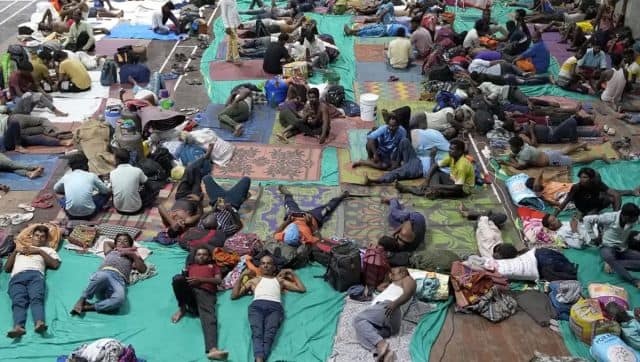 People evacuated from Kandla port, in preparation of Cyclone Biparjoy, rest at a shelter in Gandhidham. AP[/caption]Also, 1,512 shelter homes have been built across Gujarat, which includes 196 in Junagadh, 173 in Kutch, 56 in Jamnagar, 140 in Porbandar, 182 in Devbhoomi Dwarka, 507 in Gir-Somnath, 31 in Morbi, and 236 in Rajkot.Eighteen teams of the National Disaster Response Force (NDRF), 12 of the State Disaster Response Force (SDRF), 115 teams of state road and building department, and 397 of the state electricity department have also been deployed in coastal districts.[caption id="attachment_12745822" align="alignnone" width="640"]
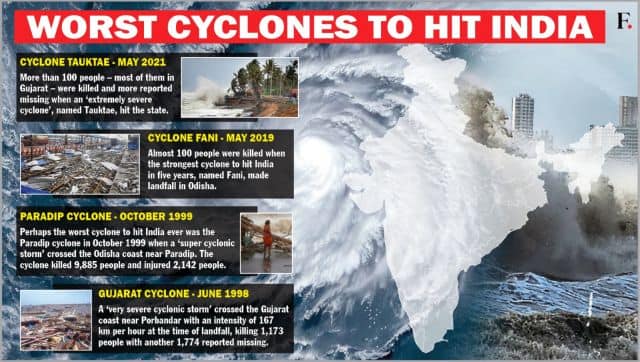 Graphic: Pranay Bhardwaj[/caption]The cyclone on Thursday evoked strong memories in the minds of the people in Gujarat who saw horrific destruction owing to a cyclone 25 years ago. In June of 1998, a ‘very severe cyclonic storm’ had crossed the Gujarat coast near Porbandar with an intensity of 167 km per hour, killing 1,173 people and another 1,774 people reported missing. Some say that these numbers didn’t reflect the reality of the moment and over 4,000 people had died in that cyclone.Blame global warmingAccording to many experts, Cyclone Biparjoy was more intense owing to ‘global warming’ factor. As per IMD, Biparjoy intensified twice in its lifetime because of the unusually warm waters of the Arabian Sea due to global warming.A study by Pune’s Indian Institute of Tropical Meteorology (IITM) has recorded that the number of cyclones has increased by 52 per cent and incidents of very severe cyclones went up by 150 per cent. The rise in sea-water temperatures increases humidity due to evaporation, which lends energy to cyclones to intensify.[caption id="attachment_12745702" align="alignnone" width="640"]
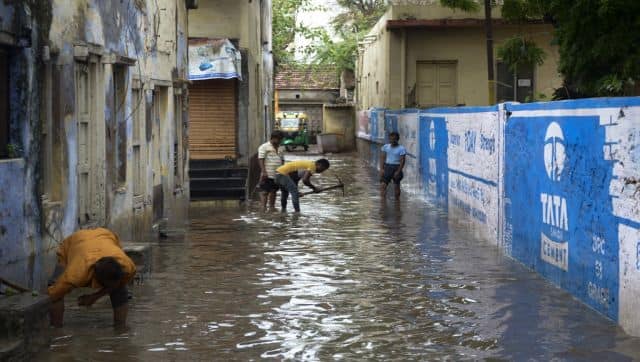 Men work to drain a waterlogged lane following heavy rains in Mandvi town after the landfall of Cyclone Biparjoy. AFP[/caption]A report prepared by the Gujarat Institute of Disaster Management (GIDM) in Rysan, Gujarat, concedes that the Arabian Sea was earlier considered less prone to cyclonic conditions as compared to the Bay of Bengal as the sea temperatures were lower there. However, the GIDM report quotes a UN Intergovernmental Panel on Climate Change (IPCC) report of 2019, which suggests that “the Arabian Sea is quickly responding to climate change signals and the frequency of severe cyclone has registered a threefold increase in recent times”. The report adds that “the intensity of tropical cyclones in the region is reaching its extreme”.With inputs from agenciesRead all the Latest News, Trending News, Cricket News, Bollywood News,India News and Entertainment News here. Follow us on Facebook, Twitter and Instagram.
First Published:Jun 16, 2023, 09:49:36 IST
Advertisement
Advertisement

Military drones & police check-ups: How Sri Lanka is fighting against worst dengue outbreak in a decade
Sri Lanka is fighting its most severe dengue outbreak in nearly a decade, with infections rising sharply across the nation. Military drones have been deployed to tackle the outbreak, which has claimed 56 lives. Health officials said the outbreak is being driven primarily by the DENV-2 variant of the virus
3 min read
How Facebook job ad lured 2 Karnataka men into Myanmar cyber scam camp
The Karnataka Cyber Command has rescued two youths from a scam compound in Myanmar operated by Chinese fraudsters. The duo from Karnataka were lured on the pretext of data-entry jobs. They were asked to work for 16 hours a day and were expected to sleep for six hours daily
4 min read
Why is India seeing 95% cloud cover despite a Super El Niño?
India is witnessing nearly 95 per cent cloud cover despite a Super El Niño, a climate event usually linked to weaker monsoons. Regional weather systems, cyclonic circulations, the monsoon trough and moisture from two seas are temporarily overpowering one of the world's strongest climate phenomena
5 min read
What is CJP’s fourth demand to the government as protests in Delhi intensify?
The protest by the Cockroach Janta Party at Delhi’s Jantar Mantar refuses to die down. The group have made a fourth demand to the Centre, asking that no FIRs are filed against the agitators and that no legal action be taken. The government has expressed willingness to speak to the protesters, but refused to accede on the resignation of Education Minister Dharmandra Pradhan
5 min read
The new geography of war: Why the Houthis can no longer be ignored
The rise of the Houthis marks the emergence of a new geography of war — one in which influence flows not only from capitals and conventional armies, but also from rugged mountains overlooking vital sea lanes
6 min read
Advertisement
Advertisement