


The Girl On The Train and the rise of the functioning yet flawed female character
With The Girl on The Train, and recent series such as The Queen's Gambit and Sharp Objects, creators have refused to define their heroines by their vices or flaws.

In one of the best scenes of Tate Taylor’s The Girl On the Train (2006), Rachel Watson (played brilliantly by Emily Blunt) is spiralling out of control in a bathroom at Grand Central Station. Every day, she watches a perfect couple from the train she takes into New York City. Though her marriage has disintegrated, seeing them renews her hope in love. Until today, that is. Today Rachel saw the wife with another man and it sends her into an explosion of fury. Fuelled by all the martinis she’s chugged, Rachel violently smears lipstick on the bathroom mirror and screams her desire to storm into Megan’s house, grab her by the hair and ‘…just smash her head all over the floor’. She had been teetering on the edge of a break down for weeks and now she’s just keeled over.
On Friday, 26 February, Netflix debuted the Hindi version of The Girl On The Train, with Parineeti Chopra enacting out the same scene as above. It’s interesting that an award-winning psycho-thriller novel, set in London, gets a desi version. What’s most interesting, however, is that a story centred around a female alcoholic gets a desi version. For those who have read the Paula Hawkins bestseller or seen the role essayed by Blunt in the Hollywood version, it’s a character that has multiple shades of grey - the kind that forces an audience to separate their ‘drinking problems’ from the people they are. The drinking itself is an emotional crutch for the protagonist, but has little to do with how an audience will finally perceive them because of everything else that’s going on.
 More from Entertainment
Still from The Queen's Gambit[/caption]What binds the two characters though, is the childhood trauma of being orphaned and getting addicted very early in life. The alcohol and substance abuse that we see is clearly a crutch, but it’s slid into the narrative the way ‘male saviours’ have been thrown into these kind of stories in the past - insignificant to the central plot really, but there to help our protagonist deal with some kind of trauma.
These saviours have little or no bearing on the intrinsic ability of the protagonist, except for creating situations and for the story to chug along. Most importantly, these filmmakers refuse to define their heroines by their vices, which is something that’s begun to happen only recently.
It’s been a gradual journey though. While female authors have given us deeply flawed heroines in the past, it’s only in the last decade that we’ve begun to see these characters make the transition to screen. David Fincher’s rendition of Gone Girl (2014) might be credited by some for the slew of ‘messy’ heroines we’ve seen in the years after, but in hindsight one can’t help feel that the award-winning director picked Gillian Flynn’s easiest novel. The lines were clearly marked out in that one - there was little doubt that Amy Dunne (played by Rosamund Pike) would be perceived by the audience as an out-and-out bad seed. [caption id="attachment_9364611" align="alignnone" width="640"]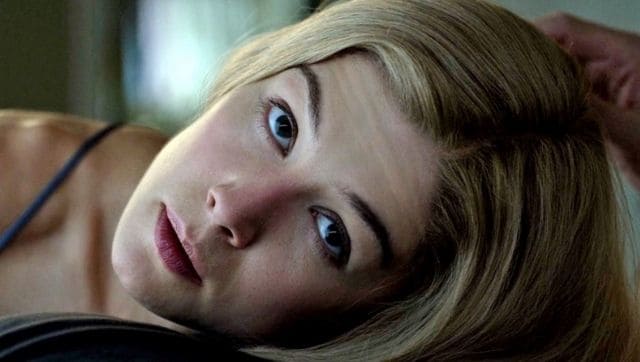
Rosamund Pike in a still from Gone Girl. Image from Twitter[/caption]It was Sharp Objects, Flynn’s 2006 debut novel that truly captures the essence of a female protagonist that’s neither a vamp nor a virgin, neither perfect nor broken, neither black nor white. When HBO adapted the book into a series a couple of years back, it truly marked a shift in how filmmakers were willing to take on female characters that were flawed and completely unapologetic about it. Amy Adams plays Camille Preaker, a crime journalist who returns to her hometown to investigate the murders of two young girls. Preaker has an alcohol addiction, suffers from depression and has a self-mutilation disorder, but none of this takes away from the functioning woman and crime investigator that she is. She may not be likeable, she might come across as self-serving, but she isn’t trying to be anything other than herself. The filmmaker isn’t trying to actively make you like or hate Preaker either. It all just is what it is.
On the other hand, we’ve always had alcoholic heroes and problematic male protagonists. Did anyone use words like 'messy' to describe Charlie Chaplin getting wasted in City Lights (1931)? Did we have long discussions on the drinking problems of Anthony Gonsalves (Amitabh Bachchan, Amar Akbar Anthony, 1977) and the negative role model he most decidedly was for an entire generation of young men in bellbottoms? Did Don Draper’s (Jon Hamm, Mad Men, 2007-2015) excessive drinking and philandering make him less of a hero?

Kangana Ranaut in a still from Fashion. Image from Twitter[/caption]In Fashion (2008), the downfall of a successful model Shonali Gujral (Kangana Ranaut) is shown through excessive alcohol and drug abuse. In Cocktail (2012), Veronica (Deepika Padukone) is the quintessential rich party girl who’s always ready to get drunk and laid. But to get the guy of her dreams, she must undergo a transformation into a salwar-kameez wearing teetotaller. Her unvirginal and unbecoming-of-a-decent-Indian-girl behaviour, of course, makes her tainted for life and she doesn’t get the guy in the end. While the first is a cautionary tale, the other sounds like a bedtime story that’s told to little girls, with a moral at the end and all of that. There are more than a few of these characters in our recent films, and what’s common to all of them is that these women are never portrayed as ‘good’ and always need some form of salvation. These characters are designed to elicit either pity or hate from an audience that’s inherently patriarchal.
With the release of The Girl On The Train this weekend, one hopes that it could be the film that opens doors for others to take on more flawed female characters, to break the mould that society has given us, of what their ‘ideal functioning woman’ should be.

How Spider-Man actor Tom Holland has been on a sobriety journey of 4.5 years after being "addicted to alcohol"
Sitar virtuoso Rishab Sharma steals the spotlight with Rs 35.8 lakh Jacob & Co Ram Janmabhoomi watch at ‘Ramayana’ event: Here's what makes it rare
Amitabh Bachchan reveals being admitted to the ICU and undergoing surgery, calls recovery 'the most difficult phase of life'
Avengers Doomsday trailer out: What to expect from Marvel's ultimate crossover
Christopher Nolan banned the orchestra for 'The Odyssey': The sound of gongs, scrap metal and more