
Advertisement


Sections
Machines movie review: Rahul Jain's documentary offers sharp comment on inequality, dehumanisation
In his documentary Machines, writer-director Rahul Jain juxtaposes the word of the worker with that of the mill owner

Editor's note: The 19th edition of the Jio MAMI Mumbai Film Festival is finally here, and with it comes an unending list of critically acclaimed Indian and international films to watch. Some of these are submissions for the Oscars, while others are hitherto untold, hyperlocal stories. Firstpost will review the most promising of these films.For approximately the first four-and-a-half minutes of this documentary, a camera tracks into machines and observes men working the machines. Sparks fly around a man shovelling material into a furnace, the camera moves around as men indifferently go about their tasks that are processes in textile manufacture and dyeing.Writer-director Rahul Jain’s debut film premiered at the Sundance Film Festival this year (where it won the World Cinema Documentary Special Jury Award for excellence in Cinematography) and had its India premiere at the Jio MAMI 19th Mumbai Film Festival. Jain uses his camera and the sounds of the factory to take us into the grimy, sweaty, dingy, claustrophobic spaces of a textile factory in Gujarat. The sound of the machines provides the background score. Cinematographer Rodrigo Trejo Villanueva captures the stifling atmosphere. As you watch the 75-minute film, the lens lingering over the faces of the workers might remind you of Brazilian photographer Sebastião Salgado’s seminal images of workers.[caption id="attachment_4142247" align="alignnone" width="825"]![Still from Rahul Jain's documentary Machines]() Still from Rahul Jain's documentary Machines[/caption]This is a rare documentary that does not use supers, voice-over or expert talking heads. The voices are primarily those of the factory workers who share their point of view on their situation. Twelve hour shifts earn them a paltry $3 dollars a day. Some doze off during their brain-dead, mechanical jobs, others take an hours break and return to work an additional shift, forsaking rest for the extra earnings. The monotony and rhythmic repetition of tasks and sounds lulls workers into sleep while others go about their tasks handling hazardous material without any protective gear.The machines have to be controlled by arms and brains, says one proud worker. Another older man says poverty is their compulsion. “It’s not exploitation, it’s our need,” he say. Several of the workers are migrants who have been forced to seek poorly paid work far from their home states to pay off mounting debts. Being from different regions, with varying reasons, their condition is augmented by disunity and their spirit overrun by resignation and helplessness.Jain makes no judgment. He simply juxtaposes the word of the worker with that of the mill owner who is acutely aware that he has the upper hand. Sitting in his air-conditioned cabin, he has never met most of these shift workers, but he knows their disunity works in his favour. In a country where there is no dearth of unskilled labour, where supply outweighs demand, the mill owner is in the convenient position of being in a buyer’s market. By consciously not placing himself in the frame, Jain lets the narrative play out with neutrality, while also bringing out the understanding that the need of the worker is far greater than his sufferance of inhuman working conditions, and that the latter cannot be overturned without some form of unionisation.Machines is a confident first film and an intimate, sensory and sharp comment on inequality and dehumanisation.
Still from Rahul Jain's documentary Machines[/caption]This is a rare documentary that does not use supers, voice-over or expert talking heads. The voices are primarily those of the factory workers who share their point of view on their situation. Twelve hour shifts earn them a paltry $3 dollars a day. Some doze off during their brain-dead, mechanical jobs, others take an hours break and return to work an additional shift, forsaking rest for the extra earnings. The monotony and rhythmic repetition of tasks and sounds lulls workers into sleep while others go about their tasks handling hazardous material without any protective gear.The machines have to be controlled by arms and brains, says one proud worker. Another older man says poverty is their compulsion. “It’s not exploitation, it’s our need,” he say. Several of the workers are migrants who have been forced to seek poorly paid work far from their home states to pay off mounting debts. Being from different regions, with varying reasons, their condition is augmented by disunity and their spirit overrun by resignation and helplessness.Jain makes no judgment. He simply juxtaposes the word of the worker with that of the mill owner who is acutely aware that he has the upper hand. Sitting in his air-conditioned cabin, he has never met most of these shift workers, but he knows their disunity works in his favour. In a country where there is no dearth of unskilled labour, where supply outweighs demand, the mill owner is in the convenient position of being in a buyer’s market. By consciously not placing himself in the frame, Jain lets the narrative play out with neutrality, while also bringing out the understanding that the need of the worker is far greater than his sufferance of inhuman working conditions, and that the latter cannot be overturned without some form of unionisation.Machines is a confident first film and an intimate, sensory and sharp comment on inequality and dehumanisation.
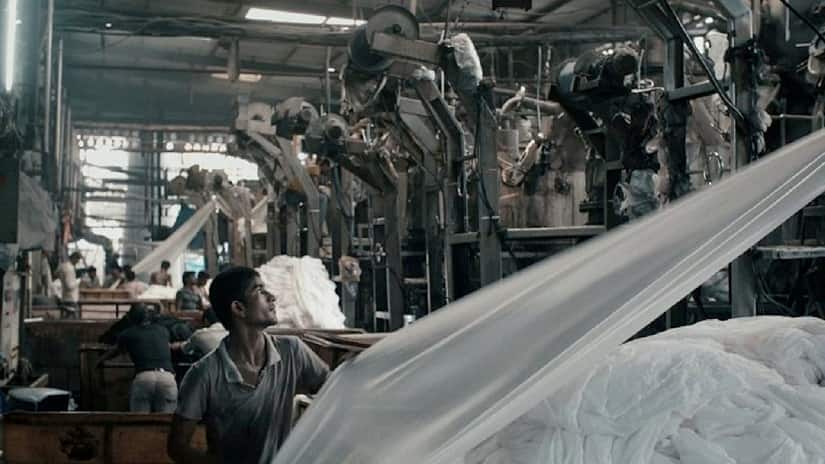 Still from Rahul Jain's documentary Machines[/caption]This is a rare documentary that does not use supers, voice-over or expert talking heads. The voices are primarily those of the factory workers who share their point of view on their situation. Twelve hour shifts earn them a paltry $3 dollars a day. Some doze off during their brain-dead, mechanical jobs, others take an hours break and return to work an additional shift, forsaking rest for the extra earnings. The monotony and rhythmic repetition of tasks and sounds lulls workers into sleep while others go about their tasks handling hazardous material without any protective gear.The machines have to be controlled by arms and brains, says one proud worker. Another older man says poverty is their compulsion. “It’s not exploitation, it’s our need,” he say. Several of the workers are migrants who have been forced to seek poorly paid work far from their home states to pay off mounting debts. Being from different regions, with varying reasons, their condition is augmented by disunity and their spirit overrun by resignation and helplessness.Jain makes no judgment. He simply juxtaposes the word of the worker with that of the mill owner who is acutely aware that he has the upper hand. Sitting in his air-conditioned cabin, he has never met most of these shift workers, but he knows their disunity works in his favour. In a country where there is no dearth of unskilled labour, where supply outweighs demand, the mill owner is in the convenient position of being in a buyer’s market. By consciously not placing himself in the frame, Jain lets the narrative play out with neutrality, while also bringing out the understanding that the need of the worker is far greater than his sufferance of inhuman working conditions, and that the latter cannot be overturned without some form of unionisation.Machines is a confident first film and an intimate, sensory and sharp comment on inequality and dehumanisation.
First Published:Oct 14, 2017, 13:42:43 IST
Advertisement
Advertisement

How Spider-Man actor Tom Holland has been on a sobriety journey of 4.5 years after being "addicted to alcohol"
Tom Holland has been open about his struggle with alcohol addiction and his 4.5-year sobriety journey, even at the height of his Spider-Man and The Odyssey fame.
3 min read
Sitar virtuoso Rishab Sharma steals the spotlight with Rs 35.8 lakh Jacob & Co Ram Janmabhoomi watch at ‘Ramayana’ event: Here's what makes it rare
Sitarist Rishab Sharma grabbed attention at the Ramayana event with a limited-edition Rs 35.8 lakh Jacob & Co. Epic X Ram Janmabhoomi watch. Here's what makes the luxury timepiece so special.
2 min read
Amitabh Bachchan reveals being admitted to the ICU and undergoing surgery, calls recovery 'the most difficult phase of life'
Amitabh Bachchan has revealed he was hospitalised, underwent surgery and spent time in the ICU. The veteran actor reflected on the emotional and physical challenges of recovery in a deeply personal blog post.
2 min read
Avengers Doomsday trailer out: What to expect from Marvel's ultimate crossover
Marvel Studios has dropped the first trailer for Avengers: Doomsday. From Robert Downey Jr.'s Doctor Doom and Chris Evans' return to the X-Men crossover, here's everything you need to know.
3 min read
Christopher Nolan banned the orchestra for 'The Odyssey': The sound of gongs, scrap metal and more
Composer Ludwig Göransson reveals how he built the epic's entire sound world from bronze gongs, scrap metal and ancient Greek instruments like the aulos and lyre.
2 min read
Advertisement
Advertisement