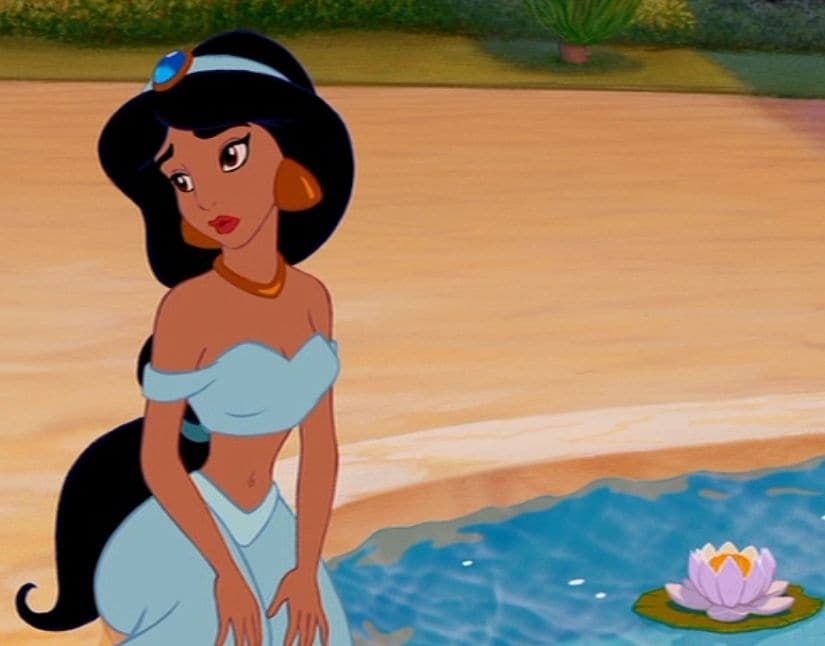
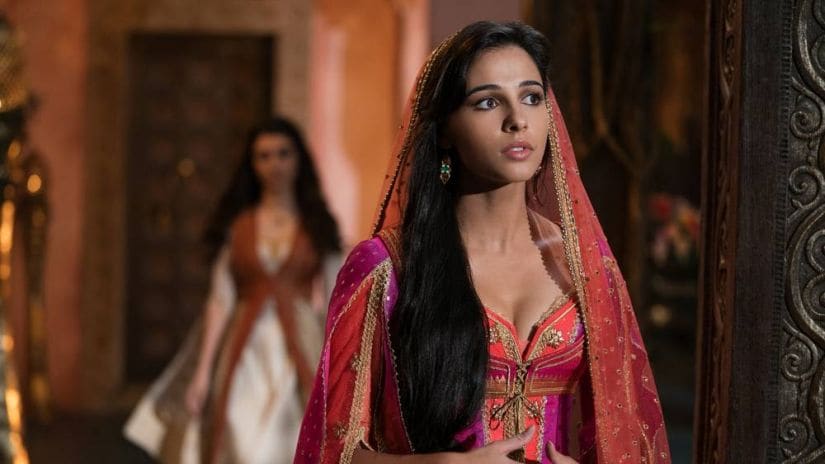
Princess Jasmine was a groundbreaking character even at the time of its inception in the 1992 Aladdin animated film. But the live-action remake trumps that portrayal by a mile. Naomi Scott's Princess Jasmine is ironically not a princess, at least not in her head.Disney had crystallised the notion of a princess as a perpetual damsel in distress, waiting to be rescued by a Prince Charming. Over the years, when the studio moved with the times, it made several progressions. Some of these were in the form of Jasmine's predecessors, Ariel from The Little Mermaid (1989) and Belle from Beauty and The Beast (1991). But Jasmine was unique for various reasons.Princess Jasmine in a still from AladdinFirstly, she was the first non-white Disney princess. Secondly, her role was not the focal point of the film she was a part of. While her character was admired for having the "agency to choose her prince" and for being a symbol of "feminist consciousness", she was subsequently criticised for she did not have a "more pressing role apart from being "Aladdin's love interest". Moreover, allegations of racial appropriation were also hurled at Disney for anglicising a Middle-Eastern princess. Joanna Kadi, in her book Thinking Class: Sketches From A Cultural Worker, claimed Jasmine was "as Arab as baseball and apple pie".At the time it did not feel out of place since Aladdin was designed as a fantasy. Jasmine was a rebel of limited cause. Yes, she enjoyed the agency to choose her prince, and at a later stage, also ridiculed her father, the Sultan, for objectifying her as a prize. Yes, she did often sneak out of her palace to interact with the commoners in disguise. But the intention behind the same was only to escape the claustrophobia of being born into a fiercely protected environment.The Jasmine of Guy Ritchie's Aladdin is given ambition. This ambition is not restricted to the guilty pleasure of roaming the streets under a veil. The idea behind exploring the city covertly is to acquaint herself with her subjects, whom she wishes to rule in the future. Though she reluctantly gives in to her father's request of entertaining her suitors, she always treats them as greedy men vying for her father's kingdom. She is aware that the Sultan's intention to get her married to a prince of another state also stems from an expansionist approach.Naomi Scott as Jasmine in a still from AladdinThese shades of Jasmine, save the aspiration to become the Sultan instead of marrying one, are also seen in the original animated version. However, the resolution in that film was so hackneyed that it ultimately shows Jasmine resigning to patriarchy. Buried under 1,000 years of patriarchy, she certainly has conflicts of her own.
But Scott's Jasmine is a Sultan at heart. All the men around her, including Aladdin, Jafar and Sultan, did not approve of (or even foresee) her as the next Sultan because of their conditioning. But Jasmine had the vision to see 'A Whole New World' out there, where women inclined to rule kingdoms would serve as the ideal Sultan (and not a Sultanah).
Her political ideology as the ruler of Agrabah is evident in her conversations with her father and Jafar. She seemed a better king than her father because unlike him, she was willing to bend the law and also interact more with the people of Agrabah to gauge what they actually need. She probably inherited this approach from her mother, who, as revealed early in the film, was killed on the streets. She is seen quoting her mother in one of the scenes, "A Sultan can be as happy as the least happy subject of their kingdom." She also proves she does not have the streak of a conqueror like Jafar when she vehemently opposes his proposition of invading her mother's kingdom. She believes in consolidating her kingdom more than expanding it.*Spoiler* In the end, when she does become the Sultan and changes the law immediately, she proves that she always had the vision to rule a kingdom and bring change to the archaic rules that restricted its prosperity. *Spoiler alert ends*In the deserted land of Agrabah, Jasmine was originally introduced in a blue ensemble, symbolising water, sitting next to a fountain. She was thus presented as "the most precious thing one can find in the desert". Fittingly so, since the original Aladdin revolved around the titular character's quest to win over Jasmine. The remake projects Jasmine not as a precious object to be won over, but as a 'diamond in the rough'.All images from Twitter.