
Advertisement
Co Presented By
Co Presented By


Sections
5 top Indian cars fail global NCAP safety test
Hyundai Eon, Maruti Suzuki Eeco, Maruti Celerio, Mahindra Scorpio and three models of Renault Kwid failed in crash tests carried by Global New Car Assessment Programme

Some of the most popular Indian cars that have been clocking robust sales and are the local customers' preferred choice for their dream cars have failed the crash test carried out by a UK-based organisation.![alto-GNCAP]() The most notable four-wheeler names such as Hyundai Eon, Maruti Suzuki Eeco, Maruti Celerio, Mahindra Scorpio and three models of Renault Kwid failed in crash tests carried by Global New Car Assessment Programme (NCAP).These seven cars scored zero stars for adults on safety parameters when these were crashed at 64 kmph speed."The Renault Kwid, Maruti Suzuki Celerio, Maruti Suzuki Eeco, Mahindra Scorpio and Hyundai Eon all showed low levels of adult occupant protection," said a statement from a UK-based safety watchdog.David Ward, the secretary general of Global NCAP, said that "The latest SaferCarsforIndia results show how important it is for cars to have a body shell that can remain stable in a crash. This is an absolutely crucial pre-requisite for occupant safety together with fitment at least of front air bags. It is very surprising that a manufacturer like Renault introduced the Kwid initially lacking this essential feature.""Global NCAP strongly believes that no manufacturer anywhere in the world should be developing new models that are so clearly sub-standard. Car makers must ensure that their new models pass the UN's minimum crash test regulations, and support use of an airbag," said Ward.Among the seven cars tested this time six scored two stars for child occupants and Maruti Celerio scored one.In the past three years, the global NCAP has tested 16 vehicles of which only two vehicles of Toyota and Volkswagen scored four star ratings for adult occupants.enaults fast selling small car Kwid was tested in three versions, including one with airbags, but each was rated as zero star for adult safety, Global NCAP said, adding as a result of the crash testing the company has sought to improve the safety performance of the Kwid."It is very surprising that a manufacturer like Renault introduced the Kwid initially lacking this essential feature. Global NCAP strongly believes that no manufacturer anywhere in the world should be developing new models that are so clearly sub-standard," Ward said.Car makers must ensure that their new models pass the UNs minimum crash test regulations, and support the use of airbag, he added.When contacted, Renault India Operations Country CEO & Managing Director Sumit Sawhney told PTI: "We appreciate Global NCAP recognising Renaults efforts and commitment to safety enhancement. Safety is of paramount importance for Renault and all our products meet and exceed the requisite safety standards set by Indian Regulatory Authorities."Stating the Indian government has announced that the crash test regulation for the existing cars will come into effect in 2019 and for the new cars in 2017, he said: "We are already future-ready in terms of technology, design and engineering for enhanced safety for all our vehicles. Renault is committed to comply with these timelines."While Maruti Suzuki declined to comment, comments from Hyundai and Mahindra & Mahindra could not be immediately obtained.Industry experts, however questioned why Global NCAP tested vehicles at a speed of 64kmph while the frontal offset regulation in Europe and US, which have the most advanced safety standards, is to test them at 56 kmph. India is also adopting 56 kmph in its regulations from 2017."Theres no scientific reason whatsoever of testing cars at 64kmph and then failing them. Testing a car at 64 kmph by crashing it against a wall in lab conditions is equivalent to about 120 kmph speed in real life, road crash conditions," said in official of an automobile company, on anonymity.Below are the videos of seven Indian cars that failed the crash test carried by NCAP.1) Hyundai Eon - No Airbags2) Maruti Suzuki Eeco - No Airbags3) Maruti Suzuki Celerio - No Airbags4) Mahindra Scorpio - No Airbags5) Renault Kwid (I) - No Airbags6) Renault Kwid (III) - No Airbags7) Renault Kwid (III) - Driver Airbag
The most notable four-wheeler names such as Hyundai Eon, Maruti Suzuki Eeco, Maruti Celerio, Mahindra Scorpio and three models of Renault Kwid failed in crash tests carried by Global New Car Assessment Programme (NCAP).These seven cars scored zero stars for adults on safety parameters when these were crashed at 64 kmph speed."The Renault Kwid, Maruti Suzuki Celerio, Maruti Suzuki Eeco, Mahindra Scorpio and Hyundai Eon all showed low levels of adult occupant protection," said a statement from a UK-based safety watchdog.David Ward, the secretary general of Global NCAP, said that "The latest SaferCarsforIndia results show how important it is for cars to have a body shell that can remain stable in a crash. This is an absolutely crucial pre-requisite for occupant safety together with fitment at least of front air bags. It is very surprising that a manufacturer like Renault introduced the Kwid initially lacking this essential feature.""Global NCAP strongly believes that no manufacturer anywhere in the world should be developing new models that are so clearly sub-standard. Car makers must ensure that their new models pass the UN's minimum crash test regulations, and support use of an airbag," said Ward.Among the seven cars tested this time six scored two stars for child occupants and Maruti Celerio scored one.In the past three years, the global NCAP has tested 16 vehicles of which only two vehicles of Toyota and Volkswagen scored four star ratings for adult occupants.enaults fast selling small car Kwid was tested in three versions, including one with airbags, but each was rated as zero star for adult safety, Global NCAP said, adding as a result of the crash testing the company has sought to improve the safety performance of the Kwid."It is very surprising that a manufacturer like Renault introduced the Kwid initially lacking this essential feature. Global NCAP strongly believes that no manufacturer anywhere in the world should be developing new models that are so clearly sub-standard," Ward said.Car makers must ensure that their new models pass the UNs minimum crash test regulations, and support the use of airbag, he added.When contacted, Renault India Operations Country CEO & Managing Director Sumit Sawhney told PTI: "We appreciate Global NCAP recognising Renaults efforts and commitment to safety enhancement. Safety is of paramount importance for Renault and all our products meet and exceed the requisite safety standards set by Indian Regulatory Authorities."Stating the Indian government has announced that the crash test regulation for the existing cars will come into effect in 2019 and for the new cars in 2017, he said: "We are already future-ready in terms of technology, design and engineering for enhanced safety for all our vehicles. Renault is committed to comply with these timelines."While Maruti Suzuki declined to comment, comments from Hyundai and Mahindra & Mahindra could not be immediately obtained.Industry experts, however questioned why Global NCAP tested vehicles at a speed of 64kmph while the frontal offset regulation in Europe and US, which have the most advanced safety standards, is to test them at 56 kmph. India is also adopting 56 kmph in its regulations from 2017."Theres no scientific reason whatsoever of testing cars at 64kmph and then failing them. Testing a car at 64 kmph by crashing it against a wall in lab conditions is equivalent to about 120 kmph speed in real life, road crash conditions," said in official of an automobile company, on anonymity.Below are the videos of seven Indian cars that failed the crash test carried by NCAP.1) Hyundai Eon - No Airbags2) Maruti Suzuki Eeco - No Airbags3) Maruti Suzuki Celerio - No Airbags4) Mahindra Scorpio - No Airbags5) Renault Kwid (I) - No Airbags6) Renault Kwid (III) - No Airbags7) Renault Kwid (III) - Driver Airbag
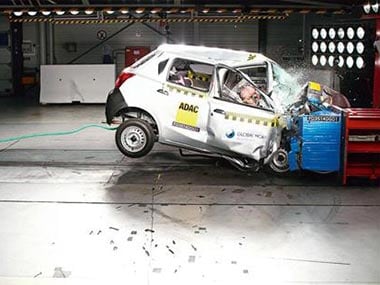 The most notable four-wheeler names such as Hyundai Eon, Maruti Suzuki Eeco, Maruti Celerio, Mahindra Scorpio and three models of Renault Kwid failed in crash tests carried by Global New Car Assessment Programme (NCAP).These seven cars scored zero stars for adults on safety parameters when these were crashed at 64 kmph speed."The Renault Kwid, Maruti Suzuki Celerio, Maruti Suzuki Eeco, Mahindra Scorpio and Hyundai Eon all showed low levels of adult occupant protection," said a statement from a UK-based safety watchdog.David Ward, the secretary general of Global NCAP, said that "The latest SaferCarsforIndia results show how important it is for cars to have a body shell that can remain stable in a crash. This is an absolutely crucial pre-requisite for occupant safety together with fitment at least of front air bags. It is very surprising that a manufacturer like Renault introduced the Kwid initially lacking this essential feature.""Global NCAP strongly believes that no manufacturer anywhere in the world should be developing new models that are so clearly sub-standard. Car makers must ensure that their new models pass the UN's minimum crash test regulations, and support use of an airbag," said Ward.Among the seven cars tested this time six scored two stars for child occupants and Maruti Celerio scored one.In the past three years, the global NCAP has tested 16 vehicles of which only two vehicles of Toyota and Volkswagen scored four star ratings for adult occupants.enaults fast selling small car Kwid was tested in three versions, including one with airbags, but each was rated as zero star for adult safety, Global NCAP said, adding as a result of the crash testing the company has sought to improve the safety performance of the Kwid."It is very surprising that a manufacturer like Renault introduced the Kwid initially lacking this essential feature. Global NCAP strongly believes that no manufacturer anywhere in the world should be developing new models that are so clearly sub-standard," Ward said.Car makers must ensure that their new models pass the UNs minimum crash test regulations, and support the use of airbag, he added.When contacted, Renault India Operations Country CEO & Managing Director Sumit Sawhney told PTI: "We appreciate Global NCAP recognising Renaults efforts and commitment to safety enhancement. Safety is of paramount importance for Renault and all our products meet and exceed the requisite safety standards set by Indian Regulatory Authorities."Stating the Indian government has announced that the crash test regulation for the existing cars will come into effect in 2019 and for the new cars in 2017, he said: "We are already future-ready in terms of technology, design and engineering for enhanced safety for all our vehicles. Renault is committed to comply with these timelines."While Maruti Suzuki declined to comment, comments from Hyundai and Mahindra & Mahindra could not be immediately obtained.Industry experts, however questioned why Global NCAP tested vehicles at a speed of 64kmph while the frontal offset regulation in Europe and US, which have the most advanced safety standards, is to test them at 56 kmph. India is also adopting 56 kmph in its regulations from 2017."Theres no scientific reason whatsoever of testing cars at 64kmph and then failing them. Testing a car at 64 kmph by crashing it against a wall in lab conditions is equivalent to about 120 kmph speed in real life, road crash conditions," said in official of an automobile company, on anonymity.Below are the videos of seven Indian cars that failed the crash test carried by NCAP.1) Hyundai Eon - No Airbags
First Published:May 17, 2016, 18:31:21 IST
Advertisement
Advertisement

India remains among fastest-growing major economies despite global uncertainty, says RBI Bulletin
RBI says industrial and services activity stayed resilient through June, while strong trade, stable external sector and improving foreign investment continue to support economic growth.
1 min read
Iran war could cut global growth by more than half: World Bank’s chief economist Indermit Gill
Prolonged US-Iran conflict could fuel inflation, push up borrowing costs and deepen debt distress across developing economies, says Indermit Gill
2 min read
Brent crude climbs to $94 as analysts expect oil prices to stay in $90–100 range
Rising US-Iran tensions and tight OPEC+ supply have pushed crude to a five-week high, but experts believe prices are unlikely to sustain a rally beyond $100 without a major supply disruption.
1 min read
UK inflation cools further to 2.6% in June as transport and food prices ease
Softer price growth in transport and food categories helps push headline inflation lower, while core inflation remains sticky.
1 min read
India's gem and jewellery exports jump 26.5% in June on stronger global demand
Lower gold prices, healthy overseas demand and rising exports of gold jewellery, diamonds and lab-grown diamonds drive sharp recovery in June
1 min read
Advertisement
Advertisement