
Advertisement
Co Presented By
Co Presented By


Sections
Thyssenkrupp agrees to restructuring approach with labour leaders, could lead to loss of 6,000 jobs
The management and labour leaders at Germany’s Thyssenkrupp have agreed on a way forward after the industrial conglomerate announced a fresh restructuring drive that could lead to the loss of 6,000 jobs.

Duesseldorf: Management and labour leaders at Germany’s Thyssenkrupp have agreed on a way forward after the industrial conglomerate announced a fresh restructuring drive that could lead to the loss of 6,000 jobs.Agreement was reached in talks between management and workers overnight to recognise the need for radical action whilst ensuring fair treatment of employees at the Essen-based group, a senior workers’ leader told Reuters.CEO Guido Kerkhoff announced the overhaul on Friday, ditching plans to split the business into two and abandoning a European steel merger with India’s Tata Steel.The group will adopt a holding structure and plans to list its elevators unit, its most successful business.The decision, first reported by Reuters, triggered a 28 percent recovery in Thyssenkrupp shares—their biggest daily gain—as Kerkhoff abandoned a cross-shareholding structuring that had ceased to be financially viable.![A logo of Thyssenkrupp AG is pictured at the company's headquarters in Essen, Germany. Reuters]() A logo of Thyssenkrupp AG is pictured at the company's headquarters in Essen, Germany. Reuters[/caption]The restructuring will lead to the loss of around 4 percent of the workforce. Some 4,000 jobs would go in Germany, where labour protection is strong and companies usually try to negotiate job cuts before resorting to forced layoffs.Kerkhoff’s reversal bowed to months of pressure from investors who have demanded more radical steps to turn around the steel-to-submarines group and realise shareholder value - in particular by floating its profitable elevators business.They reckon that the elevators business is worth 14 billion euros—twice the value of the parent—reflecting a so-called conglomerate discount that already has forced other industrials, including Siemens and GE, to take more or less radical action to reduce corporate sprawl.
A logo of Thyssenkrupp AG is pictured at the company's headquarters in Essen, Germany. Reuters[/caption]The restructuring will lead to the loss of around 4 percent of the workforce. Some 4,000 jobs would go in Germany, where labour protection is strong and companies usually try to negotiate job cuts before resorting to forced layoffs.Kerkhoff’s reversal bowed to months of pressure from investors who have demanded more radical steps to turn around the steel-to-submarines group and realise shareholder value - in particular by floating its profitable elevators business.They reckon that the elevators business is worth 14 billion euros—twice the value of the parent—reflecting a so-called conglomerate discount that already has forced other industrials, including Siemens and GE, to take more or less radical action to reduce corporate sprawl.
“Now it is up to shareholders to decide whether Thyssenkrupp steers towards a (viable) future, or towards conflict,” said Markus Grolms, deputy head of the Thyssenkrupp works council who represents the IG Metall industrial trade union.Thyssenkrupp personnel chief Oliver Burkhard confirmed that agreement had been reached with labour leaders. Further details were not immediately available ahead of a supervisory board meeting on 21 May to vote on the plan.[caption id="attachment_6615131" align="alignleft" width="380"]
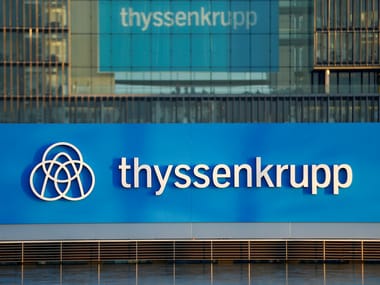 A logo of Thyssenkrupp AG is pictured at the company's headquarters in Essen, Germany. Reuters[/caption]The restructuring will lead to the loss of around 4 percent of the workforce. Some 4,000 jobs would go in Germany, where labour protection is strong and companies usually try to negotiate job cuts before resorting to forced layoffs.Kerkhoff’s reversal bowed to months of pressure from investors who have demanded more radical steps to turn around the steel-to-submarines group and realise shareholder value - in particular by floating its profitable elevators business.They reckon that the elevators business is worth 14 billion euros—twice the value of the parent—reflecting a so-called conglomerate discount that already has forced other industrials, including Siemens and GE, to take more or less radical action to reduce corporate sprawl.
First Published:May 11, 2019, 19:58:18 IST
Advertisement
Advertisement

India remains among fastest-growing major economies despite global uncertainty, says RBI Bulletin
RBI says industrial and services activity stayed resilient through June, while strong trade, stable external sector and improving foreign investment continue to support economic growth.
1 min read
Iran war could cut global growth by more than half: World Bank’s chief economist Indermit Gill
Prolonged US-Iran conflict could fuel inflation, push up borrowing costs and deepen debt distress across developing economies, says Indermit Gill
2 min read
Brent crude climbs to $94 as analysts expect oil prices to stay in $90–100 range
Rising US-Iran tensions and tight OPEC+ supply have pushed crude to a five-week high, but experts believe prices are unlikely to sustain a rally beyond $100 without a major supply disruption.
1 min read
UK inflation cools further to 2.6% in June as transport and food prices ease
Softer price growth in transport and food categories helps push headline inflation lower, while core inflation remains sticky.
1 min read
India's gem and jewellery exports jump 26.5% in June on stronger global demand
Lower gold prices, healthy overseas demand and rising exports of gold jewellery, diamonds and lab-grown diamonds drive sharp recovery in June
1 min read
Advertisement
Advertisement