
Advertisement
Co Presented By
Co Presented By


Sections
Nirmala Sitharaman wrong in playing down Rahul Bajaj criticism: How does questioning govt hurt national interest?
Soon after Bajaj’s comment, Biocon chief Kiran Mazumdar Shaw tweeted her views on the same lines.

It is not in national interest to spread “one’s own impressions” by way of criticism and questions; instead one should seek answers from the government, said Union Finance Minister Nirmala Sitharaman, on Twitter responding to billionaire Rahul Bajaj’s recent statements that this government isn’t fond of questions.There is ‘an atmosphere of fear” prevalent in the country about which none of his industry colleagues will talk about publicly, Bajaj said, speaking at an award function in Mumbai late on Saturday. Sitharaman said: “Questions/criticisms are heard and answered/addressed. Always a better way to seek an answer than spreading one’s own impressions which, on gaining traction, can hurt national interest.”![825]() To begin with, Sitharaman’s statement that expressing one’s views in public on matters concerning the country could hurt national interest is unfortunate. Especially, as this comes from a senior minister in the government. It is even surprising given the fact the very idea of a democracy mandates that every citizen is entitled to question the government’s actions without fear.[caption id="attachment_7679911" align="alignleft" width="380"]
To begin with, Sitharaman’s statement that expressing one’s views in public on matters concerning the country could hurt national interest is unfortunate. Especially, as this comes from a senior minister in the government. It is even surprising given the fact the very idea of a democracy mandates that every citizen is entitled to question the government’s actions without fear.[caption id="attachment_7679911" align="alignleft" width="380"]![Union Finance Minister Nirmala Sitharaman addresses the media after a cabinet meeting, in New Delhi. PTI]() File image of Union Finance Minister Nirmala Sitharaman. PTI[/caption]The question that arises is: How is criticising the government publicly causing hurt in national interest? On a closer look, there is also a veiled warning in Sitharaman’s statement that will discourage the industry from voicing their criticism. This is because questioning the government could be seen as a bid to hurt 'national interest'. That’s exactly the situation Bajaj is cautioning against.Soon after Bajaj’s comment, Biocon chief Kiran Mazumdar Shaw tweeted her views on the same lines.This isn’t the first time industry captains have publicly voiced their concerns on the government not welcoming criticism. Earlier, influential industrialists had commented that there is an element of fear among them with respect to actions by government agencies if they criticise the government.Let’s forget the politics of it for a moment and stick to the part concerning the current economic situation. With the economy slipping at a much faster pace than what economists initially thought and in the backdrop of the government’s various measures failing to bring back momentum, it goes without saying that it is of utmost importance for the government to consult industry captains and other stakeholders to find ways to rebuild the slowing economy. This is especially important given the fact that the current economic slowdown is more on account of a major demand slump, loss of business confidence and dwindling private investments.Private investors, somehow, are not willing to put money on the table in India and have stayed on the sidelines all along. It is only government spending that has supported economic growth, mainly in the recent past. The consumption momentum has faded across sectors and this has been reflecting on the numbers of automakers, fast-moving consumer goods (FMCG) companies and in the construction/real estate industry.It is increasingly clear that the government isn’t in sync with the ground reality as far as the economic situation is concerned. Two key reasons for the current economic mess, as pointed out by this writer in earlier columns, are flawed government policies and the lack of consumer/business confidence about future economic outlook. Along with these and the prevalent global scenario, there are a host of other factors including distress in the rural economy, skyrocketing unemployment, absence of land/labour reforms and frequent flip-flops in government policies, which has created a state of confusion among industries.
File image of Union Finance Minister Nirmala Sitharaman. PTI[/caption]The question that arises is: How is criticising the government publicly causing hurt in national interest? On a closer look, there is also a veiled warning in Sitharaman’s statement that will discourage the industry from voicing their criticism. This is because questioning the government could be seen as a bid to hurt 'national interest'. That’s exactly the situation Bajaj is cautioning against.Soon after Bajaj’s comment, Biocon chief Kiran Mazumdar Shaw tweeted her views on the same lines.This isn’t the first time industry captains have publicly voiced their concerns on the government not welcoming criticism. Earlier, influential industrialists had commented that there is an element of fear among them with respect to actions by government agencies if they criticise the government.Let’s forget the politics of it for a moment and stick to the part concerning the current economic situation. With the economy slipping at a much faster pace than what economists initially thought and in the backdrop of the government’s various measures failing to bring back momentum, it goes without saying that it is of utmost importance for the government to consult industry captains and other stakeholders to find ways to rebuild the slowing economy. This is especially important given the fact that the current economic slowdown is more on account of a major demand slump, loss of business confidence and dwindling private investments.Private investors, somehow, are not willing to put money on the table in India and have stayed on the sidelines all along. It is only government spending that has supported economic growth, mainly in the recent past. The consumption momentum has faded across sectors and this has been reflecting on the numbers of automakers, fast-moving consumer goods (FMCG) companies and in the construction/real estate industry.It is increasingly clear that the government isn’t in sync with the ground reality as far as the economic situation is concerned. Two key reasons for the current economic mess, as pointed out by this writer in earlier columns, are flawed government policies and the lack of consumer/business confidence about future economic outlook. Along with these and the prevalent global scenario, there are a host of other factors including distress in the rural economy, skyrocketing unemployment, absence of land/labour reforms and frequent flip-flops in government policies, which has created a state of confusion among industries.
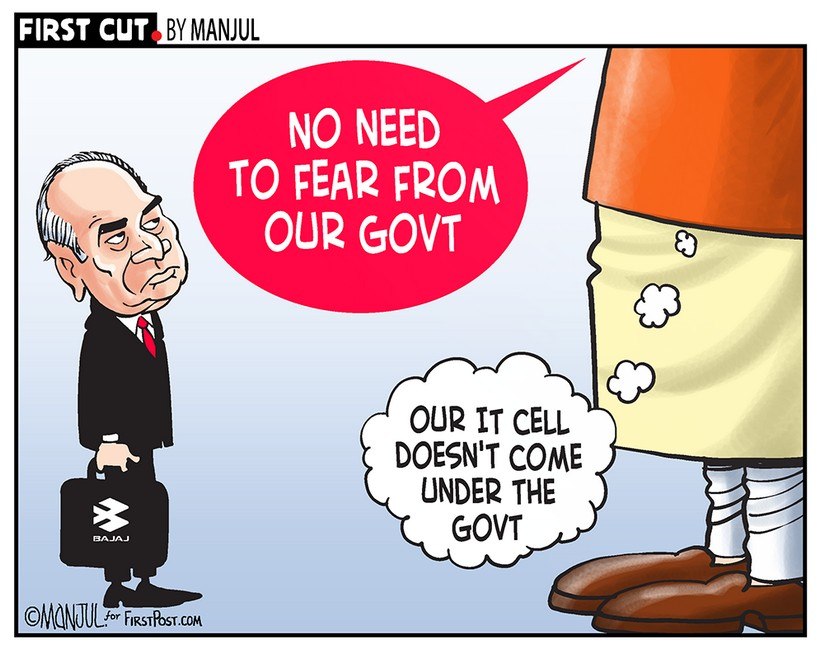 To begin with, Sitharaman’s statement that expressing one’s views in public on matters concerning the country could hurt national interest is unfortunate. Especially, as this comes from a senior minister in the government. It is even surprising given the fact the very idea of a democracy mandates that every citizen is entitled to question the government’s actions without fear.[caption id="attachment_7679911" align="alignleft" width="380"]
 File image of Union Finance Minister Nirmala Sitharaman. PTI[/caption]The question that arises is: How is criticising the government publicly causing hurt in national interest? On a closer look, there is also a veiled warning in Sitharaman’s statement that will discourage the industry from voicing their criticism. This is because questioning the government could be seen as a bid to hurt 'national interest'. That’s exactly the situation Bajaj is cautioning against.Soon after Bajaj’s comment, Biocon chief Kiran Mazumdar Shaw tweeted her views on the same lines.This isn’t the first time industry captains have publicly voiced their concerns on the government not welcoming criticism. Earlier, influential industrialists had commented that there is an element of fear among them with respect to actions by government agencies if they criticise the government.Let’s forget the politics of it for a moment and stick to the part concerning the current economic situation. With the economy slipping at a much faster pace than what economists initially thought and in the backdrop of the government’s various measures failing to bring back momentum, it goes without saying that it is of utmost importance for the government to consult industry captains and other stakeholders to find ways to rebuild the slowing economy. This is especially important given the fact that the current economic slowdown is more on account of a major demand slump, loss of business confidence and dwindling private investments.Private investors, somehow, are not willing to put money on the table in India and have stayed on the sidelines all along. It is only government spending that has supported economic growth, mainly in the recent past. The consumption momentum has faded across sectors and this has been reflecting on the numbers of automakers, fast-moving consumer goods (FMCG) companies and in the construction/real estate industry.It is increasingly clear that the government isn’t in sync with the ground reality as far as the economic situation is concerned. Two key reasons for the current economic mess, as pointed out by this writer in earlier columns, are flawed government policies and the lack of consumer/business confidence about future economic outlook. Along with these and the prevalent global scenario, there are a host of other factors including distress in the rural economy, skyrocketing unemployment, absence of land/labour reforms and frequent flip-flops in government policies, which has created a state of confusion among industries.
The comments of Bajaj and Shaw indicate that the industry is not taken into confidence in policy formulation and consultation in the desired manner. This is counterproductive in the present economic juncture.When the economy is collapsing due to a demand slump and government measures are failing, it is vital for the government to keep its ears open to industry captains and consult them for solutions. Questioning the government and criticising its actions are certainly, in the national interest.
First Published:Dec 02, 2019, 10:59:45 IST
Advertisement
Advertisement

Air India to cut Delhi-Toronto flight time by 3 hours, resume non-stop services from August 1
Air India will resume non-stop Delhi-Toronto flights from August 1, cutting travel time by nearly three hours and deploying its new Boeing 787-9 Dreamliner on the route
2 min read
South Korea economy grows faster than expected in Q2 as chip exports power recovery
South Korea’s economy grew 0.6% in the second quarter, beating expectations as strong semiconductor exports offset weakness in construction investment and domestic demand
2 min read
India remains among fastest-growing major economies despite global uncertainty, says RBI Bulletin
RBI says industrial and services activity stayed resilient through June, while strong trade, stable external sector and improving foreign investment continue to support economic growth.
1 min read
Iran war could cut global growth by more than half: World Bank’s chief economist Indermit Gill
Prolonged US-Iran conflict could fuel inflation, push up borrowing costs and deepen debt distress across developing economies, says Indermit Gill
2 min read
Brent crude climbs to $94 as analysts expect oil prices to stay in $90–100 range
Rising US-Iran tensions and tight OPEC+ supply have pushed crude to a five-week high, but experts believe prices are unlikely to sustain a rally beyond $100 without a major supply disruption.
1 min read
Advertisement
Advertisement