
Advertisement
Co Presented By
Co Presented By


Sections
Missing consumer expenditure survey: Everyone knows what the numbers signal; opaqueness will only widen trust deficit
One just needs to look at the sales figures of auto makers, FMCG companies and state of the manufacturing and construction sector to understand where does the consumer confidence indicators point at this stage.

The Statistics and Programme Implementation Ministry (MOSPI) has said the government will not release the findings of Consumer Expenditure Survey for 2017-18. The findings of the survey have been withheld citing data quality issues. The survey was carried out during July 2017 to June 2018.![Representational image. Reuters.]() Representational image. Reuters.[/caption]International rating agency, Moody’s has forecast a full year growth of 5.6 percent this year. Japanese brokerage Nomura has gone a step further to cut the GDP forecast to a 4.9 percent as against its earlier forecast of 5.7 percent noting that the economy is going through a 'deeper trough' and any chances of recovery are far away. The United Nations Conference on Trade and Development (UNCTAD) has pegged India's economic growth rate at a seven-year low of 6 percent.There have been a few instances in the past when the country’s data credibility has been questioned including the relevance and accuracy of the new GDP series that showed a sharp jump in national income. Experts questioned the new series citing lack of disconnect with a range of high frequency indicators on the ground such as flow of bank credit, poor auto and FMCG sales, rising unemployment and slowdown in manufacturing and agriculture sectors.Former chief economic advisor, Arvind Subramanian openly criticized the new GDP numbers explaining lack of correlation with ground reality. Similarly, the government allegedly delayed the release of the National Sample Survey Office’s (NSSO) job survey for 2017-18 that showed a spike in the unemployment rate at 6.1 per cent, a 45-year high, calling it a draft report. This was later released after the findings appeared in the media.Lack of transparency in timely dissemination of crucial data that concerns a larger section of the economy, especially the economically weak, will only help to widen the trust deficit that already exists on India’s official data. In fact, we already know what the numbers indicate. There are very clear indications that household consumption has declined in the recent months on account of poor economic situation.For instance, according to a survey conducted by the Reserve Bank of India (RBI), consumer confidence declined to a six-year low in September as sentiment on the overall economic conditions and employment availability expectations remained negative among households. The survey was conducted among 5,192 households in 13 major cities with respect to perceptions and expectations on the general economic situation, the employment scenario, the overall price situation and their own income and spending.One just needs to look at the sales figures of auto makers, FMCG companies and state of the manufacturing and construction sector to understand where does the consumer confidence indicators point at this stage. Facts don’t change. But, the point here is allegations that government is hiding official data will raise further questions on the credibility of the government’s statistics department and widen the trust deficit that already exists. That wouldn’t augur well for an ambitious economy.
Representational image. Reuters.[/caption]International rating agency, Moody’s has forecast a full year growth of 5.6 percent this year. Japanese brokerage Nomura has gone a step further to cut the GDP forecast to a 4.9 percent as against its earlier forecast of 5.7 percent noting that the economy is going through a 'deeper trough' and any chances of recovery are far away. The United Nations Conference on Trade and Development (UNCTAD) has pegged India's economic growth rate at a seven-year low of 6 percent.There have been a few instances in the past when the country’s data credibility has been questioned including the relevance and accuracy of the new GDP series that showed a sharp jump in national income. Experts questioned the new series citing lack of disconnect with a range of high frequency indicators on the ground such as flow of bank credit, poor auto and FMCG sales, rising unemployment and slowdown in manufacturing and agriculture sectors.Former chief economic advisor, Arvind Subramanian openly criticized the new GDP numbers explaining lack of correlation with ground reality. Similarly, the government allegedly delayed the release of the National Sample Survey Office’s (NSSO) job survey for 2017-18 that showed a spike in the unemployment rate at 6.1 per cent, a 45-year high, calling it a draft report. This was later released after the findings appeared in the media.Lack of transparency in timely dissemination of crucial data that concerns a larger section of the economy, especially the economically weak, will only help to widen the trust deficit that already exists on India’s official data. In fact, we already know what the numbers indicate. There are very clear indications that household consumption has declined in the recent months on account of poor economic situation.For instance, according to a survey conducted by the Reserve Bank of India (RBI), consumer confidence declined to a six-year low in September as sentiment on the overall economic conditions and employment availability expectations remained negative among households. The survey was conducted among 5,192 households in 13 major cities with respect to perceptions and expectations on the general economic situation, the employment scenario, the overall price situation and their own income and spending.One just needs to look at the sales figures of auto makers, FMCG companies and state of the manufacturing and construction sector to understand where does the consumer confidence indicators point at this stage. Facts don’t change. But, the point here is allegations that government is hiding official data will raise further questions on the credibility of the government’s statistics department and widen the trust deficit that already exists. That wouldn’t augur well for an ambitious economy.
Why is this survey important? This is a crucial study that collects information regarding expenditure on consumption of goods and services (food and non-food) consumed by households. The results, after release, are also used for rebasing of the gross domestic product (GDP) and other macro-economic indicators.What did the 2017-18 survey find about the household expenditure pattern? Since the government is not releasing the data, there is no official version. But, a Business Standard report which quoted the results of the Household Consumer Expenditure Survey said that consumer spending fell for the first time in more than four decades in 2017-18, thanks to the falling rural demand. The average amount of money spent by a person in a month fell by 3.7 per cent to Rs 1,446 in 2017-18 from Rs 1,501 in 2011-12, the report said.The survey findings, if true, are even more critical at this stage when the Indian economy is on a rough patch. The Gross Domestic Product (GDP) for the April-June quarter came at a seven-year low of 5 percent. The September quarter, for which the data is due, is likely to be even worse because most high frequency economic indicators have been showing further deterioration. An SBI research report pegged the September quarter GDP figure at 4.2 percent. If that happens, that will be the lowest quarterly growth in 30 quarters ever since the new series, with 2011-12 base, was introduced.[caption id="attachment_4147477" align="alignleft" width="380"]
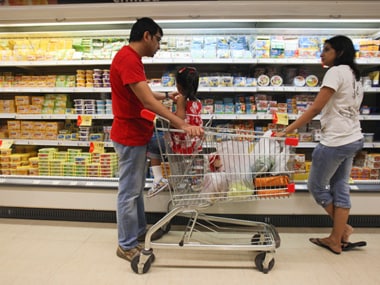 Representational image. Reuters.[/caption]International rating agency, Moody’s has forecast a full year growth of 5.6 percent this year. Japanese brokerage Nomura has gone a step further to cut the GDP forecast to a 4.9 percent as against its earlier forecast of 5.7 percent noting that the economy is going through a 'deeper trough' and any chances of recovery are far away. The United Nations Conference on Trade and Development (UNCTAD) has pegged India's economic growth rate at a seven-year low of 6 percent.There have been a few instances in the past when the country’s data credibility has been questioned including the relevance and accuracy of the new GDP series that showed a sharp jump in national income. Experts questioned the new series citing lack of disconnect with a range of high frequency indicators on the ground such as flow of bank credit, poor auto and FMCG sales, rising unemployment and slowdown in manufacturing and agriculture sectors.Former chief economic advisor, Arvind Subramanian openly criticized the new GDP numbers explaining lack of correlation with ground reality. Similarly, the government allegedly delayed the release of the National Sample Survey Office’s (NSSO) job survey for 2017-18 that showed a spike in the unemployment rate at 6.1 per cent, a 45-year high, calling it a draft report. This was later released after the findings appeared in the media.Lack of transparency in timely dissemination of crucial data that concerns a larger section of the economy, especially the economically weak, will only help to widen the trust deficit that already exists on India’s official data. In fact, we already know what the numbers indicate. There are very clear indications that household consumption has declined in the recent months on account of poor economic situation.For instance, according to a survey conducted by the Reserve Bank of India (RBI), consumer confidence declined to a six-year low in September as sentiment on the overall economic conditions and employment availability expectations remained negative among households. The survey was conducted among 5,192 households in 13 major cities with respect to perceptions and expectations on the general economic situation, the employment scenario, the overall price situation and their own income and spending.One just needs to look at the sales figures of auto makers, FMCG companies and state of the manufacturing and construction sector to understand where does the consumer confidence indicators point at this stage. Facts don’t change. But, the point here is allegations that government is hiding official data will raise further questions on the credibility of the government’s statistics department and widen the trust deficit that already exists. That wouldn’t augur well for an ambitious economy.
First Published:Nov 16, 2019, 09:58:13 IST
Advertisement
Advertisement

India remains among fastest-growing major economies despite global uncertainty, says RBI Bulletin
RBI says industrial and services activity stayed resilient through June, while strong trade, stable external sector and improving foreign investment continue to support economic growth.
1 min read
Iran war could cut global growth by more than half: World Bank’s chief economist Indermit Gill
Prolonged US-Iran conflict could fuel inflation, push up borrowing costs and deepen debt distress across developing economies, says Indermit Gill
2 min read
Brent crude climbs to $94 as analysts expect oil prices to stay in $90–100 range
Rising US-Iran tensions and tight OPEC+ supply have pushed crude to a five-week high, but experts believe prices are unlikely to sustain a rally beyond $100 without a major supply disruption.
1 min read
UK inflation cools further to 2.6% in June as transport and food prices ease
Softer price growth in transport and food categories helps push headline inflation lower, while core inflation remains sticky.
1 min read
India's gem and jewellery exports jump 26.5% in June on stronger global demand
Lower gold prices, healthy overseas demand and rising exports of gold jewellery, diamonds and lab-grown diamonds drive sharp recovery in June
1 min read
Advertisement
Advertisement