
Advertisement
Co Presented By
Co Presented By


Sections
Mahindra & Mahindra lays off 1,500 temporary workers, says fiscal stimulus needed to tide over slump in auto sales, arrest job losses

Auto major Mahindra & Mahindra has made a case for a fiscal stimulus package from the government for the automobile sector to tide over an unprecedented slump in sales and arrest job losses. The company’s Managing Director Pawan Goenka told reporters in Colombo that the auto maker has retrenched about 1,500 temporary workers since 1 April this year, adding that if the slowdown continues it will be forced to lay off more employees.However, he emphasised that the concern on job losses will come more from automotive suppliers and dealers and not as much from original equipment manufacturers.“I think from 1 April till now we have removed about 1,500 (temporary workforce)… We are trying not to remove more but if the slowdown continues we will probably be forced to remove,” the Mahindra & Mahindra MD said.Goenka was speaking on the sidelines of the opening of Mahindra & Mahindra’s first completely knocked down automotive assembly unit in Colombo in a joint venture collaboration with Ideal Motors of Sri Lanka.Anand Mahindra, Chairman, Mahindra Group tweeted about it:Called Mahindra Ideal Lanka Private Limited, this plant is a 65:35 joint venture between M&M and Ideal Motors, Sri Lanka set up at a cost of Sri Lankan Rs 200 crore (approximately Indian Rs 80-81 crore).The local assembly plant located in Welipenna near Colombo on Saturday also rolled out its first product, the compact SUV, KUV100 petrol K6+ variant to start off with, followed by other variants in the near future.[caption id="attachment_85377" align="alignleft" width="380"]![Pawan Goenka, Mahindra & Mahindra. Reuters]() Pawan Goenka, MD, Mahindra & Mahindra. Reuters[/caption]The local assembly cum manufacturing operations will lead to significant tax savings for Mahindra Ideal Lanka, which is hoping to price the KUV100 below 3.2 million Sri Lankan Rupee (INR 12.85 lakh).“This is our first effort to sell passenger vehicles in Sri Lanka and I hope with this effort we will get to a market share similar to or even larger than what we have in India,” Goenka said.He observed that achieving a turnaround was crucial for India’s automotive industry during the ongoing festive season, otherwise a significant negative effect may be witnessed in terms of jobs, investment, and even suppliers being forced to declare bankruptcy.“The only thing that can make a difference is if the government of India sees it fit to support the industry for 6-8 months, then you can perhaps see a big change,” Goenka said.Asked if a fiscal stimulus was required from the government at this stage, he replied in the affirmative. “In the previous slowdowns, both times the government had given a fiscal stimulus and both times they have worked very well,” Goenka said.Automobile sales in India witnessed its sharpest decline in nearly 19 years in July, dropping 18.71 percent, rendering almost 15,000 workers jobless over the past two-three months as the sector reels under a prolonged slump, auto industry body SIAM reported earlier this month.“If you look at our capex we have 15-20 percent capex that has been deferred from our overall investment,” Goenka said.--With PTI inputs
Pawan Goenka, MD, Mahindra & Mahindra. Reuters[/caption]The local assembly cum manufacturing operations will lead to significant tax savings for Mahindra Ideal Lanka, which is hoping to price the KUV100 below 3.2 million Sri Lankan Rupee (INR 12.85 lakh).“This is our first effort to sell passenger vehicles in Sri Lanka and I hope with this effort we will get to a market share similar to or even larger than what we have in India,” Goenka said.He observed that achieving a turnaround was crucial for India’s automotive industry during the ongoing festive season, otherwise a significant negative effect may be witnessed in terms of jobs, investment, and even suppliers being forced to declare bankruptcy.“The only thing that can make a difference is if the government of India sees it fit to support the industry for 6-8 months, then you can perhaps see a big change,” Goenka said.Asked if a fiscal stimulus was required from the government at this stage, he replied in the affirmative. “In the previous slowdowns, both times the government had given a fiscal stimulus and both times they have worked very well,” Goenka said.Automobile sales in India witnessed its sharpest decline in nearly 19 years in July, dropping 18.71 percent, rendering almost 15,000 workers jobless over the past two-three months as the sector reels under a prolonged slump, auto industry body SIAM reported earlier this month.“If you look at our capex we have 15-20 percent capex that has been deferred from our overall investment,” Goenka said.--With PTI inputs
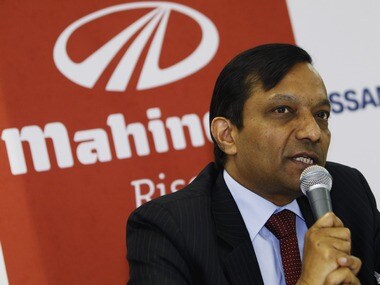 Pawan Goenka, MD, Mahindra & Mahindra. Reuters[/caption]The local assembly cum manufacturing operations will lead to significant tax savings for Mahindra Ideal Lanka, which is hoping to price the KUV100 below 3.2 million Sri Lankan Rupee (INR 12.85 lakh).“This is our first effort to sell passenger vehicles in Sri Lanka and I hope with this effort we will get to a market share similar to or even larger than what we have in India,” Goenka said.He observed that achieving a turnaround was crucial for India’s automotive industry during the ongoing festive season, otherwise a significant negative effect may be witnessed in terms of jobs, investment, and even suppliers being forced to declare bankruptcy.“The only thing that can make a difference is if the government of India sees it fit to support the industry for 6-8 months, then you can perhaps see a big change,” Goenka said.Asked if a fiscal stimulus was required from the government at this stage, he replied in the affirmative. “In the previous slowdowns, both times the government had given a fiscal stimulus and both times they have worked very well,” Goenka said.Automobile sales in India witnessed its sharpest decline in nearly 19 years in July, dropping 18.71 percent, rendering almost 15,000 workers jobless over the past two-three months as the sector reels under a prolonged slump, auto industry body SIAM reported earlier this month.“If you look at our capex we have 15-20 percent capex that has been deferred from our overall investment,” Goenka said.--With PTI inputs
First Published:Aug 19, 2019, 07:06:58 IST
Advertisement
Advertisement

Bharat Forge, Flying Whales sign pact to develop 60-tonne airships for India’s defence logistics
Bharat Forge has signed an MoU with Flying Whales to jointly develop and manufacture 60-tonne heavy-lift airships in India for defence logistics, strategic mobility and disaster response
3 min read
Air India to cut Delhi-Toronto flight time by 3 hours, resume non-stop services from August 1
Air India will resume non-stop Delhi-Toronto flights from August 1, cutting travel time by nearly three hours and deploying its new Boeing 787-9 Dreamliner on the route
2 min read
South Korea economy grows faster than expected in Q2 as chip exports power recovery
South Korea’s economy grew 0.6% in the second quarter, beating expectations as strong semiconductor exports offset weakness in construction investment and domestic demand
2 min read
India remains among fastest-growing major economies despite global uncertainty, says RBI Bulletin
RBI says industrial and services activity stayed resilient through June, while strong trade, stable external sector and improving foreign investment continue to support economic growth.
1 min read
Iran war could cut global growth by more than half: World Bank’s chief economist Indermit Gill
Prolonged US-Iran conflict could fuel inflation, push up borrowing costs and deepen debt distress across developing economies, says Indermit Gill
2 min read
Advertisement
Advertisement