



Low formal credit reach to keep most farmers off loan waivers, says report
Institutional credit is skewed in favour of households with higher decile classes of asset holding,

Mumbai: Large share of non-institutional channels in rural credit is likely to limit the effectiveness of farm loan waivers announced by five states, warns a report.Uttar Pradesh, Maharashtra, Punjab, Karnataka and Madhya Pradesh have announced farm loan waivers amounting to Rs 99,600 crore in recent months, following public outcry over rising number of suicide by indebted farmers. But the move has met with scepticism by key policymakers."The share of non-institutional sources is significantly higher for lower decile classes of asset holding, which are typically the intended beneficiaries of loan waiver schemes," ICICI Securities said in a report on Thursday.The average share of non-institutional credit for the lowest five decile classes of asset holding is over 70 percent of the outstanding credit for those decile classes,according to the 70th Round of the NSS Household Indebtedness Survey, the report notes."Since institutional credit is skewed in favour of households with higher decile classes of asset holding, the latter's overlap with loan waiver beneficiaries is likely to be large," the report adds.[caption id="attachment_3733229" align="alignleft" width="380"]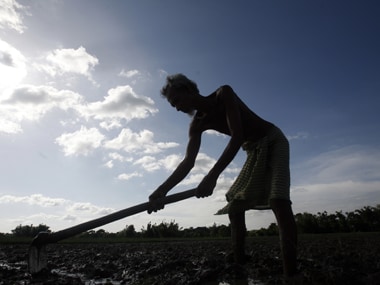 Representational image. Reuters[/caption]The NSS survey shows that non-institutional channels of credit--professional moneylenders, landlords, friends and relatives and input suppliers among others--constituted nearly 44 percent of outstanding rural credit in 2012.Mapping agriculture GVA growth with agriculture credit growth in FY13 and FY17 shows that the share of institutional channels is likely to have improved moderately, shows the NSS survey.Share of commercial and cooperative banks in total institutional credit is nearly 25 percent each which add up to 50 percent of total rural credit.Noting that the classes of banks covered under the waivers are different for different states, the report says while Karnataka has waived off loans from only cooperative banks, other states do not have any such differentiation.The report further says the effectiveness of loan waivers is likely to vary significantly across the states depending on their level of development."States with higher share of outstanding institutional rural credit, such as Maharashtra and Punjab, are likely to get the most out of loan waivers. On the other hand,Karnataka, UP and MP are likely to derive limited benefit as they have relatively lower share of outstanding rural institutional credit." it said.

South Korea economy grows faster than expected in Q2 as chip exports power recovery
India remains among fastest-growing major economies despite global uncertainty, says RBI Bulletin
Iran war could cut global growth by more than half: World Bank’s chief economist Indermit Gill
Brent crude climbs to $94 as analysts expect oil prices to stay in $90–100 range
UK inflation cools further to 2.6% in June as transport and food prices ease