
Advertisement
Co Presented By
Co Presented By


Sections
Last date for filing Income Tax Returns extended to 31 August: Here's how salaried employees can fill ITR for AY 2019-20 on incometaxindiaefiling.gov.in
If you are a salaried employee, you will have to file your Income Tax Returns (ITR). The last date for filing your ITR is 31 August, 2019.

The government on Tuesday extended the due date for filing income tax returns by individuals for financial year 2018-19 by a month till 31 August.If you are a salaried employee, you will have to file your Income Tax Returns (ITR). The new last date for filing your ITR is 31 August, 2019.ITR 1 is filed by individuals having a total income of up to Rs 50 lakh, having income from salaries, one house property, other sources (like interest), and agricultural income up to Rs 5,000.This Return Form is applicable for the assessment year 2019-20 only, i.e., it relates to income earned during the Financial Year 2018-19.Aadhaar card mandatory for tax filingThe Income Tax Department has made it mandatory for all taxpayers to link the Aadhaar card with PAN on the Income Tax Department website.Your employer would have issued the Form 16 (It is a certificate issued by an employer which has all the details of how much tax the employer has deducted from the salary of the employee and when it was submitted to the Income Tax Department) by 15 June.The ITR 1 form has been simplified this year, making it easier for salaried employees to e-File returns.Changes in ITR1 for the AY 2019-20 ITR 1 form for FY 2018-19 is not applicable to an individual who is either a director of a company or has invested in unlisted equity shares, said Archit Gupta, Founder and CEO, Cleartax.Under Part A, ‘Pensioners’ checkbox has been introduced under the ‘Nature of employment’ section.Return filed under section has been segregated between normal filing and filed in response to notices.Deductions under salary will be bifurcated into standard deduction, entertainment allowance and professional tax.[caption id="attachment_7023271" align="alignleft" width="380"]![Representational image. Reuters.]() Representational image. Reuters.[/caption]The taxpayers will be required to provide income-wise detailed information under the ‘Income from other sources’.A separate column is introduced under ‘Income from other sources’ for deduction u/s 57(iia) – in case of family pension income.‘Deemed to be let out property’ option now available under ‘Income from house property’.Section 80TTB column has been included for senior citizens.Who is eligible to file ITR-1 for AY 2019-20ITR 1 Form is a simplified one-page form for individuals having income up to Rs 50 lakh from the following sources:(a) Income from Salary/ Pension; or(b) Income from One House Property (excluding cases where loss is brought forward from previous years); or(c) Income from Other Sources (excluding winning from Lottery and Income from Race Horses),In the case of clubbed Income Tax Returns, where a spouse or a minor is included, this can be done only if their income is limited to the above specifications.
Representational image. Reuters.[/caption]The taxpayers will be required to provide income-wise detailed information under the ‘Income from other sources’.A separate column is introduced under ‘Income from other sources’ for deduction u/s 57(iia) – in case of family pension income.‘Deemed to be let out property’ option now available under ‘Income from house property’.Section 80TTB column has been included for senior citizens.Who is eligible to file ITR-1 for AY 2019-20ITR 1 Form is a simplified one-page form for individuals having income up to Rs 50 lakh from the following sources:(a) Income from Salary/ Pension; or(b) Income from One House Property (excluding cases where loss is brought forward from previous years); or(c) Income from Other Sources (excluding winning from Lottery and Income from Race Horses),In the case of clubbed Income Tax Returns, where a spouse or a minor is included, this can be done only if their income is limited to the above specifications.
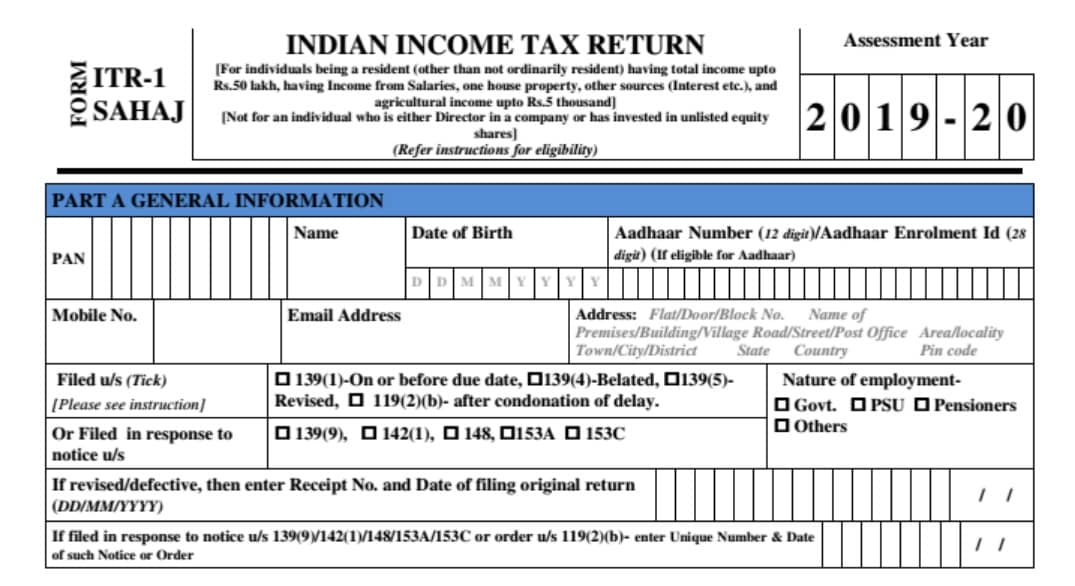
Who is not eligible to file ITR 1 for AY 2019-20A. This Return Form should not be used by an individual who(a) is a Director in a company,(b) has held any unlisted equity shares at any time during the previous year,(c) has any asset (including financial interest in any entity) located outside India,(d) has signing authority in any account located outside India; or(e) has income from any source outside India.B. This return form also cannot be used by an individual who has any income of the following nature during the previous year:(a) Profits and gains from business and professions,(b) Capital gains,(c) Income from more than one house property;(d) Income under the head other sources which is of following nature:-(i) winnings from lottery;(ii) activity of owning and maintaining race horses;(iii) income taxable at special rates under section 115BBDA orsection 115BBE;(e) income to be apportioned in accordance with provisions of section 5A; or(f) agricultural income in excess of ₹5,000.C. Further, this return form also cannot be used by an individual who has any claims of loss/deductions/relief/tax credit etc. of the following nature:-(a) any brought forward loss or loss to be carried forward under the head 'Income from house property';(b) loss under the head 'Income from other sources‘;(c) any claim of relief under section 90 and/or section 91;(d) any claim of deduction under section 57, other than deduction under clause (iia) thereof (relating to family pension); or(e) any claim of credit of tax deducted at source in the hands of any other personWhat is the structure of ITR 1 Form?Part A: General Information![PART-A]() Part B: Gross total Income
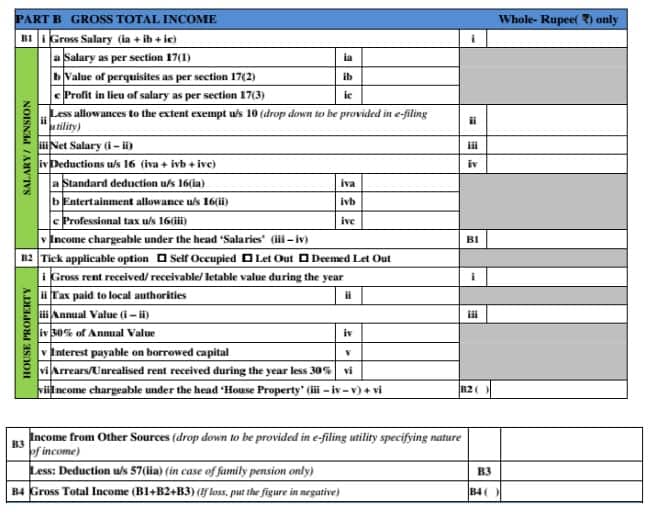
Part B: Gross total Income![PART-B]() Part C : Deductions and taxable total income
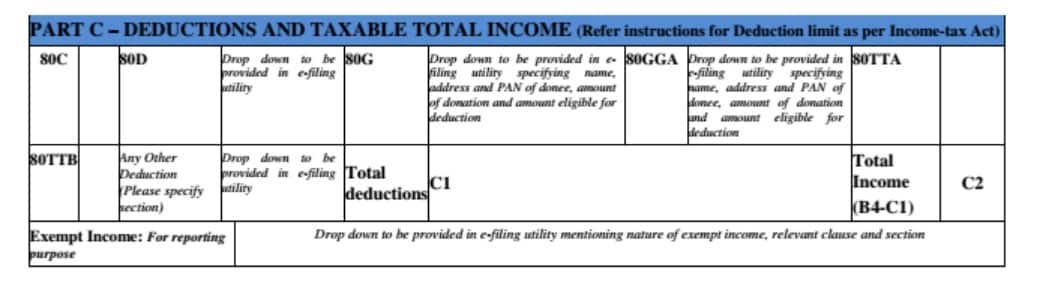
Part C : Deductions and taxable total income![PART-C]() Part D: Computation of Tax Payable
Part D: Computation of Tax Payable![PART-D]() Part E : Other Information
Part E : Other Information![PART-E]() Schedule IT : Detail of Advance Tax and Self Assessment Tax payments
Schedule IT : Detail of Advance Tax and Self Assessment Tax payments![PART-F]() Schedule TDS: Detail of TDS/TCS
Schedule TDS: Detail of TDS/TCS![PART-G]() Verification
Verification![VERIFICATION]() Documents required for filing ITRa) PANb) Aadhaarc) Bank account detailsd) Form 16 (It is a certificate issued by an employer which has all the details of how much tax the employer deducted from the salary of the employee and when it was submitted to the Income Tax Department)e) Investments detailsHow to file ITR1) Login with all the documents required for ITR in the Income Tax Department website2) Enter your personal information3) Enter your salary details4) Enter details for claiming deduction5) Enter details of taxes paid6) e-File your ITR7) E-VerifyFAQsI earn income over Rs 50 lakhs. Which ITR form should I file this year?If you have income above Rs 50 lakhs, you can file ITR 2, ITR 3 or ITR 4 (Sugam) depending upon your source of income. If you are a salaried individual having income above Rs 50 lakhs, you should file ITR 2. And if you are having income from business or profession, then you should file ITR 3. In case you are following presumptive income u/s 44AD /44AE, then you should file ITR 4 (Sugam).Do I need to report exempt LTCG in ITR-1?You need to report exempt LTCG in ITR 1 provided it is exempt under Section 10(38). If you have taxable LTCG, you may use the other forms as applicable. Also it is mandatory to e file tax returns for those whose LTCG exceeds Rs 2.5 lakhs even if your income is below taxable limit.Can I file ITR-1 with exempt agricultural income?Yes, you can if the agricultural income does not exceed Rs 5000.And If the agricultural income is more than Rs 5000, then you should file ITR 2.How to report bank accounts in ITR-1?The details of all the savings and current accounts held at any time during the previous year must be provided. However, it is not mandatory to provide details of dormant accounts which are not operational for more than 3 years. The account number should be as per Core Banking Solution (CBS) system of the bank. It is to be provided in the Part E – other information of the ITR form.Do I need to include dividend income from mutual funds?Yes. Dividend income from mutual funds is exempt under sec 10(35). It is to shown in Part D under the head Exempt Income (others)
Documents required for filing ITRa) PANb) Aadhaarc) Bank account detailsd) Form 16 (It is a certificate issued by an employer which has all the details of how much tax the employer deducted from the salary of the employee and when it was submitted to the Income Tax Department)e) Investments detailsHow to file ITR1) Login with all the documents required for ITR in the Income Tax Department website2) Enter your personal information3) Enter your salary details4) Enter details for claiming deduction5) Enter details of taxes paid6) e-File your ITR7) E-VerifyFAQsI earn income over Rs 50 lakhs. Which ITR form should I file this year?If you have income above Rs 50 lakhs, you can file ITR 2, ITR 3 or ITR 4 (Sugam) depending upon your source of income. If you are a salaried individual having income above Rs 50 lakhs, you should file ITR 2. And if you are having income from business or profession, then you should file ITR 3. In case you are following presumptive income u/s 44AD /44AE, then you should file ITR 4 (Sugam).Do I need to report exempt LTCG in ITR-1?You need to report exempt LTCG in ITR 1 provided it is exempt under Section 10(38). If you have taxable LTCG, you may use the other forms as applicable. Also it is mandatory to e file tax returns for those whose LTCG exceeds Rs 2.5 lakhs even if your income is below taxable limit.Can I file ITR-1 with exempt agricultural income?Yes, you can if the agricultural income does not exceed Rs 5000.And If the agricultural income is more than Rs 5000, then you should file ITR 2.How to report bank accounts in ITR-1?The details of all the savings and current accounts held at any time during the previous year must be provided. However, it is not mandatory to provide details of dormant accounts which are not operational for more than 3 years. The account number should be as per Core Banking Solution (CBS) system of the bank. It is to be provided in the Part E – other information of the ITR form.Do I need to include dividend income from mutual funds?Yes. Dividend income from mutual funds is exempt under sec 10(35). It is to shown in Part D under the head Exempt Income (others)
 Representational image. Reuters.[/caption]The taxpayers will be required to provide income-wise detailed information under the ‘Income from other sources’.A separate column is introduced under ‘Income from other sources’ for deduction u/s 57(iia) – in case of family pension income.‘Deemed to be let out property’ option now available under ‘Income from house property’.Section 80TTB column has been included for senior citizens.Who is eligible to file ITR-1 for AY 2019-20ITR 1 Form is a simplified one-page form for individuals having income up to Rs 50 lakh from the following sources:(a) Income from Salary/ Pension; or(b) Income from One House Property (excluding cases where loss is brought forward from previous years); or(c) Income from Other Sources (excluding winning from Lottery and Income from Race Horses),In the case of clubbed Income Tax Returns, where a spouse or a minor is included, this can be done only if their income is limited to the above specifications.
| Income Tax slabs for FY 2018-19 | |
| Men & women aged under 60 years | Tax rate |
| Rs 250000 | Nil |
| Rs 250001 to Rs 500000 | 5% |
| Rs 500001 to Rs 1000000 | 20% |
| Above Rs 1000001 | 30% |
| Senior citizens aged 60 years-79 years | Tax rate |
| Rs 300000 | Nil |
| Rs 300001 to Rs 500000 | 5% |
| Rs 500001 to Rs 1000000 | 20% |
| Above Rs 1000001 | 30% |
| Very senior citizens aged 80 years & above | Tax rate |
| Rs 500000 | Nil |
| Rs 500001 to Rs 1000000 | 20% |
| Above Rs 1000001 | 30% |
| Education and healthcare cess | 4% |
 Part B: Gross total Income
 Part C : Deductions and taxable total income
 Part D: Computation of Tax Payable
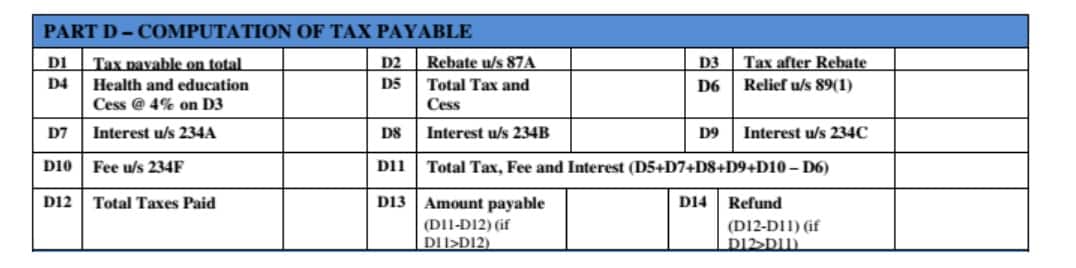 Part E : Other Information
 Schedule IT : Detail of Advance Tax and Self Assessment Tax payments
 Schedule TDS: Detail of TDS/TCS
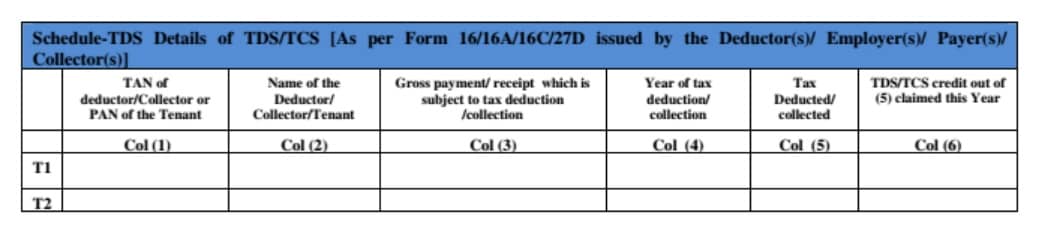 Verification
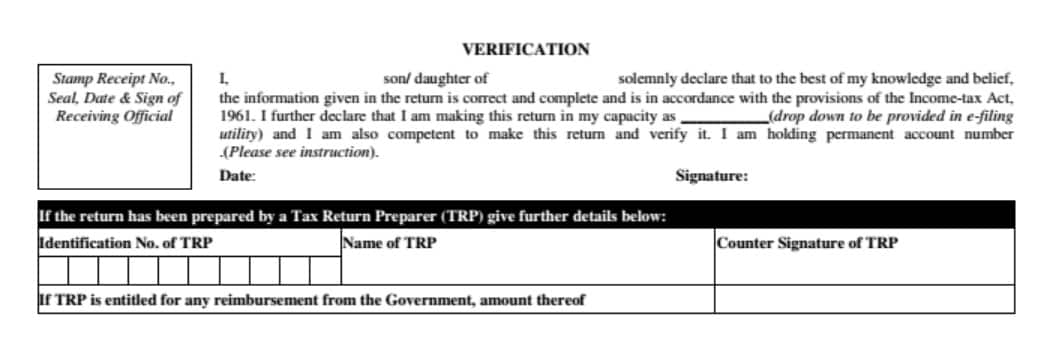 Documents required for filing ITRa) PANb) Aadhaarc) Bank account detailsd) Form 16 (It is a certificate issued by an employer which has all the details of how much tax the employer deducted from the salary of the employee and when it was submitted to the Income Tax Department)e) Investments detailsHow to file ITR1) Login with all the documents required for ITR in the Income Tax Department website2) Enter your personal information3) Enter your salary details4) Enter details for claiming deduction5) Enter details of taxes paid6) e-File your ITR7) E-VerifyFAQsI earn income over Rs 50 lakhs. Which ITR form should I file this year?If you have income above Rs 50 lakhs, you can file ITR 2, ITR 3 or ITR 4 (Sugam) depending upon your source of income. If you are a salaried individual having income above Rs 50 lakhs, you should file ITR 2. And if you are having income from business or profession, then you should file ITR 3. In case you are following presumptive income u/s 44AD /44AE, then you should file ITR 4 (Sugam).Do I need to report exempt LTCG in ITR-1?You need to report exempt LTCG in ITR 1 provided it is exempt under Section 10(38). If you have taxable LTCG, you may use the other forms as applicable. Also it is mandatory to e file tax returns for those whose LTCG exceeds Rs 2.5 lakhs even if your income is below taxable limit.Can I file ITR-1 with exempt agricultural income?Yes, you can if the agricultural income does not exceed Rs 5000.And If the agricultural income is more than Rs 5000, then you should file ITR 2.How to report bank accounts in ITR-1?The details of all the savings and current accounts held at any time during the previous year must be provided. However, it is not mandatory to provide details of dormant accounts which are not operational for more than 3 years. The account number should be as per Core Banking Solution (CBS) system of the bank. It is to be provided in the Part E – other information of the ITR form.Do I need to include dividend income from mutual funds?Yes. Dividend income from mutual funds is exempt under sec 10(35). It is to shown in Part D under the head Exempt Income (others)
First Published:Jul 23, 2019, 22:36:01 IST
Advertisement
Advertisement

Air India to cut Delhi-Toronto flight time by 3 hours, resume non-stop services from August 1
Air India will resume non-stop Delhi-Toronto flights from August 1, cutting travel time by nearly three hours and deploying its new Boeing 787-9 Dreamliner on the route
2 min read
South Korea economy grows faster than expected in Q2 as chip exports power recovery
South Korea’s economy grew 0.6% in the second quarter, beating expectations as strong semiconductor exports offset weakness in construction investment and domestic demand
2 min read
India remains among fastest-growing major economies despite global uncertainty, says RBI Bulletin
RBI says industrial and services activity stayed resilient through June, while strong trade, stable external sector and improving foreign investment continue to support economic growth.
1 min read
Iran war could cut global growth by more than half: World Bank’s chief economist Indermit Gill
Prolonged US-Iran conflict could fuel inflation, push up borrowing costs and deepen debt distress across developing economies, says Indermit Gill
2 min read
Brent crude climbs to $94 as analysts expect oil prices to stay in $90–100 range
Rising US-Iran tensions and tight OPEC+ supply have pushed crude to a five-week high, but experts believe prices are unlikely to sustain a rally beyond $100 without a major supply disruption.
1 min read
Advertisement
Advertisement