



JLR India head wants 'reasonable' taxes on luxury cars against the current 50%
Stating that taxes on luxury vehicles in India are among the highest in the world, JLR India President and Managing Director Rohit Suri said this has restricted volumes growth thereby preventing companies from assembling more models here

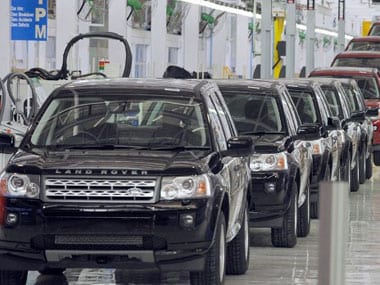
Representational image. AFP.[/caption]Last year in September, the government had hiked cess by 5 percent on large cars and 7 percent on SUVs, taking the total incidence of taxation to pre-GST levels.Insisting that the auto industry was not asking to bring down taxes on luxury vehicles to "zero or equivalent to some low level utility vehicles", he said, "It should be reasonable. It can't be very high because it is a luxury car".Suri said the luxury vehicles segment can play a bigger role in the country's overall economic development and employment generation."Luxury car is driven by a customer who can afford it obviously, but there are thousands of people who are behind that car," he said.He said JLR India has increased local assembly from one product in 2011 with Freelander to six products now."It has gone to six products because we want to make in India but only if there is a business case and it works. The issue is can we have a threshold volume in the market? That depends on primarily taxation," Suri said.While local assembly adds more jobs, market expansion and addition of new dealerships also create further employment opportunities down the chain."Any new dealership generates an employment potential of 50 people. This will all depend on if the market is allowed to grow," he said.With high taxation, Suri said, "If it is not allowed to grow, one would not be able to generate more employment, we will not be able to localise easily as it will be difficult as there will not be threshold volume."Suri also said customs duty is also extremely high and it doesn't allow more cars to be sold in India. While the basic duty is 100 percent, by the time an imported vehicle is driven out of the port, it all adds up to 180 percent."What the government can do is to look at it at a reasonable level," he said, adding the luxury vehicle makers were not asking for duty similar to local manufacturing but at a rate that would help in bringing new technologies through new products.

South Korea economy grows faster than expected in Q2 as chip exports power recovery
India remains among fastest-growing major economies despite global uncertainty, says RBI Bulletin
Iran war could cut global growth by more than half: World Bank’s chief economist Indermit Gill
Brent crude climbs to $94 as analysts expect oil prices to stay in $90–100 range
UK inflation cools further to 2.6% in June as transport and food prices ease