
Advertisement
Co Presented By
Co Presented By


Sections
If diesel prices are reined in to protect farmers, the best way forward is to do direct benefit transfer
In India, diesel pricing has always had greater political implications and ramifications than petrol because it is perceived as catering more to the poor man’s fuel needs,

In Orissa, diesel prices went past the petrol marginally by 12 paisa on Sunday (21 October 2018), causing a flutter in political circles. It happened for the first time in India and hence the nation was awe-struck.[caption id="attachment_4222823" align="alignleft" width="380"]![Representational image. Reuters.]() Representational image. Reuters.[/caption]Orissa has the distinction of being the lone state which doesn’t discriminate between petrol and diesel when it comes to local VAT, and this is touted as the reason for this rare denouement though it is not entirely true because even today there is a softer central excise duty on diesel vis-à-vis petrol (Rs 14.33 per liter vs Rs 18.48). So the only logical explanation for Orissa bucking the trend is other states tax diesel lightly vis-à-vis petrol and oil marketing companies daring to move in the direction of bringing about a parity between the two fuels.In the USA, diesel has always been pricier vis-à-vis petrol with the reason being refineries produce more of petrol and less of diesel thus giving them economies of scale in gasoline (petrol) production in comparison to diesel. The refining cost of the two is almost the same.During the process of refining, crude oil is separated into different components and these components are converted through further treatments into gasoline, diesel fuel, and other petroleum products.Diesel fuel is heavier and less volatile than gasoline, which makes it simpler to refine from crude oil. As a result, diesel tended to be cheaper than gasoline in most countries around the world. However, the introduction of Ultra-Low Sulfur Diesel (ULSD) between 2006 and 2010 increased diesel production costs since ULSD requires more refining.
Representational image. Reuters.[/caption]Orissa has the distinction of being the lone state which doesn’t discriminate between petrol and diesel when it comes to local VAT, and this is touted as the reason for this rare denouement though it is not entirely true because even today there is a softer central excise duty on diesel vis-à-vis petrol (Rs 14.33 per liter vs Rs 18.48). So the only logical explanation for Orissa bucking the trend is other states tax diesel lightly vis-à-vis petrol and oil marketing companies daring to move in the direction of bringing about a parity between the two fuels.In the USA, diesel has always been pricier vis-à-vis petrol with the reason being refineries produce more of petrol and less of diesel thus giving them economies of scale in gasoline (petrol) production in comparison to diesel. The refining cost of the two is almost the same.During the process of refining, crude oil is separated into different components and these components are converted through further treatments into gasoline, diesel fuel, and other petroleum products.Diesel fuel is heavier and less volatile than gasoline, which makes it simpler to refine from crude oil. As a result, diesel tended to be cheaper than gasoline in most countries around the world. However, the introduction of Ultra-Low Sulfur Diesel (ULSD) between 2006 and 2010 increased diesel production costs since ULSD requires more refining.
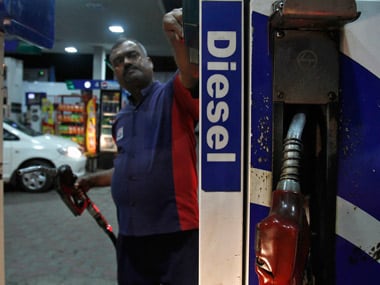 Representational image. Reuters.[/caption]Orissa has the distinction of being the lone state which doesn’t discriminate between petrol and diesel when it comes to local VAT, and this is touted as the reason for this rare denouement though it is not entirely true because even today there is a softer central excise duty on diesel vis-à-vis petrol (Rs 14.33 per liter vs Rs 18.48). So the only logical explanation for Orissa bucking the trend is other states tax diesel lightly vis-à-vis petrol and oil marketing companies daring to move in the direction of bringing about a parity between the two fuels.In the USA, diesel has always been pricier vis-à-vis petrol with the reason being refineries produce more of petrol and less of diesel thus giving them economies of scale in gasoline (petrol) production in comparison to diesel. The refining cost of the two is almost the same.During the process of refining, crude oil is separated into different components and these components are converted through further treatments into gasoline, diesel fuel, and other petroleum products.Diesel fuel is heavier and less volatile than gasoline, which makes it simpler to refine from crude oil. As a result, diesel tended to be cheaper than gasoline in most countries around the world. However, the introduction of Ultra-Low Sulfur Diesel (ULSD) between 2006 and 2010 increased diesel production costs since ULSD requires more refining.
Diesel is a more virulent pollutant, with one study going as far as suggesting that one diesel car pollutes 25 times as much as a petrol-driven car. Green activists would, therefore, love to discourage its consumption more by subjecting it to a greater tax.Against this backdrop, it is curious that we indulge diesel to the point of making such indulgence a fetish. Diesel consumption in India is 7 million tonnes per month vis-à-vis petrol at 2.5 million tonnes. Of course, it cannot be helped and certainly cannot be changed overnight given the state-of-the-art which makes diesel engines more suitable for public transportation which is virtually absent in the US.In India, diesel pricing has always had greater political implications and ramifications than petrol because it is perceived as catering more to the poor man’s fuel needs, be it tractor or buses though the truth is even diesel is by large used by the transport sector -- 70 percent as opposed to petrol that caters to transport to the tune of 99 percent with the farm sector accounting for just 13 percent of the diesel consumption. And therefore states except Orissa perhaps have been misplaced in deferring to this pseudo-politically sensitive fuel and taxing it lightly vis-à-vis petrol.Those city slickers who by and large use diesel-guzzling and polluting SUVs benefit immensely from this skew in pricing is somehow lost on the policymakers. The stiff GST on diesel cars has not deterred its adherents a wee bit because it is after all a one-time burden whereas savings in diesel is perennial.If indeed protecting farmers and other vulnerable segments were the rationale for keeping diesel prices low, the best way forward is to do direct benefit transfer (DBT) a la LPG instead of having a one size fits all approach that benefits city slickers more.It is not practicale to have dual pricing, lower diesel price in rural areas and higher in urban, but it is far easier to identify the rural consumers through an issuance of a diesel card linked to one’s bank account and compensate them directly through transfer to their bank accounts. Ditto for state transport buses that account for a sizeable sliver of diesel consumption.(The writer is a senior columnist and tweets @smurlidharan)
First Published:Oct 23, 2018, 12:03:37 IST
Advertisement
Advertisement

Bharat Forge, Flying Whales sign pact to develop 60-tonne airships for India’s defence logistics
Bharat Forge has signed an MoU with Flying Whales to jointly develop and manufacture 60-tonne heavy-lift airships in India for defence logistics, strategic mobility and disaster response
3 min read
Air India to cut Delhi-Toronto flight time by 3 hours, resume non-stop services from August 1
Air India will resume non-stop Delhi-Toronto flights from August 1, cutting travel time by nearly three hours and deploying its new Boeing 787-9 Dreamliner on the route
2 min read
South Korea economy grows faster than expected in Q2 as chip exports power recovery
South Korea’s economy grew 0.6% in the second quarter, beating expectations as strong semiconductor exports offset weakness in construction investment and domestic demand
2 min read
India remains among fastest-growing major economies despite global uncertainty, says RBI Bulletin
RBI says industrial and services activity stayed resilient through June, while strong trade, stable external sector and improving foreign investment continue to support economic growth.
1 min read
Iran war could cut global growth by more than half: World Bank’s chief economist Indermit Gill
Prolonged US-Iran conflict could fuel inflation, push up borrowing costs and deepen debt distress across developing economies, says Indermit Gill
2 min read
Advertisement
Advertisement