



The Subbarao season: Will it be a CRR cut again?
India Inc is hopeful that the RBI governor will aid the government's efforts to bring growth back on track by way of a small, signal rate cut of, say 25bps.

Finance minister Palaniappan Chidambaram cannot be faulted on one front: speaking the right language. Ever since he took charge, the minister has given the impression of attempting to do the right thing, set things right, send the right signals to domestic and foreign investors. Even on 29 October, a day before the Reserve Bank of India is to sit for a review of its monetary policy for 2012-13, Chidambaram made the right noises as far as reining in the fiscal deficit is concerned. Yes, Chidambaram hasn't talked of cutting subsidies in a major way or decontrolling fuel prices, but clearly, the finance minister is banking on disinvestments and the 2G spectrum auction to do much of the job for him.
At a time when there's very little window for Chidambaram to pull something dramatic out of his hat, the finance minister does realise that he will have to move quickly on disinvestments-something far less controversial than subsidies-to bring in revenues for him. How quickly he can get this done will hold the key to the sanctity of the numbers. However, the move is clearly to bring the deficit in control, and 5.3 percent is the number being talked of for the current year. This may come as good news for the RBI which has been engaged in its own battle to tackle inflation, without too much success.[caption id="attachment_507420" align="alignleft" width="380"]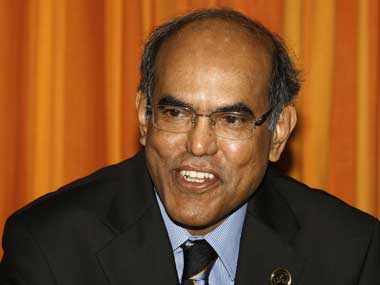 RBI Governor D Subbarao. Reuters[/caption]
The RBI's stance, as Subbarao has elucidated often, is that unless the supply-side constraints are addressed and there are credible moves on fiscal consolidation, merely cutting key rates will not solve the problem of inflation. The slowing down of the economy, RBI believes, is not on account of interest rates but because of those supply constraints. With the September inflation figure ruling at 7.81 percent, higher than the previous month's 7.55 percent, all bets are off whether RBI governor Duvvuri Subbarao will do anything on the repo rate.
 More from Economy
Even a day before the policy review, the RBI's second quarter review of macroeconomic and monetary developments for 2012-13, hinted that the central bank may, despite a slightly less hawkish stance, not yet take its finger off the pause button on rates. "As macro-risks from inflation and twin deficits recede further, that could yield space down the line for monetary policy to respond more effectively to growth concerns," RBI said.
"Speedy implementation of recent policy measures announced by the government and sustained reforms are important for turning the economy around", it added, underscoring that implementation, not mere announcements, is what it will look for before finalising its stance on easing interest rates.
The review notes that inflation has stayed sticky around 7.5 percent. Persistent non-food manufactured product inflation, despite the growth slowdown has emerged as a concern, the central bank adds. The figure to watch, it is evident, is clearly the inflation number. However, this time, the central bank seems somewhat optimistic about the future, as far as price rise is concerned. "While the near-term inflation risks are on the upside, inflation is expected to moderate from Q4 of 2012-13. However, improved supply responses and moderation of wage inflation is vital for bringing down inflation to comfort level," the RBI says. In other words, the inflation concern may moderate going forward, but supply side constraints need to be removed. A watchful central bank, a day before the policy review.
Despite all this, India Inc, however, is hopeful that the RBI governor will aid the government's efforts to bring growth back on track by way of a small, signal rate cut of, say 25 basis points. However, even those corporate bosses who say this know it's tough predicting Subbarao's actions, particularly in the present context of inflation sticking well beyond the RBI's comfort zone. But Chidambaram's efforts at fiscal consolidation and the overall pro-reform environment still hold out some hope for the pro-rate cut school of thought.
Indranil Pan, chief economist at Kotak Mahindra Bank, seems to feel that the RBI will opt for the cash reserve ratio (CRR) as a more potent tool once again and make more money available to the system, rather than go for a direct repo rate cut. "For the October 30 policy meeting, we continue to argue for a status quo on the repo rate and a 25 bps cut on the CRR, though the decision for the CRR would possibly be better taken closer to the policy date and by judging the liquidity implications of a likely higher currency in circulation during the festive season," Pan says.
Pan's argument is RBI should continue to hold on to the policy rates and should not adopt a monetary easing stance immediately. "However, RBI can prefer to cut CRR again as it would achieve the dual objective of providing a push to the base money and also reduce the cost of the banking sector, which then be passed on to the real sector. Liquidity generated through the CRR may necessarily not be inflationary as liquidity anyway persists in the negative zone," he reasons. CRR, therefore, is what analysts would be watching closely this time.
Going by the ministry's own pronouncements, the government itself seems to be betting against a rate cut by RBI. The Economic Times of 29 October quotes unnamed ministry officials as saying that a rate cut on 30 October is unlikely given the inflation levels. The first signs, perhaps, that the ministry now understands the dilemma of the central bank much better.

India’s trade surplus with US may cross $90 billion after tariff cuts, says SBI report
Inflation likely to be a big focus area for budget 2024, say sources
Explained: Will the Bank of Japan break tradition and raise interest rates?
UK enters recession, central bank admits
Explained: How the rising US dollar can affect everyone