



No major economy will escape slowdown: OECD
Readings for individual countries were broadly lower indicating slowdowns, and were in many cases below their long-term averages.

None of the world's major economies will escape a slowdown, the Organisation for Economic Co-operation and Development said on Monday, highlighting increasing signs that growth momentum is dwindling across the board.
The Paris-based organisation's composite leading indicator (CLI) for its members fell for the seventh straight month to 100.4 in September, down from 100.9 in August and hitting the lowest reading since December 2009.
[caption id="attachment_130667" align="alignleft" width="380" caption="OCDE Secretary General, Mexican Angel Gurria .AFP"]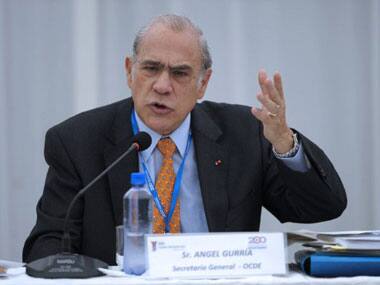 [/caption]
Readings for individual countries and big developing world economies were broadly lower at levels indicating slowdowns, and were in many cases below their long-term averages.
"Compared to last month's assessment, the CLIs point more strongly to slowdowns in all major economies," the OECD said in a statement.
The OECD CLIs are designed to anticipate turning points in economic activity relative to trend - a turnaround in an indicator tends to precede turning points in economic activity by around six months.
 More from Economy
The Group of Seven's CLI fell to 100.6 in September from 101.1 in August while the reading for the euro area dropped to 99.1 from 99.9, well below its long-term average of 100.
Japan's CLI remained above its long-term average of 100 with a reading of 101.6, but it was still down from 102.0, suggesting an economic recovery after its March earthquake and tsunami disaster is losing steam.
Economic momentum in the United States eased only slightly, according to the OECD's indicator, which fell to 101.2 from 101.5.
The Chinese economy also showed only marginally weaker activity with a reading of 99.8, down from 99.9. Among other emerging market economies, Brazil's CLI fell to 94.0 from 95.1 while India's reading decreased to 93.8 from 94.4.
In a report released at the end of last month, the OECD slashed its 2012 growth estimate for the United States to 1.8 percent from 3.1 percent and cut its forecast for growth in the euro area next year to 0.3 percent from 2.0 percent in May.
Reuters

India’s trade surplus with US may cross $90 billion after tariff cuts, says SBI report
Inflation likely to be a big focus area for budget 2024, say sources
Explained: Will the Bank of Japan break tradition and raise interest rates?
UK enters recession, central bank admits
Explained: How the rising US dollar can affect everyone