
Advertisement
Co Presented By
Co Presented By


Sections
Downfall of Jet Airways: How Naresh Goyal’s airline walked into a trap of its own making from where there was no return
The Naresh Goyal-founded airline had an almost unhindered flight till 2003-4 until Air Deccan came to the scene

Editor's note: This is part of a multi-article series on the downfall of Jet Airways and the path ahead for the cash-strapped airline.As Jet Airways suspended operations on 17 April 2019, the immediate focus shifted on the bank-led process of Expression of Interest (EoI) and subsequent change of ownership along with equity infusion. However, the question is, what led to the situation. It was not a sudden meltdown but something that was brewing for a period of time. It could be a combination of luck or rather the lack of it, management decisions, and more that led to the state the cash-strapped airline found itself in that led to a temporary suspension.The Naresh Goyal-founded airline had an almost unhindered flight till 2003-4 when Air Deccan came to the scene and started offering rock-bottom fares. The increased competition led to Goyal to look for ways to protect his market share. The first folly as remarked by many was the purchase of Air Sahara. Jet Airways started negotiations to acquire Air Sahara and agreed on an amount before the deal hit a road block. The airline could not wriggle out of the deal and in the second attempt the deal went through.The enormity and complexity of the deal can be understood by the fact that the issues pertaining to the deal have been dragging in courts until now and Jet Airways was forced to write-off its entire investment in Air Sahara. The government has subsequently rejected the airline’s application for merger of both the airlines and at the time of suspension, Jet Airways continued to hold two Air Operating Permits.![File image of Naresh Goyal. Reuters]() File image of Naresh Goyal. Reuters[/caption]Jet Airways' last year of operations again saw the airline introduce a fare class to offer buy-on-board option. The investment in crew training and customer orientation is huge for such a model where the onward flight on the sector has service but the return has buy-on-board. Not only did this change create confusion in the minds of passengers, but also affected the Jet Airways brand. Besides low fares are affordable only when the company has a low-cost structure, which Jet Airways was struggling to have for most part of its operations.As the airline kept shifting between low-cost and full-service models, it kept underestimating the competition from budget carriers. The airline was already a decade-old when Air Deccan started. Low fare is not low-cost is something that Jet Airways did not understand for a very long time as it tried to compete with IndiGo and SpiceJet by converting Air Sahara ino to a low fare carrier. The costs associated with the business were higher than its low-cost competition and thus the profitability gap kept widening. These changes were of no help for Jet Airways at it did not anticipate the tsunami of capacity that the low-cost carriers would induct and flood the market with and takeover half the market.To make matters worse, Jet Airways has only been marginally better than Go Air when it came to management changes. Frequent changes at the top have meant that the airline has not made a long-term plan and executed it under a single leadership.
File image of Naresh Goyal. Reuters[/caption]Jet Airways' last year of operations again saw the airline introduce a fare class to offer buy-on-board option. The investment in crew training and customer orientation is huge for such a model where the onward flight on the sector has service but the return has buy-on-board. Not only did this change create confusion in the minds of passengers, but also affected the Jet Airways brand. Besides low fares are affordable only when the company has a low-cost structure, which Jet Airways was struggling to have for most part of its operations.As the airline kept shifting between low-cost and full-service models, it kept underestimating the competition from budget carriers. The airline was already a decade-old when Air Deccan started. Low fare is not low-cost is something that Jet Airways did not understand for a very long time as it tried to compete with IndiGo and SpiceJet by converting Air Sahara ino to a low fare carrier. The costs associated with the business were higher than its low-cost competition and thus the profitability gap kept widening. These changes were of no help for Jet Airways at it did not anticipate the tsunami of capacity that the low-cost carriers would induct and flood the market with and takeover half the market.To make matters worse, Jet Airways has only been marginally better than Go Air when it came to management changes. Frequent changes at the top have meant that the airline has not made a long-term plan and executed it under a single leadership.
As the airline took over Air Sahara, the first thing it did was to switch the Air Sahara brand to Jetlite (later Jet Konnect) which was to be a low-cost carrier. The airline with a high-cost base couldn’t afford such a shift.Over the next few years, the airline moved flights, sectors in a haphazard manner between low-cost and full-service models, until after the launch of Vistara, the airline declared that it would be a complete full-service model. The confusion of service it created in the minds of people saw a lot of corporate traffic move to low-cost carriers, viz., IndiGo and SpiceJet, which were growing leaps and bounds.[caption id="attachment_2045049" align="alignleft" width="380"]
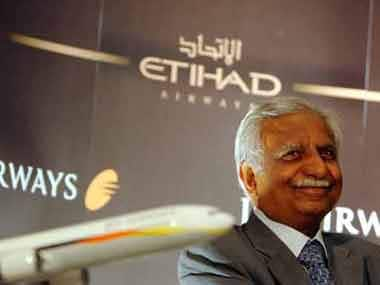 File image of Naresh Goyal. Reuters[/caption]Jet Airways' last year of operations again saw the airline introduce a fare class to offer buy-on-board option. The investment in crew training and customer orientation is huge for such a model where the onward flight on the sector has service but the return has buy-on-board. Not only did this change create confusion in the minds of passengers, but also affected the Jet Airways brand. Besides low fares are affordable only when the company has a low-cost structure, which Jet Airways was struggling to have for most part of its operations.As the airline kept shifting between low-cost and full-service models, it kept underestimating the competition from budget carriers. The airline was already a decade-old when Air Deccan started. Low fare is not low-cost is something that Jet Airways did not understand for a very long time as it tried to compete with IndiGo and SpiceJet by converting Air Sahara ino to a low fare carrier. The costs associated with the business were higher than its low-cost competition and thus the profitability gap kept widening. These changes were of no help for Jet Airways at it did not anticipate the tsunami of capacity that the low-cost carriers would induct and flood the market with and takeover half the market.To make matters worse, Jet Airways has only been marginally better than Go Air when it came to management changes. Frequent changes at the top have meant that the airline has not made a long-term plan and executed it under a single leadership.
The control of Goyal has been both a boon and a bane as well. While the 'hands-on' attitude helped the airline in some ways, it was the very same attitude which led the airline's CEOs to leave quickly. In the last decade, the airline has seen four expat CEOs at the helm with some for as little as less than a year. Vinay Dube, Crammer Ball, Gary Kenneth Toomey and Nikos Kardassis have been at the helm at varying tenures. The gap between their leaving and the new incumbent joining was filled up by acting CEOs such as Ravishankar Gopalkrishnan, Gaurang Shetty and Amit Agarwal.India is not kind to aviation businesses. Nearly 50 percent of the cost of operations comprises of fuel costs and taxes. Costs such as leasing of airplanes, fuel and operating cost at foreign airports are dollar denominated and also see an impact in rupee to the dollar exchange rate fluctuation which adds to the costs for the airline.And while so many things were in turmoil, the last thing which could have made a difference was also not in favor of Jet Airways. The luck factor dodged the airline for most of the time. The first phase of expansion in 2008-09 with the wide body aircraft saw the financial meltdown and global increase in oil prices. The airline had to lease out its aircraft to other carriers to sustain the fuel shock. As the airline got them back and launched flights to Europe, the fuel was going up again to levels not seen in the previous five years, leading to another fuel shock.The airline launched a successful Initial Public Offering (IPO) in March 2015 and since then the share price has never crossed its issue price of Rs 1,100 per share. There were umpteen opportunities to correct its path but alas that was never to be!(The writer is founder of aviation analysis blog Network Thoughts)Read Part One of series here.
First Published:Apr 23, 2019, 11:59:12 IST
Advertisement
Advertisement

India remains among fastest-growing major economies despite global uncertainty, says RBI Bulletin
RBI says industrial and services activity stayed resilient through June, while strong trade, stable external sector and improving foreign investment continue to support economic growth.
1 min read
Iran war could cut global growth by more than half: World Bank’s chief economist Indermit Gill
Prolonged US-Iran conflict could fuel inflation, push up borrowing costs and deepen debt distress across developing economies, says Indermit Gill
2 min read
Brent crude climbs to $94 as analysts expect oil prices to stay in $90–100 range
Rising US-Iran tensions and tight OPEC+ supply have pushed crude to a five-week high, but experts believe prices are unlikely to sustain a rally beyond $100 without a major supply disruption.
1 min read
UK inflation cools further to 2.6% in June as transport and food prices ease
Softer price growth in transport and food categories helps push headline inflation lower, while core inflation remains sticky.
1 min read
India's gem and jewellery exports jump 26.5% in June on stronger global demand
Lower gold prices, healthy overseas demand and rising exports of gold jewellery, diamonds and lab-grown diamonds drive sharp recovery in June
1 min read
Advertisement
Advertisement