
Advertisement
Co Presented By
Co Presented By


Sections
Ahead of Budget 2020, Narendra Modi, Amit Shah meet economists, experts at NITI Aayog; discuss steps to revive growth
The meeting assumes importance as the government is in the process of formulating Budget proposals for 2020-21

New Delhi: Prime Minister Narendra Modi is meeting economists and experts at the NITI Aayog to discuss the state of economy and steps to be taken to revive growth which is estimated to drop to 5 percent during the current fiscal.Among others, the meeting is being attended by Home Minister Amit Shah and other cabinet ministers, besides NITI Aayog Vice Chairman Rajiv Kumar, CEO Amitabh Kant and other senior officials of the think-tank.Bibek Debroy, chairman of the Economic Advisory Council to the Prime Minister, too is present at the high-level meeting which began Thursday morning here.The meeting assumes significance as the government is in the process of formulating Budget proposals for 2020-21 the focus of which is likely to be on accelerating economic growth which is estimated to slip to an 11-year low of 5 percent during 2019-20.The Prime Minister on Monday interacted with top business tycoons to discuss the issues facing the economy and measures needed to boost growth and create jobs.Finance Minister Nirmala Sitharaman will be presenting her second Union Budget on February 1.[caption id="attachment_7883301" align="alignleft" width="380"]![PM Narendra Modi interacting with economists and experts in a meeting held at NITI Aayog today. Pic courtesy: PIB India]() PM Narendra Modi interacting with economists and experts in a meeting held at NITI Aayog today. Pic courtesy: PIB India[/caption]The latest GDP data for the July-September quarter showed a significant further moderation in the pace of economic growth to 4.5 percent—the weakest in six years, with a key contributory factor being a slump in manufacturing output.The Modi government has undertaken a number of measures to arrest the growth slowdown. In September 2019, it announced a cut in the corporate tax rate to 22 percent from 30 percent.The government also lowered the tax rate for new manufacturing companies to 15 percent to attract new foreign direct investments. The tax rate reductions bring India in line with rates in other Asian countries.The government's other initiatives include bank recapitalisation, the mergers of 10 public sector banks into four, support for the auto sector, plans for infrastructure spending, as well as tax benefits for startups.But experts say none of these measures directly address the widespread weakness in consumption demand, which has been the chief driver of the economy.Also, financial sector fragilities continue to weigh on the economic growth momentum, with the high level of non-performing loans on the balance-sheets of the public sector banks, constraining their fresh lending.Furthermore, there are also risks from potential contagion effects from troubled non-bank financial companies (NBFCs) to the balance-sheets of some commercial banks, which could further weigh on the overall pace of credit expansion.In response to the growth slowdown, the Reserve Bank of India (RBI) has eased policy rates significantly during 2019, with a series of rate cuts since February 2019.Further stimulus measures are expected in the upcoming Budget where the focus is likely to be on reforms, including some structural measures such as reducing red tape and boosting foreign direct investment.The Prime Minister's meeting with industrialists is in the series of discussions that Modi has had during the last couple of weeks to seek suggestions to revive growth.In the previous meetings, he met Kotak Mahindra Bank CEO Uday Kotak, State Bank of India head Rajnish Kumar, HDFC Bank managing director Aditya Puri, IT industry veteran TV Mohandas Pai; former finance secretary Hasmukh Adhia; Tech Mahindra CEO CP Gurnani, Intel India general manager Nivruti Rai and Tata Consultancy Services chief executive Rajesh Gopinath.Modi has so far met over 60 entrepreneurs and businessmen from sectors such as FMCG, finance, renewable energy, diamond, retail, textiles, MSMEs and startups and technology.Follow full coverage of Union Budget 2020-21 here
PM Narendra Modi interacting with economists and experts in a meeting held at NITI Aayog today. Pic courtesy: PIB India[/caption]The latest GDP data for the July-September quarter showed a significant further moderation in the pace of economic growth to 4.5 percent—the weakest in six years, with a key contributory factor being a slump in manufacturing output.The Modi government has undertaken a number of measures to arrest the growth slowdown. In September 2019, it announced a cut in the corporate tax rate to 22 percent from 30 percent.The government also lowered the tax rate for new manufacturing companies to 15 percent to attract new foreign direct investments. The tax rate reductions bring India in line with rates in other Asian countries.The government's other initiatives include bank recapitalisation, the mergers of 10 public sector banks into four, support for the auto sector, plans for infrastructure spending, as well as tax benefits for startups.But experts say none of these measures directly address the widespread weakness in consumption demand, which has been the chief driver of the economy.Also, financial sector fragilities continue to weigh on the economic growth momentum, with the high level of non-performing loans on the balance-sheets of the public sector banks, constraining their fresh lending.Furthermore, there are also risks from potential contagion effects from troubled non-bank financial companies (NBFCs) to the balance-sheets of some commercial banks, which could further weigh on the overall pace of credit expansion.In response to the growth slowdown, the Reserve Bank of India (RBI) has eased policy rates significantly during 2019, with a series of rate cuts since February 2019.Further stimulus measures are expected in the upcoming Budget where the focus is likely to be on reforms, including some structural measures such as reducing red tape and boosting foreign direct investment.The Prime Minister's meeting with industrialists is in the series of discussions that Modi has had during the last couple of weeks to seek suggestions to revive growth.In the previous meetings, he met Kotak Mahindra Bank CEO Uday Kotak, State Bank of India head Rajnish Kumar, HDFC Bank managing director Aditya Puri, IT industry veteran TV Mohandas Pai; former finance secretary Hasmukh Adhia; Tech Mahindra CEO CP Gurnani, Intel India general manager Nivruti Rai and Tata Consultancy Services chief executive Rajesh Gopinath.Modi has so far met over 60 entrepreneurs and businessmen from sectors such as FMCG, finance, renewable energy, diamond, retail, textiles, MSMEs and startups and technology.Follow full coverage of Union Budget 2020-21 here
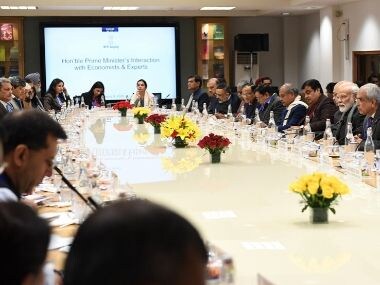 PM Narendra Modi interacting with economists and experts in a meeting held at NITI Aayog today. Pic courtesy: PIB India[/caption]The latest GDP data for the July-September quarter showed a significant further moderation in the pace of economic growth to 4.5 percent—the weakest in six years, with a key contributory factor being a slump in manufacturing output.The Modi government has undertaken a number of measures to arrest the growth slowdown. In September 2019, it announced a cut in the corporate tax rate to 22 percent from 30 percent.The government also lowered the tax rate for new manufacturing companies to 15 percent to attract new foreign direct investments. The tax rate reductions bring India in line with rates in other Asian countries.The government's other initiatives include bank recapitalisation, the mergers of 10 public sector banks into four, support for the auto sector, plans for infrastructure spending, as well as tax benefits for startups.But experts say none of these measures directly address the widespread weakness in consumption demand, which has been the chief driver of the economy.Also, financial sector fragilities continue to weigh on the economic growth momentum, with the high level of non-performing loans on the balance-sheets of the public sector banks, constraining their fresh lending.Furthermore, there are also risks from potential contagion effects from troubled non-bank financial companies (NBFCs) to the balance-sheets of some commercial banks, which could further weigh on the overall pace of credit expansion.In response to the growth slowdown, the Reserve Bank of India (RBI) has eased policy rates significantly during 2019, with a series of rate cuts since February 2019.Further stimulus measures are expected in the upcoming Budget where the focus is likely to be on reforms, including some structural measures such as reducing red tape and boosting foreign direct investment.The Prime Minister's meeting with industrialists is in the series of discussions that Modi has had during the last couple of weeks to seek suggestions to revive growth.In the previous meetings, he met Kotak Mahindra Bank CEO Uday Kotak, State Bank of India head Rajnish Kumar, HDFC Bank managing director Aditya Puri, IT industry veteran TV Mohandas Pai; former finance secretary Hasmukh Adhia; Tech Mahindra CEO CP Gurnani, Intel India general manager Nivruti Rai and Tata Consultancy Services chief executive Rajesh Gopinath.Modi has so far met over 60 entrepreneurs and businessmen from sectors such as FMCG, finance, renewable energy, diamond, retail, textiles, MSMEs and startups and technology.Follow full coverage of Union Budget 2020-21 here
First Published:Jan 09, 2020, 11:10:32 IST
Advertisement
Advertisement

India remains among fastest-growing major economies despite global uncertainty, says RBI Bulletin
RBI says industrial and services activity stayed resilient through June, while strong trade, stable external sector and improving foreign investment continue to support economic growth.
1 min read
Iran war could cut global growth by more than half: World Bank’s chief economist Indermit Gill
Prolonged US-Iran conflict could fuel inflation, push up borrowing costs and deepen debt distress across developing economies, says Indermit Gill
2 min read
Brent crude climbs to $94 as analysts expect oil prices to stay in $90–100 range
Rising US-Iran tensions and tight OPEC+ supply have pushed crude to a five-week high, but experts believe prices are unlikely to sustain a rally beyond $100 without a major supply disruption.
1 min read
UK inflation cools further to 2.6% in June as transport and food prices ease
Softer price growth in transport and food categories helps push headline inflation lower, while core inflation remains sticky.
1 min read
India's gem and jewellery exports jump 26.5% in June on stronger global demand
Lower gold prices, healthy overseas demand and rising exports of gold jewellery, diamonds and lab-grown diamonds drive sharp recovery in June
1 min read
Advertisement
Advertisement