


TAM dispute: solution hunt begins today

Updated on July 16: Tonight, expect off the record negotiations on the issue as many of the key personalities involved in the dispute meet at the Broadcast Audience Research Council meeting. The Indian Broadcasting Federation (IBF) has 60 per cent stake in BARC, while ISA and AAAI own 20 percent stake each.
BARC is the body touted as the institution which will take over television audience measurement in the country, so while major constituents of IBF are in dispute with both the ISA and AAAI, there is a long term commitment that they have to each other.
Updated on July 15: Major advertisers including Hindustan Unilever, P&G, Godrej and Dabur have cancelled their ongoing bookings with broadcasters who have got into bilateral agreements with TAM to get their audience measurement data reported monthly and in absolute numbers of viewers.
 More from Brands
The game is afoot, and the impact of the backlash from advertisers will be studied and a new strategy defined by broadcasters. Watch this space as the drama unfolds. Will broadcasters back off? Will the advertisers? Or will one side crack and yield? And finally, will back channel diplomacy take over?
Tuesday, October 1, 2013
Monday, October 14, 2013.
Sunday, November 3, 2013.
And this set of numbers: 22, 9, 5, 0, 0.
These three days and this set of numbers will play a critical role in the standoff between advertisers and their media agencies pitting against broadcasters in a dispute over the periodicity of reporting of television audience measurement data from TAM and on whether audiences should be reported in absolute numbers or in channel shares. More details about the state of the dispute here.
[embedalsosee]
If better sense does not prevail, we will see, over the next few weeks, more and more advertisers going off air, hardening their positions.
Who will blink first as they go eyeball to eyeball?
The answer lies in the dates and the numbers above, and we look at their significance below:
Tuesday, October 1, 2013.
That's the date on which the TRAI mandated 10 + 2 cap on advertising comes into force. In layman's terms, no channel, from this day on, can carry more than 10 minutes of advertising and 2 minutes of self-promotion per clock hour. What it means is that the available inventory, infinite (in theory) as of now, becomes finite - shrinks significantly.
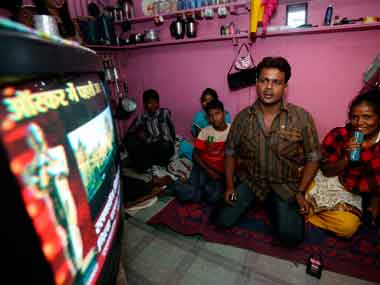
Representative Image[/caption]
Monday, October 14, 2013.
That's the day that the nation will celebrate Dussehra, the culmination of the Navratri festivity, when the family buys new clothes, goes on holiday, and, in general, splurges on themselves.
Sunday, November 3, 2013.
That's Diwali, which includes Dhanteras and Lakshmi puja. For many Hindus, Dhanteras, the first day of Diwali celebrations, marks the new financial year. It's the same story again: new clothes, but with jewellery added, new cars, holidays and splurging.
And finally, we come to the set of numbers: 22, 9, 5, 0, 0
That's a break-up of the 36 subdivisions that the country is divided by the meteorological department representing 22 subdivisions which have had excess rains as of 12 July, 9 which have had normal rains, 5 which have had deficient rains and 0 and 0 having scanty or no rain. In short, it looks like we will have a good monsoon.
So, to join the dots, it looks like the country will have a good monsoon leading up to two days of traditional celebrations and loosening of purse strings in mid-October and early November.
Do brands want to sell to a country (certainly rural and semi-urban India) which is flush with funds, with an intent to buy?
Presumably, the answer is 'yes' - which means they need to get their communication out by the middle of September for most categories. For categories such as travel, tourism and hotels, they would need to go to market even earlier.
That's a maximum of two months away.
For broadcasters, they would have to hold out for a maximum of two months. Considering the TRAI 10+2 regulation, popular channels will, anyway, have had less selling to do (thanks to the shrinking inventory) and more negotiation.
Does this standoff mean that all advertisers will stay away from TV?
No. Advertisers are free to do business with broadcasters if they choose to do so - and many will. Can the eCommerce companies stay away? Can the white goods companies? Can the cars and the two-wheelers? Some will show solidarity and some will break ranks. Those who break ranks will be welcomed with open arms by the broadcasters.
It's easier for the broadcasters to put up a strong front. After all, just 10 of them need to get into a huddle and take a position. For the advertisers, it's almost infinitely more difficult. The big advertisers can take a tough stand, but there is no way to rope in the smaller advertisers.For the moment, if push comes to shove, I'll put my money on the broadcasters.
Anant Rangaswami was, until recently, the editor of Campaign India magazine, of which Anant was also the founding editor. Campaign India is now arguably India's most respected publication in the advertising and media space. Anant has over 20 years experience in media and advertising. He began in Madras, for STAR TV, moving on as Regional Manager, South for Sony’s SET and finally as Chief Manager at BCCL’s Times Television and Times FM. He then moved to advertising, rising to the post of Associate Vice President at TBWA India. Anant then made the leap into journalism, taking over as editor of what is now Campaign India's competitive publication, Impact. Anant teaches regularly and is a prolific blogger and author of Watching from the sidelines.

IEA predicts major oil surplus in 2027 as Hormuz reopening sparks supply rebound
CNN-News18 Launches #CNNNews18OneLess, Inspiring India to Turn Small Actions into Big Environmental Impact
Sensex crashes over 1,000 points; Nifty tumbles 359 points in late sell-off
Hindware wins case against Google, Delhi HC fines tech giant Rs 30 lakh for trademark infringement
Best Ways to Get Exposure to Gold in India?