


Legalising Mumbai's slums: Why the Cong-NCP govt is in a fix
Legalising pre-2000 slum structures is not going to be easy, but not being able to do so can be an acute embarrassment for Congress and NCP leaders.

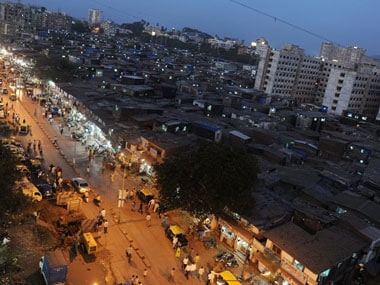
A file picture of Dharavi - one of the largest slums in Mumbai. AFP[/caption]The government’s own legal eagles have cautioned against any haste in promulgating an ordinance for it would be a brazen defiance of the court. It can be hardly expected that the apex court would take it in stride. The only possibility is having to face the slapping of a contempt notice. Another intervention application in the PIL by the Janhit, an NGO, needn’t mean a response prior to the elections.The state government has extended relief to post-1995 slums but if the structures were built prior to 2000. But it is not a universally approved policy. It has got entangled in a court case launched by this civil society organisation in 2007. Legalising all pre-2000 goes against the government’s own earlier plea that it would not do so. That slip is proving to be a serious political blunder.Caught between a rock and a hard place and unable to face the slum electorate in a city where over half the population is slum dwellers, the alliance mandarins seem to be exploring an option. A Bill legalising the post-1995 but pre-2000 slum dwellings in the current four-day legislative session, they think could do the trick. It is less brazen, and introduction does not mean adoption. Opposition, caught in a fix, cannot oppose a pro-slum move.The AAP has made it amply clear that housing issues in Mumbai is its priority. It includes not merely the slums but the housing crisis which the middle classes have not been able to cope with. Patkar’s campaigns in Mumbai on this has been long and sustained, pointing out that slums were not seen as an issue in itself but eyed as a real estate. The government lays stress on the latter, conniving with the builders lobby.A Bill, even if not adopted as an Act, has the ability to enhance the credibility of the two parties before the electorate – look, we are doing it, but there are constraints. If the apex court were to, in the least, frown, the escape route exists. Mere withdrawal of a Bill as compared to an Ordinance may be wrongly perceived as lesser of a crime. Apparent calculation appears to be that court ire be risked and leave the consequences to be handled by a successor government.The ruling alliance cannot afford to let a campaign against it by a strong voice like Medha Partkar’s underlining that the promises have not been met though made in 2009, to run the course. It is possible the AAP may not win many seats but could gain traction to build a base for the Assembly elections due in October. Perhaps this is the first time an alliance is rueing an unkept promise.
Mahesh Vijapurkar likes to take a worm’s eye-view of issues – that is, from the common man’s perspective. He was a journalist with The Indian Express and then The Hindu and now potters around with human development and urban issues.

Key differences between third party, comprehensive & zero depreciation bike insurance coverage
These lucky members played the CRED bounty and won massive prizes, including Rs 1.5 lakh cash, a PS5, and more: Here’s how you can win as well!
Tech Goes Bold with the New Age Baleno: Everything A Hatchback Wants To Be
How saving water will save our future
‘Dune’ Is A Visual Extravaganza Tied With Spellbinding Performances That You Just Can’t Afford To Miss