


How Mumbai's pucca house dream got a quick fix
In Mumbai, where 60 percent of the population builds for itself, a cement company has changed the construction paradigm and given those in slums a real, quick shot at middle-classdom — a pucca house.

Reinforced Cement Concrete (RCC) is the new Indian vernacular. Throughout India, buildings are still built by mistrys and masons instead of architects and engineers. Except, they now build with concrete.In small towns and villages, one encounters buildings that shoot above surrounding older rooftops. No longer are new buildings made using thick walls of stone or brick, with deep overhanging Mangalore tiled roofs that once defined the rural skyline.There is a profound change happening in the construction industry. More and more people at the lower end of the economic scale are building for themselves. Technology is no longer restricted only to the well-to-do.When construction is not too complicated, building spans not too wide, or buildings that do not rise above two floors, even a mason unschooled in structural technology can erect a stable frame. When enough people start using the same technology, it goes mainstream, costs come down, and the work gets speeded up.[caption id="attachment_272582" align="alignleft" width="380" caption="Time is key to the contractors’ success. Image courtesy: Mustansir Dalvi"]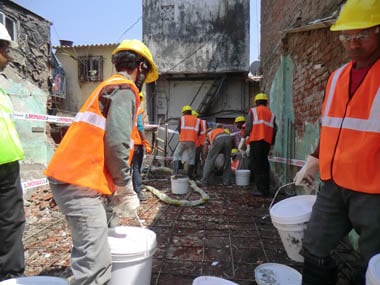 [/caption]In Mumbai, more people build for themselves than approach builders for ready-made units. With more than 60 percent of its citizens living in self-built housing, this is self evident. They are beyond the pale of Mumbailopolis at large because of their location in designated slums — areas that, to other 40 percent, are the blight seen from the airplane. Spaces and communities to be eliminated as part of official policy in a decade or so.It is these very areas that are experiencing a construction boom like never before. Those who live here are now part of the city's middle-classdom, having made enough capital through enterprise and labour. They can construct a pucca home — an expression of their aspirations and optimism.Aiding them to fulfill this dream are the many contractors, themselves inhabitants of these neighbourhoods. Many are former masons who have learnt their trade through apprenticeship and experience. They work with limited resources, plot size and available time to construct well-built homes that mirror their clients’ needs. The efficiency of their work culture is based on a network of local knowledge — of demand, supply, availability and affordability. Houses are built (from demolishing the previous structure to handing over keys) in an unprecedented time-frame of 45 days or so. This is possible only because contractors are adept in RCC construction. Once the RCC frame is constructed, several processes like plumbing, electrical fittings or interior furniture and finishing can go on simultaneously.Time is key to the contractors’ success. In contested neighbourhoods, the threat of demolition is ever present, and negotiations go on to stymie this. Materials stacked in the open for too long are an invitation for a ‘stop-work’ notice. Time is also a reflection of trust. The householder has handed his home to the contractor, and is homeless until the construction is completed. He can only rely on the kindness of neighbours and relatives for interim accommodation. Also, where there are no open spaces other than the narrow streets themselves, any construction activity can impose on the neighbours. A collective collegiality is the best way to fulfill an individual’s dreams. But even a technology such as RCC takes up time and space.Recently, in Shivajinagar at Deonar, time has been fast-tracked. Local contractors, with the intercession of urban researchers, URBZ, have been in contact with Lafarge, the world's second-largest cement manufacturer. Lafarge supplies immense quantities of cement to vast building sites all over the country. They have several batching plants in Mumbai that supply concrete in ‘ready-mix’ form. Concrete, made of cement, sand, and stone aggregate is traditionally prepared on site with water mixed in appropriately. Its success depends on material quality and proportion and its worth can be touch and go in untrained hands. It also hardens quickly and has to be placed as fast as possible. ‘Ready-mix’ concrete is made in industrial quantities under stringent quality checks. Its setting time is retarded using chemicals so that it can be supplied to distant sites. This wet mix is transported using truck-mounted transit mixers and piped out wherever needed.Continues on the next pageLafarge supplied a few contractors of Shivajinagar ready-mix concrete to construct several houses. One problem encountered was to manoeuvre supply trucks within Shivajinagar, whose streets are too constricted for two-lane traffic. Like good entrepreneurs committed to developing a prospective market, Lafarge thought laterally. They devised a means of supplying concrete in plastic buckets. Buckets of 15 litres each were neatly stacked in the modest back-space of a tempo and brought to site, traversing the narrow alleys without obstruction. The buckets were unloaded by hand by the contractor’s team, upturned into plinths and formwork and returned to the tempos that departed instantly. The speed of this process was as astonishing as its efficiency; high technology and world-class quality hand in hand with labour intensive building methods. By working with contractors who build affordable homes in areas of the city hardest to reach, an international cement company may just have changed the paradigm of the construction industry in Mumbai.This unusual collaboration has benefited the contractors of Shivajinagar. With quality assured and concrete available in retail quantities, the ease of supply and of actual use can transform site work. The cost of ready-mix is currently more than that of hand-mixed concrete on site, but the time (and space) saved more than adequately makes up for it. Their clients get a home built with the best of concrete, long-lasting and pucca to the core. There is now an increasing demand among several contractors from other neighbourhoods.Lafarge now has gained access to vast potential retail market in addition to upper-end builder and contractors. That they were willing to go beyond a comfort base and adapt to changing work circumstances and clients is to their credit. This may be strictly business, but is one with a potential for transformation. Supplying concrete to build small homes in Shivajinagar may become as profitable as supplying concrete to build that other large home in Mumbai, Antilla.
Mustansir Dalvi teaches architecture in Mumbai; and is an author, poet and translator. He writes on urban issues and critiques the unraveling urban fabric of Mumbai in its current post-planning avatar.

Key differences between third party, comprehensive & zero depreciation bike insurance coverage
These lucky members played the CRED bounty and won massive prizes, including Rs 1.5 lakh cash, a PS5, and more: Here’s how you can win as well!
Tech Goes Bold with the New Age Baleno: Everything A Hatchback Wants To Be
How saving water will save our future
‘Dune’ Is A Visual Extravaganza Tied With Spellbinding Performances That You Just Can’t Afford To Miss