
Advertisement


Sections
US shutdown drags on due to vote delay, govt workers stay home without pay
Hundreds of thousands of US federal employees were forced to stay home without pay Monday after lawmakers failed to reach an agreement on ending a government shutdown before the start of the work week

Washington: Hundreds of thousands of US federal employees were forced to stay home without pay Monday after lawmakers failed to reach an agreement on ending a government shutdown before the start of the work week.Although leaders of president Donald Trump's Republican Party and the opposition Democrats said progress had been made in a weekend of talks, they pushed back a scheduled late-night Sunday vote on a stopgap funding measure to Monday at noon (17:00 local time).Trump goaded Democrats from the sidelines, accusing them of placing non-citizens ahead of Americans, shutting down the government in the service of "their far left base.""They don't want to do it but are powerless," he tweeted, referring to the Democratic leadership in Congress.The impasse, the first of its kind since 2013, had already cast a huge shadow over the first anniversary of Trump's inauguration as president on Saturday.After special weekend sessions of Congress which had seen bitter recriminations traded across the political aisle, Senate Majority Leader Mitch McConnell pledged in a speech to the chamber late Sunday to address Democrat concerns over key issues such as immigration reform.[caption id="attachment_4314757" align="alignleft" width="380"]![File image of the US Capitol. AP]() File image of the US Capitol. AP[/caption]The Senate's top Democrat Chuck Schumer responded by saying he was "happy to continue my discussion with the majority leader about reopening the government" but added that the parties were "yet to reach an agreement on a path forward."Hopes that the shutdown, which began at midnight Friday, could be limited to the weekend were raised Sunday when a bipartisan group huddled for hours trying to end the standoff, but they ultimately failed to reach a deal.On Monday, White House Press Secretary Sarah Sanders accused the Democrats of "playing games.""The president's focus is making sure we get the government reopened. It's outrageous that Democrats are holding our national security hostage," she told ABC's "Good Morning America" program.Over the weekend, Trump had encouraged the Senate's Republican leaders to invoke the "nuclear option" -- a procedural manoeuvre to change the chamber's rules to allow passage of a budget by a simple majority of 51 votes to end the shutdown.But Senate leaders have been wary of such a move in the past, as it could come back to haunt them the next time Democrats hold a majority.Essential services continueAt the heart of the dispute is the issue of undocumented immigration.Democrats have accused Republicans of poisoning chances of a deal and pandering to Trump's populist base by refusing to back a program that protects an estimated 7,00,000 "Dreamers" — undocumented immigrants who arrived as children — from deportation.Democrats have refused to go along with the temporary federal funding request unless it addresses the Deferred Action for Childhood Arrivals program in part because they fear Republican leaders will not act to protect DACA recipients before deportations would begin in large numbers in March.But in a signal to Democrats, McConnell committed on the Senate floor to addressing immigration in a timely fashion."Should these issues not be resolved by the time the funding bill before us expires on 8 February, 2018, assuming that the government remains open, it would be my intention to proceed to legislation that would address DACA, border security and related issues," McConnell said.But that commitment means little to some in McConnell's own party; some House Republicans told reporters they would not be bound by any agreement reached in the Senate to address immigration."I don't see any of our people interested in some half-baked idea that's produced by a self-appointed group of senators," Congressman Tom Cole said, according to Roll Call.Essential federal services and military activity are continuing, but even active-duty troops will not be paid until a deal is reached to reopen the US government.There have been four government shutdowns since 1990. In the last one, more than 800,000 government workers were put on temporary leave."We're just in a holding pattern. We just have to wait and see. It's scary," Noelle Joll, 50, a furloughed US government employee, told AFP in Washington.New York Governor Andrew Cuomo, a Democrat, said that the state would pay for the reopening of the Statue of Liberty, the inspirational landmark that was among facilities closed under the shutdown.Anti-Trump protestsRepublicans have just a one-seat majority in the Senate, and therefore have to lure some Democrats to their side to get a 60-vote supermajority to bring the stopgap funding motion forward.Highlighting the deep political polarization, crowds estimated in the hundreds of thousands marched through major US cities over the weekend against the president and his policies and to express support for women's rights.
File image of the US Capitol. AP[/caption]The Senate's top Democrat Chuck Schumer responded by saying he was "happy to continue my discussion with the majority leader about reopening the government" but added that the parties were "yet to reach an agreement on a path forward."Hopes that the shutdown, which began at midnight Friday, could be limited to the weekend were raised Sunday when a bipartisan group huddled for hours trying to end the standoff, but they ultimately failed to reach a deal.On Monday, White House Press Secretary Sarah Sanders accused the Democrats of "playing games.""The president's focus is making sure we get the government reopened. It's outrageous that Democrats are holding our national security hostage," she told ABC's "Good Morning America" program.Over the weekend, Trump had encouraged the Senate's Republican leaders to invoke the "nuclear option" -- a procedural manoeuvre to change the chamber's rules to allow passage of a budget by a simple majority of 51 votes to end the shutdown.But Senate leaders have been wary of such a move in the past, as it could come back to haunt them the next time Democrats hold a majority.Essential services continueAt the heart of the dispute is the issue of undocumented immigration.Democrats have accused Republicans of poisoning chances of a deal and pandering to Trump's populist base by refusing to back a program that protects an estimated 7,00,000 "Dreamers" — undocumented immigrants who arrived as children — from deportation.Democrats have refused to go along with the temporary federal funding request unless it addresses the Deferred Action for Childhood Arrivals program in part because they fear Republican leaders will not act to protect DACA recipients before deportations would begin in large numbers in March.But in a signal to Democrats, McConnell committed on the Senate floor to addressing immigration in a timely fashion."Should these issues not be resolved by the time the funding bill before us expires on 8 February, 2018, assuming that the government remains open, it would be my intention to proceed to legislation that would address DACA, border security and related issues," McConnell said.But that commitment means little to some in McConnell's own party; some House Republicans told reporters they would not be bound by any agreement reached in the Senate to address immigration."I don't see any of our people interested in some half-baked idea that's produced by a self-appointed group of senators," Congressman Tom Cole said, according to Roll Call.Essential federal services and military activity are continuing, but even active-duty troops will not be paid until a deal is reached to reopen the US government.There have been four government shutdowns since 1990. In the last one, more than 800,000 government workers were put on temporary leave."We're just in a holding pattern. We just have to wait and see. It's scary," Noelle Joll, 50, a furloughed US government employee, told AFP in Washington.New York Governor Andrew Cuomo, a Democrat, said that the state would pay for the reopening of the Statue of Liberty, the inspirational landmark that was among facilities closed under the shutdown.Anti-Trump protestsRepublicans have just a one-seat majority in the Senate, and therefore have to lure some Democrats to their side to get a 60-vote supermajority to bring the stopgap funding motion forward.Highlighting the deep political polarization, crowds estimated in the hundreds of thousands marched through major US cities over the weekend against the president and his policies and to express support for women's rights.
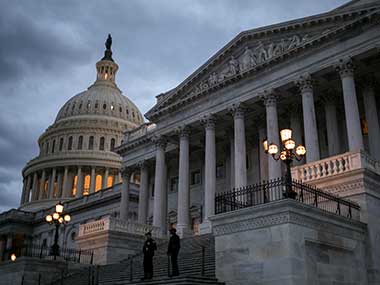 File image of the US Capitol. AP[/caption]The Senate's top Democrat Chuck Schumer responded by saying he was "happy to continue my discussion with the majority leader about reopening the government" but added that the parties were "yet to reach an agreement on a path forward."Hopes that the shutdown, which began at midnight Friday, could be limited to the weekend were raised Sunday when a bipartisan group huddled for hours trying to end the standoff, but they ultimately failed to reach a deal.On Monday, White House Press Secretary Sarah Sanders accused the Democrats of "playing games.""The president's focus is making sure we get the government reopened. It's outrageous that Democrats are holding our national security hostage," she told ABC's "Good Morning America" program.Over the weekend, Trump had encouraged the Senate's Republican leaders to invoke the "nuclear option" -- a procedural manoeuvre to change the chamber's rules to allow passage of a budget by a simple majority of 51 votes to end the shutdown.But Senate leaders have been wary of such a move in the past, as it could come back to haunt them the next time Democrats hold a majority.Essential services continueAt the heart of the dispute is the issue of undocumented immigration.Democrats have accused Republicans of poisoning chances of a deal and pandering to Trump's populist base by refusing to back a program that protects an estimated 7,00,000 "Dreamers" — undocumented immigrants who arrived as children — from deportation.Democrats have refused to go along with the temporary federal funding request unless it addresses the Deferred Action for Childhood Arrivals program in part because they fear Republican leaders will not act to protect DACA recipients before deportations would begin in large numbers in March.But in a signal to Democrats, McConnell committed on the Senate floor to addressing immigration in a timely fashion."Should these issues not be resolved by the time the funding bill before us expires on 8 February, 2018, assuming that the government remains open, it would be my intention to proceed to legislation that would address DACA, border security and related issues," McConnell said.But that commitment means little to some in McConnell's own party; some House Republicans told reporters they would not be bound by any agreement reached in the Senate to address immigration."I don't see any of our people interested in some half-baked idea that's produced by a self-appointed group of senators," Congressman Tom Cole said, according to Roll Call.Essential federal services and military activity are continuing, but even active-duty troops will not be paid until a deal is reached to reopen the US government.There have been four government shutdowns since 1990. In the last one, more than 800,000 government workers were put on temporary leave."We're just in a holding pattern. We just have to wait and see. It's scary," Noelle Joll, 50, a furloughed US government employee, told AFP in Washington.New York Governor Andrew Cuomo, a Democrat, said that the state would pay for the reopening of the Statue of Liberty, the inspirational landmark that was among facilities closed under the shutdown.Anti-Trump protestsRepublicans have just a one-seat majority in the Senate, and therefore have to lure some Democrats to their side to get a 60-vote supermajority to bring the stopgap funding motion forward.Highlighting the deep political polarization, crowds estimated in the hundreds of thousands marched through major US cities over the weekend against the president and his policies and to express support for women's rights.
First Published:Jan 22, 2018, 21:24:10 IST
Advertisement
Advertisement

Pakistan's deep state weaponising LeT to counter Asim Munir critic Maulana Fazlur Rehman: Report
A deepening military-terror nexus is reportedly emerging in Pakistan in a bid to neutralise the JUI-F chief, Maulana Fazlur Rehman, after he openly criticised Pakistan's Army Chief Asim Munir.
2 min read
No premium queues, 30-minute target: What changes for Indian passport applicants in UAE
Indian passport applicants in the UAE can now access passport, visa and attestation services through Alhind’s 16 centres, with no premium queues, a Dh19 service fee and a target of completing applications within 30 minutes
4 min read
'We don't need straits': Trump says Iran war isn't about Hormuz as US strikes for 12th night
US President Donald Trump on Wednesday declared that the country does not need the Strait of Hormuz as Washington bombards Iran for the 12th consecutive night.
2 min read
Iran claims to stop three oil tankers transiting Strait of Hormuz
In recent weeks, Iran has targeted tankers using a route along the Omani coast to cross the strait, in what it says is an effort to force vessels to use Iranian waters and pay for safe passage
1 min read
Globe at a glance: From Houthis striking Saudi tankers in Red Sea to wildfires in Europe
Your window to world news: As Yemen's Houthi rebels claimed to have struck two Saudi oil tankers in the Red Sea on Wednesday, the United States has announced a landmark deal with Saudi Arabia that would establish a civilian nuclear program in the Gulf country
2 min read
Advertisement
Advertisement