


US fiscal cliffhanger still hinges on taxes on 'fat cats'
President Obama and the House Republicans have presented contrasting proposals to avert a fiscal cliff. But they can't seem to agree on the central issue: whether wealthy Americans should pay more taxes than they do now.

New York: US President Barack Obama's re-election in November, coupled with some alacrity shown by Congressional leaders to shed their reputation of dysfunction, raised expectations for a possible deal. But with less than four weeks to go before automatic tax hikes and spending cuts get triggered in January, there are no signs of a compromise. In fact, we are seeing public negotiations in Washington that seem to be going nowhere.
US markets slipped lower on Tuesday, dragged into negative territory by jitters over the US 'fiscal cliff', as the Democrats and the Republicans struggled to find common ground in order to avert a slide back into recession. In light volume, the Dow Jones industrial average ended down 13.82 points, or 0.11 percent, at 12,951.78.
 More from World
Obama says there will be no deal to avert the "fiscal cliff" unless Republicans drop their opposition to raising tax rates on rich Americans. He told Bloomberg Television that the proposal offered by House Republicans, which doesn't raise income tax rates on upper-income Americans, is out of balance.
"When you look at the math, it doesn't work," Obama said. "What I'm going to need... is an acknowledgment that folks like me can pay a little bit higher rate," added Obama in remarks that would fire up his populist base.
[caption id="attachment_50276" align="alignright" width="380"]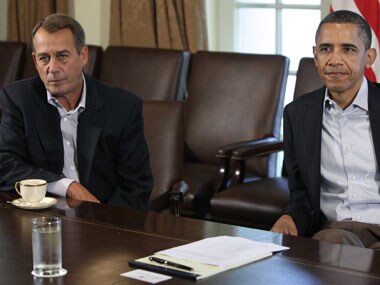 Obama and John Boehner don't see eye-to-eye on how to avert a fiscal cliff.[/caption]
However, Obama is signalling some flexibility on where the rates could eventually wind up. The president is leaving room for negotiation on that detail as he knows that he will have to give something up in negotiations with congressional Republicans.
Meanwhile, both sides have laid out preliminary offers in their talks aimed at averting the fiscal cliff, but both proposals have been rebuffed by the other side. Investors who have studied both proposals hope a deal before the year-end deadline will trigger a 'Santa Claus' rally.
President Obama's proposal:
Obama sketched out a plan that calls for a $1.6 trillion tax increase over 10 years, $50 billion in new spending in 2013, and a change that would give the White House new power to raise the federal debt limit. Republicans have slammed Obama's proposal as "a step backwards."
House Republican proposal:
On Monday, Republicans led by House Speaker John Boehner gave their own proposal, delivering an offer that includes $800 billion in increased tax revenue but doesn't raise income-tax rates for top earners.
The White House quickly rejected the Republican proposal at first glance, reasoning that Boehner offered no concessions to Obama's central demand that income tax rates be allowed to increase for the wealthiest Americans. Clearly, the two sides remain deadlocked over a central issue - whether wealthy Americans should pay more taxes than they do now.
"We're nowhere. We're farther than where we started," Wisconsin Representative Paul Ryan, the former GOP vice presidential nominee, said of the negotiations Tuesday on WTMJ radio in Wisconsin. He said Obama is now demanding higher tax rates than the ones on which he had campaigned.
You might think the Indian parliament takes the cake when it comes to policy paralysis, but Washington is equally prone to partisan gridlock. The last time the US Congress failed to come to a bipartisan agreement on raising the debt limit in August 2011 it endangered America's credit rating. After the bitter fight in Congress over raising the debt limit in the summer of 2011, Standard & Poor's downgraded the US government's credit rating to AA+ from AAA.

Secret Service agent on JD Vance security detail put on leave over alleged leak of travel plans
China has dominated Myanmar’s rare earth mines — now India eyes deal to harness country’s critical minerals
Cruise missiles, drones and more... The deadly arsenal of the Houthis
Epstein's model scout Daniel Siad found dead at his home near Paris amid rape case trial
South China Sea tensions rise as China claims it expelled Philippine ships