


US election 2016: Is America a land of plenty or military machine?
Nicholas Powers, a college professor from Brooklyn, New York City and co-host of Puerto Rican poetry slam talks about US Presidential election, race and identity.

Editor's Note: As the US Presidential Election draws near and the battle between Democrat candidate Hillary Clinton and Republican candidate Donald Trump gains more teeth, it might prove instructive to examine the constituency at which the twin campaigns are directed; to understand what America means to its citizens and what these men and women seek from their politicians. To do this Firstpost assembled profiles of a broad section of people, each telling a story that speaks of the (anticipated) state of the union.

In the first part, Nicholas Powers, a college professor from Brooklyn, New York City and co-host of Puerto Rican poetry slam talks about race and identity.
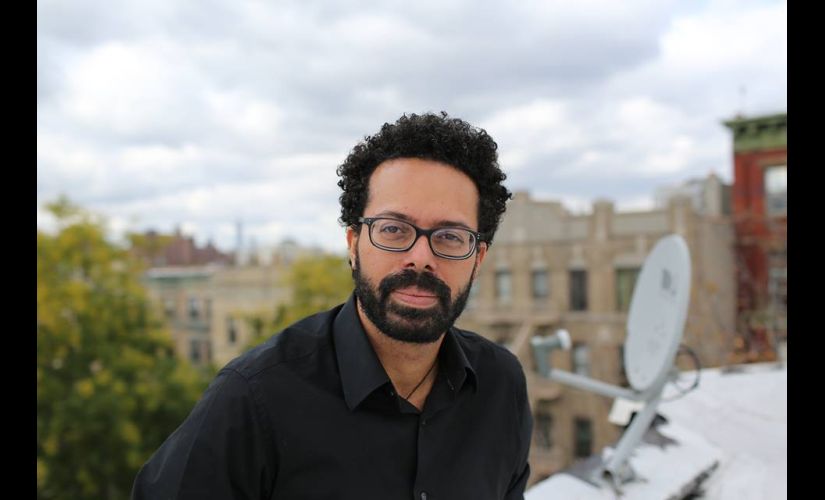
Nicholas Powers, a college professor from Brooklyn, New York city. Firstpost/Padmini Parthasarathy[/caption]Does that say something about what you think of America or masculinity in America?It’s a certain kind of masculinity, something I’ve seen often in America. Like when I travel and meet people on the road, sometimes I see these old Vietnam veterans with their Harley Davidson jacket, and I see this form of masculinity as being part of the past, but it’s a variation on a theme of rugged individualism but also deeply violent sentimentalism of the things that it has worn through. I don’t know if it’s unique, but it’s a certain kind of white, but not only white, American masculinity that’s sentimental, nationalistic, and also oddly very possessive and fragile about its possessiveness.I guess we should turn to your identity and race being a part of that. So how would you identify?I identify as a delightful mutt. Kind of a mixture of everything, so an Afro-Latino or a Nuyorican, you know, would probably be the most accurate. But I would say Nuyorican because my identity has been so shaped by my experiences in New York, so I’m almost more a citizen of New York City than of the country. I’m definitely a product of the north east and west coast, and so, I guess I would say I’m a product of American cities, the urban centres. But yeah, I guess I would say I’m Nuyorican, but more as a product of New York City than Puerto Rican heritage.Can we veer off for a second and talk about the urban-rural divide? What do you think you’ve gained from being in an urban environment and being a product of one?What I got from the city was a sense of timelessness, that's because the streetlights are always on, the city’s rhythms are continuous, through the night and the day, so it flings me out into the street and I get a sense that anything is possible at any time. There’s always this river of adventure flowing through the sidewalks of the city. People in the city feel like a herd on a concrete savannah, going from one place to another. Like a herd, there are the weak and the old, that are kind of picked off by predators. So if you see a homeless person, you shrug and keep walking. If someone is being bothered by a mugger, you shrug and you keep walking. So the experience of being in the city is being in an anonymous herd. The only time I don’t experience that is during events like Halloween, when it’s like a carnival. People are wearing costumes and saying hi to each other and dancing in the street, or like when Barack Obama got elected and there was a big political thing. So those are my two experiences of the city. There’s the herd and there’s the carnival.How do you perceive people as a result of your race?I perceive people not only in their racial identity, but I think I try to perceive where race is for them. So when I’m dealing with people who may be “raced”, South Asian, Black, Mexican, Honduran, whatever, I see them as raced, but I try to understand where race is in their life. Is it buried under class privilege? Is it something that you put up front? Where is it in relation to the other parts of your identity, so that’s one.I live in a predominantly African-American and Caribbean American neighbourhood, some recent north African on the side, so it’s an African diaspora. There were some brothers and sisters fighting on my block, and I could almost see and hear in their voice a history of generational trauma that itself was the kind of after-effects of race. The poverty from one generation, the trauma, the anger, using words, stabbing each other with words. So sometimes I can see with other people of colour the history of race. It’s almost like an X-ray but instead of looking at bones, you see a rape from 200 years ago, or someone put in jail five years ago, or some scar from someone calling you n***a or s**c and it lacerates a little bit of your soul. And when I’m talking to people who are raced but invisibly raced, so they’re white. I can see them with prejudices pulsing inside them that are hitting the walls of political correctness. So they wanna say something but they think it’s prejudice so they stop themselves. So I look at how race activates and deactivates parts of themselves and their life.

Pakistan's deep state weaponising LeT to counter Asim Munir critic Maulana Fazlur Rehman: Report
No premium queues, 30-minute target: What changes for Indian passport applicants in UAE
'We don't need straits': Trump says Iran war isn't about Hormuz as US strikes for 12th night
Iran claims to stop three oil tankers transiting Strait of Hormuz
Globe at a glance: From Houthis striking Saudi tankers in Red Sea to wildfires in Europe