
Advertisement


Sections
Trump tags US 'Fake News' media as nation's 'biggest enemy' after Singapore summit, challenges skeptical media coverage
President Donald Trump challenged skeptical media coverage of his historic summit with North Korea's Kim Jong Un on Wednesday, declaring that "Fake News" is the nation's "biggest enemy."

US President Donald Trump challenged skeptical media coverage of his historic summit with North Korea's Kim Jong-un on Wednesday, declaring that "Fake News" is the nation's "biggest enemy."The president's tweet, delivered a few hours after Air Force One touched down outside Washington, was reminiscent of his February 2017 Twitter rebuke in which he called several leading news outlets "the enemy of the American people."Trump has sought to portray his unprecedented meeting with Kim as a significant accomplishment that has made the world less vulnerable to the North's nuclear arsenal. Critics say that his agreement with the North lacks specific restraints on Kim's government and that he offered to end joint military exercises with South Korea with little in return.The president tweeted after returning from his Singapore summit that "the Fake News, especially NBC and CNN," are "fighting hard to downplay the deal with North Korea." He added: "500 days ago they would have 'begged' for this deal-looked like war would break out.""Our Country's biggest enemy is the Fake News so easily promulgated by fools!" Trump tweeted.[caption id="attachment_4508983" align="alignleft" width="380"]![Donald Trump with Kim Jong-un on Tuesday. Reuters]() Donald Trump with Kim Jong-un on Tuesday. Reuters[/caption]The president also asserted that after his initial round of talks with Kim, there is "no longer a Nuclear Threat from North Korea." Trump's claim is dubious given that independent experts estimate Pyongyang has enough fissile material for 20 to 60 bombs.The tweet followed a New York Times story on the Trump administration's lack of scientific expertise, the president's questioning of the honesty of the American media at an international summit in Canada and his dismissal of diplomatic expertise in favor of using a "touch" and "feel" approach in his talks with Kim.Trump has bristled against questions over his decision to meet with Kim, whose country is estimated to have 80,000 to 120,000 political prisoners. The president has dubbed his detractors "haters & losers.""It's a mistake to see attacks on the media as separate from those things," said Jay Rosen, a New York University journalism professor. "It's the erosion of the common world of fact. If we can't agree on what the facts are, if there are no facts because they are in endless dispute, there is no accountability."Rosen noted that international summits were often venues for the U.S. president and American journalists to insist on joint news conferences with autocratic leaders or strongmen and their accompanying press corps, a form of soft diplomacy that demonstrated America's commitment to democratic institutions such as freedom of the press.While Trump held a news conference at the G-7 summit in Quebec last week, he told reporters during one exchange that he "came up with the term fake news" because many journalists who cover him are "very dishonest." In response to a journalist representing CNN, Trump criticized the premise of the reporter's question and then criticized "fake news CNN" as "the worst.""Anybody who can exert a factual check on the president, saying 'Wait a minute, that's not what happened,' is to be dismissed, attacked, delegitimized, pushed aside and turned into a hate object," Rosen said.
Donald Trump with Kim Jong-un on Tuesday. Reuters[/caption]The president also asserted that after his initial round of talks with Kim, there is "no longer a Nuclear Threat from North Korea." Trump's claim is dubious given that independent experts estimate Pyongyang has enough fissile material for 20 to 60 bombs.The tweet followed a New York Times story on the Trump administration's lack of scientific expertise, the president's questioning of the honesty of the American media at an international summit in Canada and his dismissal of diplomatic expertise in favor of using a "touch" and "feel" approach in his talks with Kim.Trump has bristled against questions over his decision to meet with Kim, whose country is estimated to have 80,000 to 120,000 political prisoners. The president has dubbed his detractors "haters & losers.""It's a mistake to see attacks on the media as separate from those things," said Jay Rosen, a New York University journalism professor. "It's the erosion of the common world of fact. If we can't agree on what the facts are, if there are no facts because they are in endless dispute, there is no accountability."Rosen noted that international summits were often venues for the U.S. president and American journalists to insist on joint news conferences with autocratic leaders or strongmen and their accompanying press corps, a form of soft diplomacy that demonstrated America's commitment to democratic institutions such as freedom of the press.While Trump held a news conference at the G-7 summit in Quebec last week, he told reporters during one exchange that he "came up with the term fake news" because many journalists who cover him are "very dishonest." In response to a journalist representing CNN, Trump criticized the premise of the reporter's question and then criticized "fake news CNN" as "the worst.""Anybody who can exert a factual check on the president, saying 'Wait a minute, that's not what happened,' is to be dismissed, attacked, delegitimized, pushed aside and turned into a hate object," Rosen said.
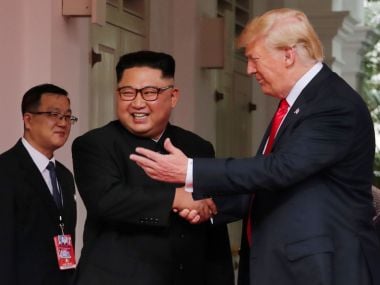 Donald Trump with Kim Jong-un on Tuesday. Reuters[/caption]The president also asserted that after his initial round of talks with Kim, there is "no longer a Nuclear Threat from North Korea." Trump's claim is dubious given that independent experts estimate Pyongyang has enough fissile material for 20 to 60 bombs.The tweet followed a New York Times story on the Trump administration's lack of scientific expertise, the president's questioning of the honesty of the American media at an international summit in Canada and his dismissal of diplomatic expertise in favor of using a "touch" and "feel" approach in his talks with Kim.Trump has bristled against questions over his decision to meet with Kim, whose country is estimated to have 80,000 to 120,000 political prisoners. The president has dubbed his detractors "haters & losers.""It's a mistake to see attacks on the media as separate from those things," said Jay Rosen, a New York University journalism professor. "It's the erosion of the common world of fact. If we can't agree on what the facts are, if there are no facts because they are in endless dispute, there is no accountability."Rosen noted that international summits were often venues for the U.S. president and American journalists to insist on joint news conferences with autocratic leaders or strongmen and their accompanying press corps, a form of soft diplomacy that demonstrated America's commitment to democratic institutions such as freedom of the press.While Trump held a news conference at the G-7 summit in Quebec last week, he told reporters during one exchange that he "came up with the term fake news" because many journalists who cover him are "very dishonest." In response to a journalist representing CNN, Trump criticized the premise of the reporter's question and then criticized "fake news CNN" as "the worst.""Anybody who can exert a factual check on the president, saying 'Wait a minute, that's not what happened,' is to be dismissed, attacked, delegitimized, pushed aside and turned into a hate object," Rosen said.
First Published:Jun 14, 2018, 01:03:46 IST
Advertisement
Advertisement

Cruise missiles, drones and more... The deadly arsenal of the Houthis
The Houthis have evolved into one of the world's most formidable non-state military forces, deploying anti-ship ballistic missiles, cruise missiles, drones and explosive boats to threaten Red Sea shipping. Their latest attacks on Saudi oil tankers have raised concerns over shipping through the Bab el-Mandeb Strait amid the Strait of Hormuz crisis
10 min read
Epstein's model scout Daniel Siad found dead at his home near Paris amid rape case trial
A modelling scout who recruited women for the late sex offender Jeffrey Epstein has been found dead at his home in Paris.
2 min read
South China Sea tensions rise as China claims it expelled Philippine ships
China said on Thursday it tracked and drove away two Philippine vessels it accused of having "intruded into" waters near the disputed Scarborough Shoal despite warnings
1 min read
Choke terror funding, keep international shipping lanes safe: Jaishankar at Asean Regional Forum
Jaishankar's remarks came against the backdrop of recent terror attacks targeting India and growing threats to commercial shipping amid conflicts in West Asia and Europe
2 min read
After Australia, New Zealand signs defence pact with Papua New Guinea as China expands in Indo-Pacific
After Australia, New Zealand has signed a defence cooperation agreement with Papua New Guinea. This is the latest agreement that countries in the region have signed to integrate themselves closer on security and defence as Chinas has sought to increase its footprint in the Indo-Pacific and the United States, the traditional guarantor of security, has abandoned the theatre.
2 min read
Advertisement
Advertisement