


SpaceX poised to launch resurrected space weather satellite
A $340 million sun-observing spacecraft that was initially dreamed up by former US vice president Al Gore is finally poised to launch Sunday after being kept in storage by NASA for years.

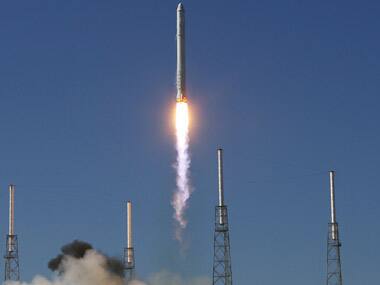
Representational Image. AP[/caption]Engineers added more hydraulic fluid so they could control the rocket's first stage and its fins better.After launching the satellite and separating at a height of 80 miles (130 kilometers), the first stage of the rocket will attempt just two burns, and will come in for a landing about twice as fast as last time, which makes success even less certain, said Koenigsmann.However, he stressed that the primary mission of the rocket launch is sending the satellite to deep space.Deep space missionThe DSCOVR mission -- a joint collaboration of the US Air Force, NASA and the National Oceanic and Atmospheric Administration (NOAA) -- is headed to a point about one million miles from Earth, a destination known as Lagrangian point, or L1.The journey will take 110 days, followed by 40 days of instrument tests.DSCOVR will replace an aging satellite, known as ACE, that is many years past its expiration date, and should provide the same lead time and accuracy as its predecessor, officials said."DSCOVR will also serve as our tsunami buoy in space, if you will, giving forecasters up to an hour's warning on the arrival of the huge magnetic eruptions from the Sun that occasionally occur called coronal mass ejections, or CME's," said Tom Berger, director of the NOAA Space Weather Prediction Center in Boulder, Colorado."CME's are the cause of the largest geomagnetic storms on Earth, some of which can severely disrupt our technological society causing loss of communications with aircraft, particularly those flying over the poles, damage to satellites in orbit, and even damage to power grid equipment on the ground."A 2009 report by the US National Academies of Science warned that an extremely large geomagnetic storm could disable electric power grids and result in projected economic and societal costs of up to $2 trillion, with full recovery taking up to 10 years.Al Gore's ideaSpace weather is the primary objective of the five-year mission, although Gore's initial idea was for a satellite that would observe Earth and send back live images that would raise environmental awareness of the planet's fragility.Known as Triana, the satellite was built in the late 1990s and ready to deploy, but before that could happen the mission was shelved in 2001 by the George W. Bush administration.In 2007, NASA and NOAA began re-examining the satellite -- which had been kept in a clean room -- and determined it was still viable, said Stephen Volz, assistant administrator of the NOAA Satellite and Information Service.The name was changed to DSCOVR and the instruments were refurbished so that it could take real-time measurements of solar wind and send data swiftly to Earth.Its secondary mission is to collect scientific data about aerosol levels, ozone and radiation balance on Earth.Among its original instruments is the Earth Polychromatic Imaging Camera, which will take full resolution images of the sunlit side of the Earth four to six times daily. The pictures will posted about a day later on a public website.By July or August, experts hope to begin receiving DSCOVR's first images.AFP

Why has Bangladesh’s choice of India spokespersons raised eyebrows?
Indian judo contender withdrawn from 2026 Commonwealth Games after failed dope test
US House passes $1 trillion defence bill despite concerns over Iran war and Israel ties
Explorers discover wreckage of plane 72 years later. Will this help in finding MH370?
Chinese Defence Attache praise India’s rescue of 12 sailors off Kerala cost