


SpaceX launches observatory DSCOVR on third try, nixes landing test
SpaceX launched an observatory inspired by former Vice President Al Gore toward a solar-storm lookout point a million miles away Wednesday.

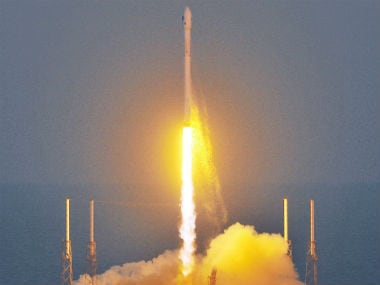
An unmanned Falcon 9 SpaceX rocket lifts off from launch complex 40 at the Cape Canaveral Air Force Station. AP[/caption]With three hours remaining in the countdown, SpaceX called off the radical landing test of the first-stage booster. It would have been just the second such experiment; last month's try ended in flames when the booster slammed into the platform, fell over and exploded."Mega storm preventing droneship from remaining on station, so rocket will try to land on water," SpaceX chief Elon Musk reported via Twitter shortly before liftoff. He said the chance of it surviving was less than 1 percent.Musk later said the rocket landed in the ocean within 10 miles (16 kilometers) of the target — and "nicely vertical!" Its descent was slowed by a pair of engine firings, with steering by fins attached to the booster. The launch was unaffected by the cancellation of the test, a secondary, personal objective for Musk, SpaceX's billionaire founder.Sending the observatory on its $340 million mission was the main event. It represented the first deep-space mission for the Southern California company, which also delivers supplies to the International Space Station and aims to haul astronauts as well in two years.NASA and NOAA pulled the sacked satellite out of storage nearly a decade ago, and retooled it to monitor solar outbursts while also measuring ozone in Earth's atmosphere and changes in the planet's radiation. Originally named Triana after the Christopher Columbus lookout who first spotted the New World, the observatory is now nicknamed DSCOVR (pronounced discover).DSCOVR will spend nearly four months traveling 1 million miles (1.61 million kilometers), four times farther than the moon, to the so-called Lagrange point, a gravity-neutral position in direct line with the sun. At this lookout location, 92 million miles from the sun, it will provide advance warnings of incoming geomagnetic storms that could disrupt power and communications on Earth, beginning around midsummer.A 17-year-old NASA satellite, ACE for Advanced Composition Explorer already is at the Lagrange or L-1 point, and DSCOVR will take over as the main solar-storm sentry, according to NOAA.The steady stream of Earth pictures, meanwhile, is expected to be high on the "wow" factor. The observatory's camera will provide the first snapshots of the entire home planet, its full face lit by the sun, since NASA's final Apollo moon-landing in 1972. Subsequent Earth views have been stitched together from multiple images.As for the scrubbed booster-landing test, SpaceX said there will be many other opportunities this year.The first and only platform landing attempt to date occurred Jan. 10. The first-stage booster ran out of hydraulic fluid too soon and slammed into the platform, falling over and exploding.SpaceX added extra hydraulic fluid for the guidance fins this time. But Musk and others warned the landing would be harder to nail because of the booster's higher incoming speed from 80 miles (128.74 million kilometers) up.Musk wants to start retrieving and reusing his rockets to save time and money. First-stage boosters normally just slam into the Atlantic and sink.SpaceX just signed a lease with the Air Force for an old launch pad that will be converted into a landing pad.Associated Press

Are Chinese UN peacekeepers spies? Trump’s UN envoy sends out a warning
Why has Bangladesh’s choice of India spokespersons raised eyebrows?
Indian judo contender withdrawn from 2026 Commonwealth Games after failed dope test
US House passes $1 trillion defence bill despite concerns over Iran war and Israel ties
Explorers discover wreckage of plane 72 years later. Will this help in finding MH370?