


Oldest-known human skeleton offers new clues about human migration
The near-complete human skeleton was found by a team of scientific divers in the Sac Actun cave system located off the eastern Yucatan Peninsula in 2007

Scientists have accurately determined the age of the oldest-known, well-preserved human skeleton, providing additional insights on how the Americas came to be populated.The skeleton of the young woman named Naia was buried underwater for thousands of years in an elaborate cave system in the Yucatan Peninsula after she had apparently fallen into what was then a dry deep pit.[caption id="attachment_1527691" align="alignleft" width="380"]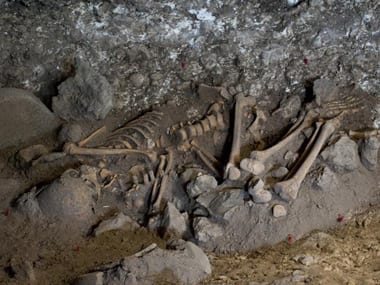 Image for representational purpose only (courtesy: Reuters)[/caption]Now, a team of researchers, including Professor Yemane Asmerom and Research Scientist Victor Polyak at the University of New Mexico's Department of Earth and Planetary Sciences, have accurately determined the age of the skeleton.Naia was one of the earliest inhabitants of the Americas and has helped resolve a long-standing question of the link between ancestral Americans and modern Native Americans.The research paints a picture of a Paleoamerican skeleton with Native American DNA haplogroup that links Paleoamericans with modern Native Americans."The challenge, to date, has been finding a fossil of an adult complete enough to do the morphology work, preserved enough to have mitochondrial DNA, while at the same time having appropriate material for dating," Asmerom said.Naia's skull shape does not look like those of Native Americans, but the Beringian-derived mitochondrial DNA (mtDNA) D1 haplogroup (D1) directly links her to the modern Native peoples of the Americas.The physical differences between Paleoamericans and Native Americans likely resulted from in situ evolution rather than having a separate ancestry.Her ancestors' origins were in Beringia, an area once above water between Siberia and North America. The D1 haplotype likely developed after early humans moved into the area from elsewhere in Asia.The near-complete human skeleton, with an intact cranium and preserved DNA, was found along with other extinct fauna by a team of scientific divers led by Alberto Nava Blank from Proyecto de Espeleologia de Tulum (PET) in the Sac Actun cave system located off the eastern Yucatan Peninsula in 2007.The divers coined the location where Naia was found as "Hoyo Negro" (Black Hole) because of the hole's vast impenetrable darkness.To unravel the mystery of Naia's age, Asmerom and Polyak first conducted uranium-thorium dating of one of her teeth.And while those first results were promising, the results were inconclusive, researchers said.The study was published in the journal Science.PTI

Pakistan's deep state weaponising LeT to counter Asim Munir critic Maulana Fazlur Rehman: Report
No premium queues, 30-minute target: What changes for Indian passport applicants in UAE
'We don't need straits': Trump says Iran war isn't about Hormuz as US strikes for 12th night
Iran claims to stop three oil tankers transiting Strait of Hormuz
Globe at a glance: From Houthis striking Saudi tankers in Red Sea to wildfires in Europe